
California Proposition 65 Review for LED Drawing Board Importers and Retailers
The direct answer is to identify relevant listed chemicals and potential exposures, then have the responsible business assess warning duties using current OEHHA guidance and qualified advice, while avoiding adding a generic warning as a substitute for exposure analysis or claiming the product is exempt without a documented basis.
1. Begin with exposure, not a blanket chemical-presence claim
Proposition 65 warning decisions turn on exposure to listed chemicals and the relevant legal thresholds; a chemical's presence somewhere in a supply chain alone does not settle the warning question.
OEHHA describes Proposition 65 as a warning requirement before knowingly and intentionally exposing people to listed chemicals, subject to the law's provisions and safe-harbor levels. The list covers chemicals identified for cancer or reproductive harm. Businesses must determine whether products or places expose people and whether exposure reaches a level requiring a warning. This means an importer should not add an all-purpose warning solely because a component is plastic or because another seller uses a warning. Nor should the buyer declare a product exempt without reviewing relevant chemical and exposure facts.
For an LED drawing board, identify the product configuration, intended user, realistic use and foreseeable handling, and potential exposure routes that a qualified reviewer considers relevant. Supplier data can help identify materials and listed substances, but exposure assessment may require product-specific reasoning, testing, or toxicological expertise. OEHHA notes businesses may use knowledge of operations and chemicals and may use safe-harbor numbers where available. The responsible business should document the basis and owner of its determination rather than treating a supplier form as a legal conclusion.
This guide does not state that any LumDigi board contains a listed chemical or requires a warning. Product-specific facts would be needed to reach that decision.
OEHHA's business FAQ is an explanatory resource, and it states that it is not legal advice. Use the regulations and counsel for a product-specific determination.
- Identify the actual California-facing product and business role.
- Separate presence information from exposure assessment.
- Document the reviewer, method, and decision basis.
2. Map the importer, supplier, brand, and retail roles
Different parties in the chain may have responsibilities for warning transmission and placement; map the commercial roles and contracts before finalizing the packaging decision.
OEHHA's business FAQ explains that responsibility can involve manufacturers, producers, packagers, importers, suppliers, distributors, and retail sellers. The exact responsibility can depend on the facts and warning method. A private-label importer may control the final label even when the physical item is made by another company. A retailer may receive a written notice and warning material from an upstream party and have responsibilities for its placement and maintenance. A marketplace seller may also control product pages and customer-facing disclosures. Identify who evaluates exposure, who supplies information, who approves the warning, who sends materials, and who confirms receipt.
Use the purchase agreement and product onboarding checklist to name the responsible contacts and response dates. If the supplier is asked to provide chemical data or pass through a warning, specify the SKU, destination, component, evidence type, and approved language. Do not ask a supplier to invent a warning or certify the legal result. If the brand or importer makes the exposure determination, it should retain the analysis and communicate the outcome to downstream sellers through the agreed process. Legal counsel should review contract allocation and state-specific obligations.
A clear RACI-style record can prevent a warning from being omitted between a factory, importer, brand, and retailer.
Keep a current copy or link to the chemical list used in the review. The list changes over time, so the date of the review matters for future orders.
- Assign assessment, artwork, transmission, and retail placement owners.
- Tie notices to SKU and approved retail presentation.
- Have counsel review contractual allocations and local obligations.

3. Ask the factory for facts that can support the evaluation
Request material identities, available chemical declarations, component scope, and change history; the factory should report evidence it holds without claiming to perform the buyer's Proposition 65 assessment.
Prepare a component map for the acrylic panel, base, cable, LED assembly, coating or print, adhesive, marker, and retail packaging as relevant. Ask what evidence exists for each material and whether it covers the actual production revision. A declaration can identify a supplier's stated scope; a lab report can address only its named sample, analytes, method, and detection limit. Ask whether the document is from an upstream material supplier or an independent lab, when it was issued, and what changed after testing. If the factory cannot verify a component, keep it open rather than marking it negative.
A good evidence request does not say 'send Prop 65 certificate' as if one universal certificate existed for every material and exposure scenario. Instead ask for the exact fact the assessment needs. If testing is considered, work with a qualified laboratory or toxicologist to choose a relevant sample and method, and have counsel interpret legal significance. Routine functional factory checks cannot measure chemical exposure. Keep supplier records separate from the buyer's risk assessment and consumer-warning approval.
When a supplier response is incomplete, define the missing part and the next owner. Avoid broad claims such as 'California compliant' based on a partial test report.
A buyer can ask a supplier whether a declaration covers the actual color and finish. The answer is more useful when it identifies the material supplier and the production revision.
- Request a component-by-component evidence scope.
- Record report issuer, sample identity, methods, and limits.
- Treat unknown materials as unresolved, not automatically clear.
4. Understand safe-harbor levels and the limits of a warning shortcut
OEHHA safe-harbor numbers can help determine whether an exposure needs a warning, but the responsible business must first identify the chemical and assess the product-specific exposure.
OEHHA publishes safe-harbor levels for many listed chemicals. A level can identify an exposure that does not require a warning under the applicable framework, but it does not create a universal concentration limit for every product. Exposure estimation may depend on the chemical, route, amount, frequency, user behavior, and product use. A concentration measured in a raw plastic component is not automatically equivalent to a consumer's exposure from the finished drawing board. Work with a competent toxicologist or laboratory where the facts warrant it, and involve counsel for the legal interpretation.
The alternative of placing a generic warning on every item also carries risk: it may confuse buyers, obscure the reason for a warning, and fail to address a specific exposure or required warning content. OEHHA describes warning methods and responsibility rules; businesses should use the current regulations and safe-harbor material, not an old label copied from another product. If a warning is required, the brand owner should verify the named chemical, format, placement, online disclosure timing, language, and channel implementation for the actual transaction.
A warning is not a substitute for product safety review or for meeting other federal and state requirements.
If test results come from an external laboratory, preserve the full report and the chain linking the tested sample to the product. A summary page alone can omit scope limitations.
- Check the current OEHHA list and relevant safe-harbor value.
- Do not equate raw-material concentration with consumer exposure.
- Review warning text and placement with qualified counsel.
5. Use samples and testing carefully
A sample can anchor an assessment to the correct model; testing is optional in OEHHA's general guidance and must answer a defined question with a suitable method.
Keep a photograph and identifier for the sample reviewed: shape, base, power option, markers, finish, packaging, and lot or revision. If an evaluator uses a sample, record whether it represents regular production or a prototype and which materials match. A factory's normal checks for light operation, edge finish, and pack contents can establish product identity and observable performance. They cannot prove chemical exposure is below a safe harbor. A laboratory report must identify its sample and scope; a result from a different color, coating, supplier, or process may not support the current version.
OEHHA indicates businesses may choose testing or an exposure evaluation, but do not have to rely on a particular single test. A qualified toxicologist can help design an assessment that fits the product and use. The buyer should not request a test simply to obtain a convenient pass statement; define which substance, part, method, and decision threshold are relevant. After an order, shipment inspection can compare the delivered goods with the evaluated sample and approved pack. It does not establish that every lot is chemically identical without supplier controls or appropriate verification.
Keep conclusions narrowly worded: identify the evidence and date, avoid implying guarantees, and reopen the assessment after a material change.
Do not interpret a warning's absence on a competitor's product as evidence that no warning is required for your SKU. The formulations and exposure analysis may differ.
- Connect the sample to production configuration.
- Define laboratory scope with a qualified expert.
- Keep functional checks separate from chemical exposure conclusions.
6. If a warning is required, control the channel implementation
When the responsible business determines a warning is needed, confirm the current warning format, product or internet placement, language, and downstream delivery process rather than using an unreviewed template.
Warning content can depend on the chemical and exposure type. OEHHA's business resources describe safe-harbor regulations and the responsibilities of upstream and retail businesses. A product label, package, shelf display, or online presentation can involve different implementation steps. The importer should have counsel validate the chosen safe-harbor method and wording, then provide exact final artwork and instructions to the supplier. If the product is sold through multiple retailers, identify who will place or maintain each warning and how the importer will confirm that the approved materials arrived.
Control all language versions against the approved source. For e-commerce, check the applicable warning visibility and timing rather than assume a box label is enough. Keep screenshots or proof records that show the live consumer-facing presentation and the dates of any change. Do not add a warning symbol, chemical name, or claim to a package before the exposure determination and artwork review are complete. If no warning is required, retain the decision record and the evidence that supports it, so later customer inquiries can be answered consistently.
A supplier can manufacture approved artwork but should not make a legal warning determination on the retailer's behalf.
Review both product labeling and online presentation under the current safe-harbor rules if a warning is chosen. Assign one owner for retailer delivery and version control.
- Release only version-controlled approved warning files.
- Check product, online, retail, and language placements.
- Retain proof of delivery and live implementation.
7. Buyer checklist for an evidence-based Prop 65 review
Use a short file that captures the product, chemicals, exposure reasoning, safe-harbor analysis, responsible business, warning decision, and change triggers.
Before listing the product in California, verify the SKU and material set; identify the entities in the supply chain; request current component data; review the OEHHA list; determine potential exposure routes; evaluate safe-harbor levels or obtain expert support; document whether a warning is needed; approve exact text and placement if required; assign downstream communication; and set triggers for a material or design change. Save supplier responses, reports, sample images, legal notes, final artwork, and implementation proof in a version-controlled folder. Keep a clear distinction between facts, assumptions, and legal conclusions.
Use a dated question log to resolve missing information. A partial response from a factory should not be silently converted into 'none present.' A retailer's existing warning on a similar board should not be copied without analysis. If business size or a claimed exemption is relevant, confirm the facts and applicable rules with counsel; do not presume an exemption from the supplier's location. OEHHA's business FAQs are informative but expressly do not substitute for legal advice. This guide is a sourcing workflow, not a legal opinion.
If the business cannot close a material uncertainty before launch, assign a documented risk decision to its compliance and legal owners.
A contract can allocate data and warning-material responsibilities, but it cannot change the underlying statutory requirements or guarantee a particular legal outcome.
- Keep source data and legal interpretation in separate columns.
- Document evidence gaps and the decision owner.
- Reassess after relevant material or use changes.
8. Conclusion: make a product-specific exposure decision
A credible California warning decision combines supplier facts, product-specific exposure analysis, current OEHHA guidance, and clear responsibility across the sales chain.
Proposition 65 is not a generic material blacklist that automatically determines a warning for every product. The business should identify listed chemicals and evaluate potential exposure against the applicable framework. Supplier data and appropriate tests can support that work, but only the responsible business and its qualified advisers can decide the warning outcome. Clear sample identity, evidence dates, and controlled artwork reduce the risk that an old answer is used for a changed product.
For a LumDigi inquiry, share the California channel, selected board version, material questions, retailer format, and requested records. LumDigi can coordinate factual product details it controls. Your compliance lead and counsel should determine whether testing, exposure assessment, a warning, or another action is required.
If a component change occurs, compare the old and new material evidence and determine whether the exposure assessment remains valid before using the old conclusion.
- Evaluate exposure rather than relying on presence or habit.
- Use current OEHHA resources and qualified advice.
- Tie the decision to the shipped product and channel.
Frequently asked questions
Does a Proposition 65 warning mean an LED drawing board is unsafe?
A warning signals potential exposure to a listed chemical, but the presence of a warning does not by itself quantify exposure or determine risk for a specific user's circumstances. Review the chemical and product facts with the manufacturer or importer and qualified advisers.
Does any listed chemical in a product automatically require a warning?
No. OEHHA explains that businesses assess whether the product exposes people to a listed chemical at a level requiring a warning. Safe-harbor levels can help, and product-specific exposure analysis may be needed.
Must a company test every LED drawing board for Prop 65?
OEHHA's general business guidance does not require one particular test. Businesses may use knowledge of their operations and materials, and may choose testing or an exposure assessment. A qualified expert should define appropriate evidence.
Can LumDigi decide whether my California listing needs a warning?
LumDigi can provide factual product information it controls. The responsible brand, importer, or retailer should decide the legal warning question with qualified compliance and legal advisers.
Image planning for this topic
These notes document the role and intended context of the two visuals used in this guide.
Show a buyer decision context for California Proposition 65 Review for LED Drawing Board Importers and Retailers.
- Placement
- hero
- Caption
- An importer organizes product and material facts before a California exposure assessment.
- ALT text
- California Proposition 65 LED drawing board B2B buyer review
View AI image direction
Photorealistic documentary photograph for a LumDigi B2B article about California Proposition 65 Review for LED Drawing Board Importers and Retailers. Photorealistic documentary photograph of a U.S. product compliance specialist and Chinese Asian supplier staff reviewing a shaped LED acrylic drawing board sample, unmarked materials and a blank exposure-assessment worksheet, realistic meeting room, no readable text, no California warning label, no certificate, no logos, no watermark, landscape. Real acrylic texture, candid commercial setting, landscape composition, no readable logos, no certificates, no text overlay, no watermark.
Show practical factory or shipment-review context for California Proposition 65 Review for LED Drawing Board Importers and Retailers.
- Placement
- after-key-considerations
- Caption
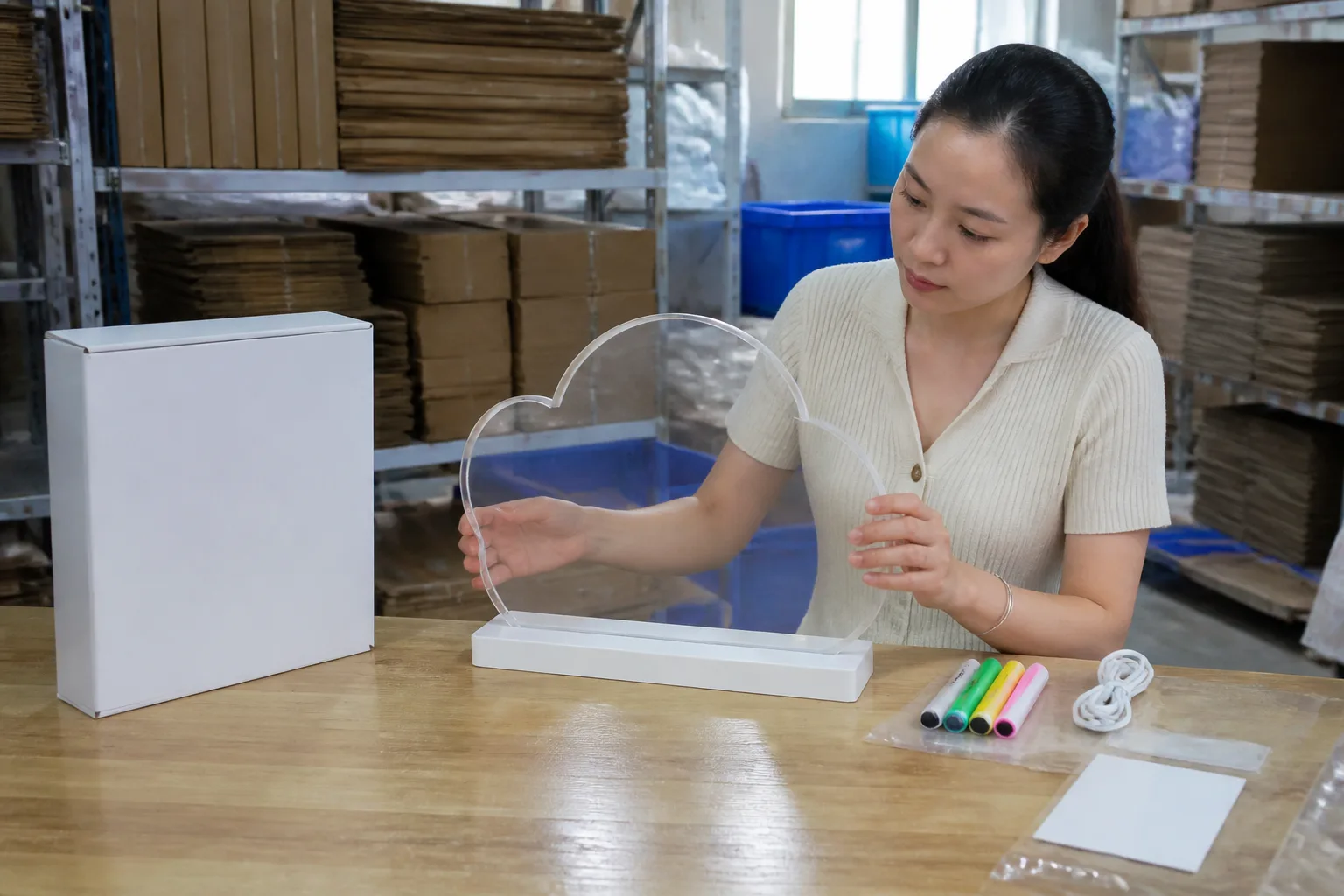
- A retailer checks approved product information and packaging without assuming a warning outcome.
- ALT text
- California Proposition 65 LED drawing board Chinese factory review
View AI image direction
Photorealistic documentary photograph for a LumDigi B2B article about California Proposition 65 Review for LED Drawing Board Importers and Retailers. Photorealistic commercial documentary image of a U.S. specialty retailer buyer checking a sealed plain retail carton and heart-shaped illuminated acrylic drawing board against a blank approved pack record, warm store stockroom daylight, no warning symbols or readable text, no logos, no watermark, realistic photography. Real acrylic texture, candid commercial setting, landscape composition, no readable logos, no certificates, no text overlay, no watermark.
Turn the article into a practical sourcing brief
Use the checkpoints above to document the product, evidence, packaging, and approval decisions relevant to your market. A clear brief helps suppliers respond to the same commercial question and gives your team a traceable basis for the next step.
Useful external references
- OEHHA: How can businesses determine if a warning is required?
California's official agency explains that businesses consider listed chemicals and potential exposure; safe-harbor levels may help assess whether a warning is required.
- OEHHA: Frequently asked questions for businesses
Official business FAQ on warning responsibilities, exposure determinations, safe-harbor levels, and the roles of manufacturers, importers, suppliers, distributors, and retail sellers.
- GS1 Product Image Standard
Primary guidance for consistent product-image identification and digital assets.
LED Drawing Board Marketplace Image Compliance Guide for Sellers
A practical buyer guide for e-commerce sellers, marketplace teams, distributors, and private-label brands who need to create a marketplace image pack from the approved SKU, product facts, packaging, and buyer-controlled channel requirements.
Read article
LED Drawing Board Marketplace Content Pack Guide
A B2B buying guide for marketplace teams, ecommerce sellers, and distributors who need to assemble a controlled listing pack from approved product images, contents, dimensions, and buyer-owned channel requirements.
Read article
LED Drawing Board Product Document Room Guide
A B2B buying guide for importers, sourcing managers, and private-label operations teams who need to maintain a controlled project file that names documents, versions, owners, purpose, and open questions.
Read article
LED Drawing Board Packaging Insert Review Guide
A practical B2B guide for private-label managers and packaging teams who need to approve packaging inserts against the final product, language, contents and retail-pack version.
Read article