
Start with market requirements and the complete product
ISO 8124, EN 71, and ASTM F963 are not universal interchangeable approvals. Determine the destination's legal requirements, current referenced editions, applicable parts, age presentation, materials, and product configuration. Give a qualified laboratory the complete set and intended offer, then review its proposed scope and the separate conformity or certification steps required by each market.
1. Understand a standard family before requesting a certificate
A family can contain several parts and address different hazards or product features. Its name alone does not define the complete evidence required for a particular drawing-board set.
The ISO 8124-1 description identifies mechanical and physical toy-safety scope; other parts cover other topics. EN 71 and ASTM F963 also need to be read through their applicable requirements rather than treated as single marketing badges. A buyer should ask which provisions apply to the actual product and what additional standards or regulations may be relevant. The goal is a test and conformity plan, not a collection of familiar acronyms.
Begin with the country or region, intended age, play function, material and component list, electrical arrangement, markers, packaging, and claims. Keep the offered model and revision fixed while the laboratory reviews scope. If the intended offer changes, reopen the scope question. A report for a panel alone may not represent a finished set with markers, power accessories, and consumer packaging.
For a concrete test brief, identify a model such as the Dinosaur LED Fluorescent Board, then confirm the actual age presentation, base, markers, and power parts offered. The silhouette alone cannot define applicable testing. Attach the product and packaging information that the customer will see so the laboratory reviews the marketed set rather than a generic acrylic sample.
- Identify family, parts, edition, and legal context.
- Submit the complete product configuration.
- Ask about additional relevant requirements.
2. Select requirements through the destination's legal framework
A standard can be published internationally yet adopted, referenced, or applied differently by a market. Confirm current legal references and required conformity processes with the responsible local party.
For the United States, the CPSC ASTM F963 chart is a useful official starting point. The relevant obligations depend on product facts, age classification, applicable sections, and other rules. For the EU, safety assessment, conformity procedures, documentation, and marking need review in addition to test selection. Do not transfer a conclusion from one jurisdiction to another because the standard topics look similar.
A multi-market project should have one row per destination showing the responsible importer, current rule, referenced standard edition, applicable scope, laboratory route, certification or declaration step, and remaining question. This makes transition dates and local differences visible. Request qualified advice where interpretation is needed rather than allowing a supplier's generic global-compliance sentence to decide the launch.
Keep a distinction between the latest published standard and the edition referenced by the applicable legal framework. They may not always be the same at a particular date or during a transition. Ask the responsible market reviewer to identify the correct basis and record why it was used. A current laboratory quote should name its editions rather than simply repeating a standard-family acronym.
- Record a separate destination row.
- Check current editions and transition rules.
- Assign a responsible local reviewer.
3. Map the actual set to relevant safety topics
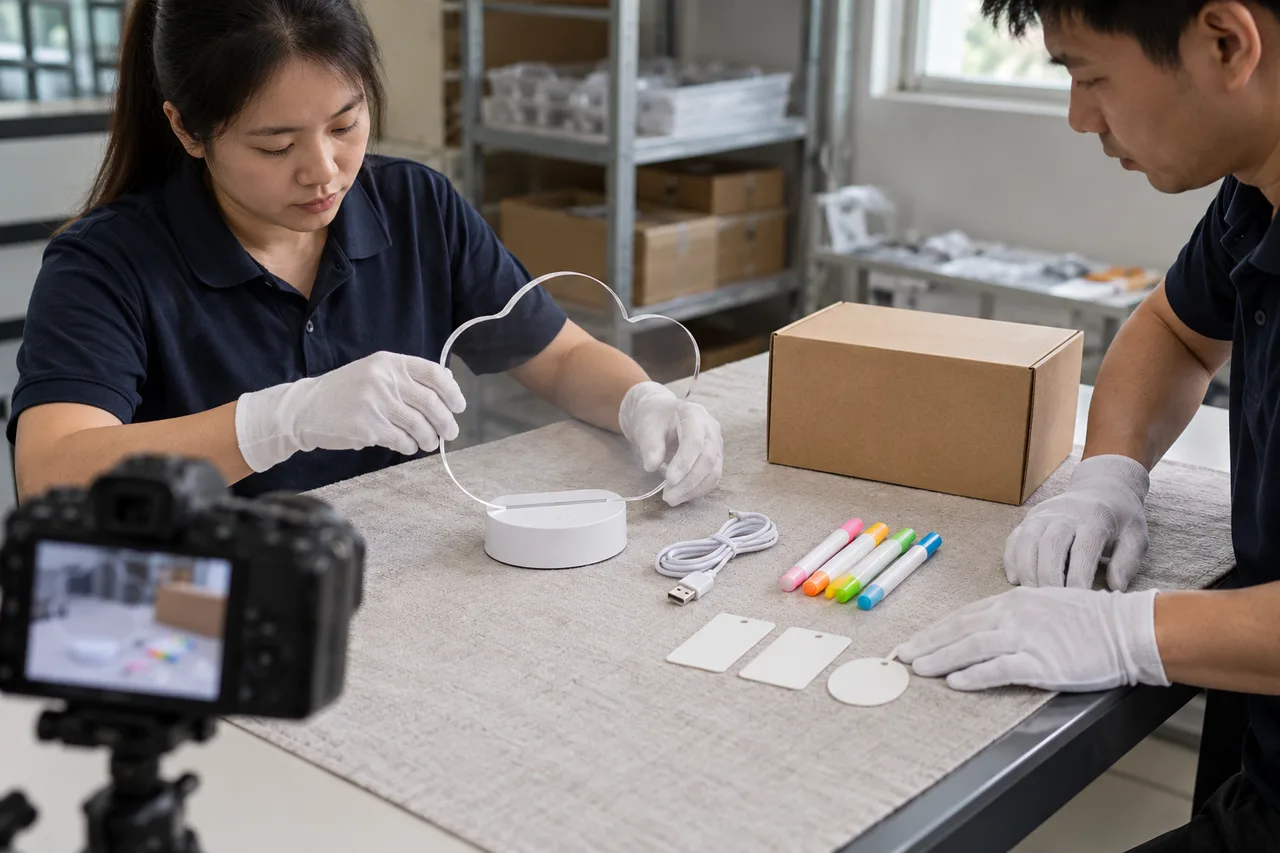
The laboratory needs the board, base, markers, power parts, packaging, intended use, and age presentation to decide relevant tests. A category name does not reveal every hazard or applicable requirement.
Make the test scope follow the supplied configuration
Provide a bill of materials and a component photo set. Identify accessible materials, detachable parts, edges, cords, batteries if present, LEDs, inks, coatings, and instructions. State which items are included and which are optional. A set marketed for children's play can need a broader assessment than its acrylic material alone suggests. The buyer should provide facts and ask the laboratory to explain its scope, not coach it toward a desired result.
Separate the laboratory plan from a factory workmanship checklist. A functional sample check can observe fit and illumination under stated conditions, while chemical, mechanical, electrical, or other formal assessments require suitable methods and competence. Use the documentation checklist to connect the product configuration, evidence, and decision owners without presenting one type of record as another.
A hazard map can include an evidence-status column for each relevant component and topic. Use it to ask what information is missing, not to invent a pass status. Some facts come from engineering drawings, some from material disclosure, some from formal tests, and some from qualified assessment. The responsible reviewer should explain how these records support the complete product decision for the particular market.
- Provide the complete component and material map.
- Disclose intended age, use, and claims.
- Separate formal testing from routine production observations.
4. Ask a laboratory for a scope proposal with reasons
A useful proposal identifies the product, market, standard edition, applicable sections, sample needs, method, report scope, and exclusions. It should explain why the proposed work answers the buyer's requirements.
Send the product dossier and the market matrix rather than only asking for an EN 71 or ASTM certificate. Ask which specimens, finished units, separate materials, labels, and instructions the laboratory needs. Confirm whether it can perform the required work under the relevant recognition or accreditation scope. Laboratory reputation alone does not establish eligibility for every regulatory testing route; the responsible market party should verify acceptance.
Review exclusions before agreeing the work. If a report covers only selected chemical parameters or only a particular mechanical part, that limitation should remain visible in the project file. Do not let a short report title become a claim that the entire set meets every standard. Resolve questions about sample grouping and model-family coverage in writing and retain the basis proposed by the laboratory.
Ask whether the laboratory needs separate specimens for different materials, colors, or product configurations. A buyer should not merge samples to reduce cost unless the qualified provider explains the method and coverage. Record grouping rationale in the scope proposal. This helps later teams understand why a report represents certain variants and which changes would require the grouping decision to be revisited.
- Request applicable sections and exclusions.
- Confirm sample and laboratory acceptance requirements.
- Keep the proposal tied to the destination matrix.
5. Read the report beyond its cover page
Check model, manufacturer, sample description, photographs, standard edition, tests performed, results, limitations, and report authenticity. A logo or pass summary cannot replace that review.
Compare the report with the physical sample and purchase file. Look for differences in base, cable, battery arrangement, marker formulation, accessible materials, or pack. Ask the issuer or responsible reviewer about any discrepancy. If the report lists several models, confirm how the offered variant is represented. A commercial model name can remain unchanged while a component substitution affects the evidence, so use the actual configuration record.
Preserve the report in its original form and record who reviewed applicability. Do not edit model names, standard references, dates, or photographs to match a later order. If clarification or additional work is needed, ask the issuer to provide a proper response. The buyer's approval record should identify the evidence accepted and the requirements that remain unresolved rather than making a broader assertion than the report supports.
Report authenticity can be checked with the issuing laboratory through its supported verification process, but that does not resolve applicability to a changed model. Keep both checks visible. If a document is genuine yet describes another base or marker formulation, ask for an appropriate technical response. Do not edit the report or attach a buyer-written statement that broadens the issuer's findings without authorization.
- Match report sample to the offered model.
- Confirm actual tests and limitations.
- Retain original reports and issuer clarifications.
6. Complete the market's conformity steps after testing
Testing can support a conformity decision, but market-specific declarations, certificates, labels, importer records, or other obligations may still be required. The responsible business should confirm the complete route.
The European Commission market-entry guidance describes safety assessment and conformity steps for toys. In another market, required certification and report acceptance can be different. A buyer should distinguish the laboratory's findings from the manufacturer's declaration, importer's filing, and authority's decision. Keep each deliverable and signature with the correct responsible party.
Ask the local reviewer which product identifiers, warnings, business details, and instructions belong on the physical product and packaging. Update the artwork only after requirements are confirmed for the actual set. Testing does not automatically approve a marketing statement about learning outcomes, environmental benefits, or optical performance. Those claims need separate evidence when proposed, even if the product also has relevant toy-safety records.
A conformity tracker should identify who signs each declaration or certificate and which evidence it relies on. The factory, importer, brand owner, laboratory, and authority can have different roles. Make those roles clear in the project so a laboratory result does not become a placeholder for a business action that remains incomplete. Request actual completed records when reporting a milestone as done.
- List remaining declaration and certification tasks.
- Assign each task to its responsible party.
- Review packaging and optional marketing claims separately.
7. Manage reports when parts or markets change
A material, component, supplier, age claim, or market change can affect the relevance of existing evidence. Require advance notice and ask qualified reviewers which conclusions need to be reopened.
Build a change log that identifies the old and new configuration and the reason for the proposal. Examples include a new marker source, different base electronics, revised acrylic grade, battery addition, or altered intended age. These are examples of review triggers, not a statement that every change requires identical retesting. The appropriate laboratory and market reviewer should determine the effect from the facts.
At reorder, verify that the report still represents the production unit and that referenced editions and market rules remain current. Factory testing and shipment inspection can check released identities and defined observations, while the conformity plan establishes what formal evidence is needed. Keep EU sourcing requirements and U.S. preparation as related resources without treating either article as a product-specific approval.
When adding a new destination, review the complete local requirement set before reusing an existing report. Some underlying data may be useful, while different editions, acceptance routes, language, markings, or certification steps may remain. Ask a qualified provider for a gap analysis tied to the actual product. This is more concrete than ordering a worldwide certificate and hoping that every retailer accepts it.
- Record changes before accepting substitutions.
- Ask qualified reviewers about evidence impact.
- Recheck current market references at launch and reorder.
| Record | Question it should answer |
|---|---|
| Market matrix | Which rules and editions apply here? |
| Lab scope | Which tests and samples are covered? |
| Report | What was assessed on which configuration? |
| Conformity file | Which remaining business obligations are completed? |
8. Conclusion: commission a market-specific evidence plan
Use each standard family in its correct context and connect the relevant parts to the complete offered set. The best RFQ asks for a reasoned scope and accepted evidence rather than a universal toy certificate.
A clear plan can reduce redundant requests and reveal missing work before a shipment is urgent. It also helps the supplier provide the right material and sample information. Keep current legal references, product facts, laboratory scope, report review, and final market actions visible in one project index. Where a conclusion remains uncertain, identify the responsible reviewer and next evidence request.
For LumDigi, share destination markets, intended age and use, selected board and power configuration, marker assortment, and your importer or retailer evidence requirements. We can confirm product facts and available records for the offered model. The qualified laboratory and responsible market parties should decide testing and conformity scope for the actual product and launch.
Retain the laboratory brief, sample photos, proposal, report, clarifications, market matrix, final artwork, and change log in one indexed folder. Each record should identify its owner and revision. A future buyer can then see the chain from intended product to accepted evidence. The file should not imply that records for one sample guarantee every future unit or every unreviewed market.
- Start with destinations and complete product facts.
- Review parts, editions, and report scope.
- Finish the separate conformity and packaging tasks.
Frequently asked questions
Can one EN 71 report replace an ASTM F963 report?
Do not assume interchangeability. Markets use different legal references, applicable sections, editions, and evidence-acceptance routes. Give the actual product and destination plan to a qualified laboratory and responsible importer, and ask which work can be shared and which additional evidence is required.
Does an ISO 8124 report mean a toy is approved worldwide?
No. A report has a specified sample, method, edition, and scope. Each market's legal requirements and conformity process must still be checked. Treat the standard family as a technical reference and confirm the local route for the actual offered configuration.
Which changes should a supplier disclose?
Require notice of changes that can affect the product file, such as materials, marker formulation, electronics, battery arrangement, factory, age claims, or packaging. A qualified reviewer should determine their effect on existing evidence rather than relying on visual similarity or an unchanged commercial model name.
Image planning for this topic
These notes document the role and intended context of the two visuals used in this guide.
Show a market-specific test brief
- Placement
- hero
- Caption
- Illustrative AI-generated photograph: a buyer compares separate market files for a complete LED drawing board set.
- ALT text
- Asian importer reviewing three plain market folders beside a complete LED drawing board set
View AI image direction
Use case: photorealistic-natural. Asset type: editorial image for a LumDigi B2B LED drawing board article. Adult Asian toy importer reviews three unmarked document folders and an acrylic LED board with base, cable, and markers on a meeting table. All document text blurred, no standard logos or certificates. Candid professional planning. Landscape 3:2, real acrylic textures, modest natural light, candid professional photography. If workers appear, they are Chinese/Asian adults. No invented logos, certification marks, readable documents, numerical test results, watermark, or text overlay. Show an illustrative procurement or sample-review scene, not proof of an actual test or shipment.
Show sample identity preparation
- Placement
- after-second-section
- Caption
- Illustrative AI-generated photograph: Chinese staff record components before an external laboratory sample submission.
- ALT text
- Chinese sample staff arranging an acrylic board and accessories for laboratory identification
View AI image direction
Use case: photorealistic-natural. Asset type: editorial image for a LumDigi B2B LED drawing board article. Adult Chinese factory sample staff arrange a clear shaped LED board, base, cable, markers, retail carton, and blank sample tags for an external laboratory submission. A camera records the flat lay. No lab results or certification imagery. Landscape 3:2, real acrylic textures, modest natural light, candid professional photography. If workers appear, they are Chinese/Asian adults. No invented logos, certification marks, readable documents, numerical test results, watermark, or text overlay. Show an illustrative procurement or sample-review scene, not proof of an actual test or shipment.
Turn the article into a practical sourcing brief
Use the checkpoints above to document the product, evidence, packaging, and approval decisions relevant to your market. A clear brief helps suppliers respond to the same commercial question and gives your team a traceable basis for the next step.
Useful external references
- ISO: ISO 8124-1 toy safety scope
Official description of the ISO standard's mechanical and physical safety scope.
- CPSC: ASTM F963 requirements chart
Official U.S. guidance on applicable toy requirements and testing context.
- European Commission: placing toys on the EU market
Official EU safety-assessment and conformity context; current legal references and standards require market review.

EU LED Drawing Board Compliance Checklist for Toy and Gift Buyers
A B2B compliance and procurement research guide for EU toy, gift, and specialty-retail import teams: build a market-specific compliance review around the exact LED drawing-board configuration and intended product classification.
Read article
LED Drawing Board U.S. Market Entry Preparation Guide
A B2B buying guide for U.S. importers, retailers, and marketplace sellers who need to prepare a U.S. project file using the selected product, destination, evidence questions, and qualified-review workflow.
Read article
LED Drawing Board Buyer Documentation Checklist for Market Review
A practical B2B guide for importers and compliance coordinators who need to organize product information and questions for the buyer's own market review and qualified advisors.
Read article
Fluorescent Marker and Acrylic Panel Compatibility: A B2B Sample Review Protocol
A sample-testing plan for buyers qualifying a specific marker formulation with a specific acrylic surface and care method.
Read article