
UAE G-Mark vs ECAS: Scope Questions for LED Drawing Board Importers
The direct answer is to identify whether the marketed set is a toy in G-Mark scope, a regulated ECAS product, or needs separate review for both, while avoiding treating G-Mark and ECAS as interchangeable approvals or applying either without verifying scope.
1. Treat G-Mark and ECAS as different scope questions
G-Mark relates to the GSO toy-safety framework for covered toys; UAE ECAS applies to products regulated under relevant UAE technical regulations. They are not interchangeable. Identify the exact product and components and verify current UAE implementation.
A shaped LED board may be presented as a children's toy, creative gift, or another consumer product. Claims, intended use, age, construction, and contents inform scope. Separately, a power accessory may need review if designated as a regulated product. Do not assume the whole set is covered or exempt because it uses low-voltage LEDs. The UAE importer should provide the complete sales pack to a competent local reviewer.
GSO guidance describes a regional toy framework; MoIAT's ECAS service concerns regulated products. A regional guide alone does not establish today's exact UAE administrative path for a SKU. Confirm adoption, current regulations, and the party responsible for local applications. Keep source date and product scope with the decision.
Toy route depends on scope and current UAE implementation, not solely on shape or catalogue category.
A scope memo should cite the text and facts reviewed. A GSO toy guide explains regional structure, but the UAE importer must confirm national adoption, service details, and later amendments before using it as a launch basis.
A route-comparison table can list question, responsible party, official source, required evidence, and release status. Do not place a single green check beside the whole product family if the board, adapter, and toy presentation were assessed separately. The format should expose unresolved questions instead of hiding them.
- Review toy and electrical-component scope independently.
- Confirm UAE implementation with local advice.
- Do not market either mark before product-specific authorization.
2. When to investigate the G-Mark toy route
If the board is designed and marketed for children's play under 14, ask whether it falls within the applicable GSO toy regulation and UAE procedure. Confirm scope, exceptions, conformity assessment, technical file, and marking for the exact set.
Submit intended age, play description, artwork, instructions, accessories, photographs, and test records to a local assessor. A children's creative-toy claim may raise review even when the supplier calls it educational. Age grading should reflect design and instructions, not be selected just to avoid a route. The importer owns accurate presentation.
GSO guidance discusses risk assessment, technical documentation, conformity procedures, and distributor verification. Check current competent-authority guidance. Ask whether acrylic edges, marker accessories, powered base, package, or age range changes the evidence. The supplier provides samples and facts; local conformity actors make formal decisions.
GSO guidance is regional. Confirm UAE rules, authority, and procedure before relying on a guide.
Toy classification should use design, instructions, age, and claims together. A product called educational may still be designed for play. Conversely, an LED does not automatically make a product a regulated toy or electrical item. Give the reviewer the full context.
Retail partners may ask for a declaration that a product meets every regional requirement. Narrow that request to the UAE market, the specific SKU, and the relevant route. Return only claims supported by a current document and authorized by the importer. This protects the brand from repeating a supplier's informal description as a formal conformity statement.
- Give assessors the real claims and intended users.
- Confirm the procedure in force in the UAE.
- Keep technical and marking records tied to the model.
3. When to investigate ECAS
ECAS is a UAE conformity service for products under applicable technical regulations. Do not assume a USB port, LED, or adapter automatically triggers ECAS; check whether the exact product or component is designated.
Record input ratings, adapter inclusion, battery details, and which entity supplies each part. Give the information to the importer and conformity service. If an adapter is separately regulated, a certificate may relate to that model and supplier rather than certify the complete drawing board. Ensure the listing describes contents accurately.
MoIAT's service page gives current ECAS information and applicant prerequisites, including licensing and test evidence. Check directly. Ask which lab and report scope are accepted. A CE mark or other-market report is not automatically a UAE ECAS certificate; get confirmation before using a claim.
MoIAT ECAS applies to regulated products. Check the latest list instead of assuming all electronics are included.
For ECAS screening, list each power component with maker, model, rating, and whether it ships in the box. Check current UAE technical rules and MoIAT service information. Foreign marks do not settle UAE scope.
A multi-emirate distribution plan should be discussed with the local importer and adviser. The buyer should identify where goods will be offered, whether the importer entity changes, and whether online marketplaces introduce additional content rules. Do not assume one distributor's historic approval covers a different seller or product revision.
- Identify each power component and its supplier.
- Check the current UAE regulation for the item.
- Verify evidence and applicant eligibility with MoIAT or service body.
4. Could one retail set face more than one review?
A covered toy that includes a separately regulated component may raise multiple questions. The importer should map product-level and component-level duties independently and ask a local adviser how requirements interact.
Prepare a bill of materials and sale configuration: board, base, cable, adapter, batteries, markers, package, and instructions. For each item, record proposed route, responsible entity, evidence, and open question. This prevents one certificate request being treated as universal approval. If an item is excluded from the set or buyer-supplied, document the sales arrangement.
Do not double-certify blindly or ignore overlap. Ask the assessment body whether a report can support multiple duties, whether separate certificates are required, and which mark may appear. Keep the answer in writing. Before printing, verify that claims are authorized and relate to the tested version.
If laboratory evidence is needed, confirm acceptable laboratories and model with the conformity service before testing.
Where both routes may apply, ask the body to explain evidence reuse and mark presentation. Do not assume one report satisfies another framework. Keep decisions separate, with owner, status, validity, and exact product or component covered.
Keep photos of the actual Arabic carton and instruction insert with the approved translation. If a package uses a transparent window, review whether required information remains visible after packing. The factory can show the physical arrangement in a sample review; the local reviewer determines whether presentation meets applicable requirements.
- Map the complete set and each component.
- Ask the local body whether routes overlap.
- Keep written scope answers for each mark.
5. Make the supplier handoff specific
The supplier should provide specifications, representative samples, packaging data, and revision information. The UAE importer identifies the local route and evidence; neither side should replace it with vague GCC-approved language.
Send an RFQ with destination, channel, age, shape, power, contents, Arabic needs, and quantity. Request technical data and reports with model/scope. Ask which accessories are optional and how changes are communicated. If no current report exists, state that and let the buyer decide on lab work. The chosen assessor defines sample and procedure.
Ensure the pre-production sample matches the reviewed configuration. Keep dated photos and sample identity. During inspection, verify agreed contents and package revision. Factory checks execute buyer requirements but are not G-Mark or ECAS approval. If assessment requires change, close the local review before updating a listing or production run.
CE or other-market files may provide technical context but are not automatically UAE certificates.
Arabic artwork should reflect final contents. Translate after power and accessories are known, then compare proof to sample. Supplier translation may support production but does not replace local linguistic and legal review.
When the supplier proposes a lower-cost power accessory, treat it as a configuration change rather than a harmless substitution. Ask for model, rating, manufacturer, and sample, then send those facts to the conformity reviewer. Update artwork, listings, and any component file only after the responsible importer decides what changes are needed.
- Request model-linked evidence and optional-item status.
- Align assessment sample with order configuration.
- Separate factory inspection from local certification.
6. Review Arabic information and channel claims
The UAE offer may require Arabic product information, warnings, or instructions depending on applicable rules and sales route. Ask a qualified local reviewer to confirm requirements and compare every listing, carton, and insert with the authorized product.
Use a controlled artwork master. Check identity, model, age, instructions, warnings, input, included pieces, business details, and certificate claims. Have Arabic text reviewed for meaning and print legibility. Do not add G-Mark or ECAS references before authorization. Ensure ecommerce photos do not imply an adapter or accessory absent from the box.
If sold through different emirates or channels, ask whether local requirements or marketplace policies affect the offer. Keep final proof, translation, sample, and authorization together. Reopen review after new shape, age claim, power item, or seller arrangement.
For separate adapters, keep manufacturer and model identities clear and check independent requirements.
The supplier can provide construction details, photos, and inspection findings. If a report is unavailable, say so. Importers should not ask suppliers to promise regulatory acceptance because assessment belongs to local bodies and responsible entities.
A buyer can close each route with a dated approval record that states product identifier, included power items, applicable source, mark status, and approving entity. This makes future reorder decisions faster and prevents an old certificate or mark image from being copied into a new catalogue without checking scope.
- Approve Arabic text locally.
- Use certification claims only after written authorization.
- Align pack and online images.
7. UAE market-entry decision tree
First assess toy scope; then screen each item against UAE technical regulations; finally document evidence, Arabic information, and importer responsibility. Confirm every conclusion with current official UAE sources.
A release file should answer: Who is importer? What age/use claims are made? Which products and components are sold? What toy scope applies? Does any item fall under ECAS? Which local service, report, or certificate is required? Which language and mark claims are authorized? Does the sample match? If an answer is unknown, assign owner and due date rather than assume.
Review GSO and MoIAT information before production or repeat order. Rules and portals change. Keep a separate buyer quality gate for sample acceptance and shipment inspection. A product may pass factory checks while local conformity remains open; do not collapse statuses in a sales message.
Do not print a mark or imply a certificate is valid until the authorized party verifies scope and status.
At order release, freeze the configuration sheet. If adapter, package, age claim, or channel changes, send updated facts to the adviser. A small change record prevents old claims appearing on new stock.
- Make a written scope decision for each route.
- Verify current UAE requirements after product changes.
- Separate regulatory release from supplier acceptance.
Conclusion: compare routes, then choose only what applies
G-Mark and ECAS are different frameworks. A UAE importer should assess toy and regulated-component scope separately, rely on current guidance, and authorize only marks applicable to the exact set.
A clear brief—age, claims, power items, contents, packaging, and channel—makes review more efficient. Ask a local body to map requirements before production artwork. Retain sample and decisions so later changes do not inherit an outdated conclusion.
For a LumDigi UAE project, share channel, age/use plan, board configuration, accessories, pack, and open questions. We can confirm supplier-side product facts. Your UAE importer and adviser decide classification, applicability, testing, and claims.
This is an informational guide, not legal advice. Use current GSO/MoIAT sources and qualified local support.
If a retailer requests one certificate for the whole set, ask which model and requirement it seeks to verify. Provide the authorized relevant record rather than unrelated marks, keeping the product file credible.
At final approval, record the precise UAE model, market claims, power accessories, applicable route, document reference, authorized mark status, and decision maker. Reopen review if any fact changes. This keeps a product manager's sourcing approval separate from the conformity decision made by the local importer or authorized assessment service.
- Do not treat marks as substitutes.
- Use advice tied to the SKU.
- Hold release until product and authorized evidence align.
Frequently asked questions
Are G-Mark and ECAS the same?
No. They address different frameworks. Check toy scope and any UAE regulated-product component separately with the responsible authority or conformity service.
Does every children's LED board need G-Mark?
Do not infer that automatically. Determine whether the exact marketed product falls within current toy scope and what UAE procedure applies.
Can an adapter need separate review?
Potentially. Record whether one is included, its model and rating, and ask the UAE conformity body whether it is separately regulated.
Can a supplier apply the UAE mark?
Only the responsible authorized party should approve marks or conformity claims. A supplier provides facts and samples but does not replace UAE authorization.
Image planning for this topic
These notes document the role and intended context of the two visuals used in this guide.
Show a buyer decision context for UAE G-Mark vs ECAS: Scope Questions for LED Drawing Board Importers.
- Placement
- hero
- Caption
- A UAE importer compares a toy product brief with a separate electrical-component checklist.
- ALT text
- UAE buyer reviewing an LED drawing board and product scope notes
View AI image direction
Photorealistic documentary photograph for a LumDigi B2B article about UAE G-Mark vs ECAS: Scope Questions for LED Drawing Board Importers. Photorealistic commercial documentary photo in a Dubai importer office: adult UAE product buyer reviews a shaped acrylic LED board with separate blank files for toy and electrical scope, writing blurred, daylight, realistic product, landscape 3:2. No G-Mark, ECAS or government logo, readable text, certificate, watermark, or overlay. Real acrylic texture, candid commercial setting, landscape composition, no readable logos, no certificates, no text overlay, no watermark.
Show practical factory or shipment-review context for UAE G-Mark vs ECAS: Scope Questions for LED Drawing Board Importers.
- Placement
- after-key-considerations
- Caption
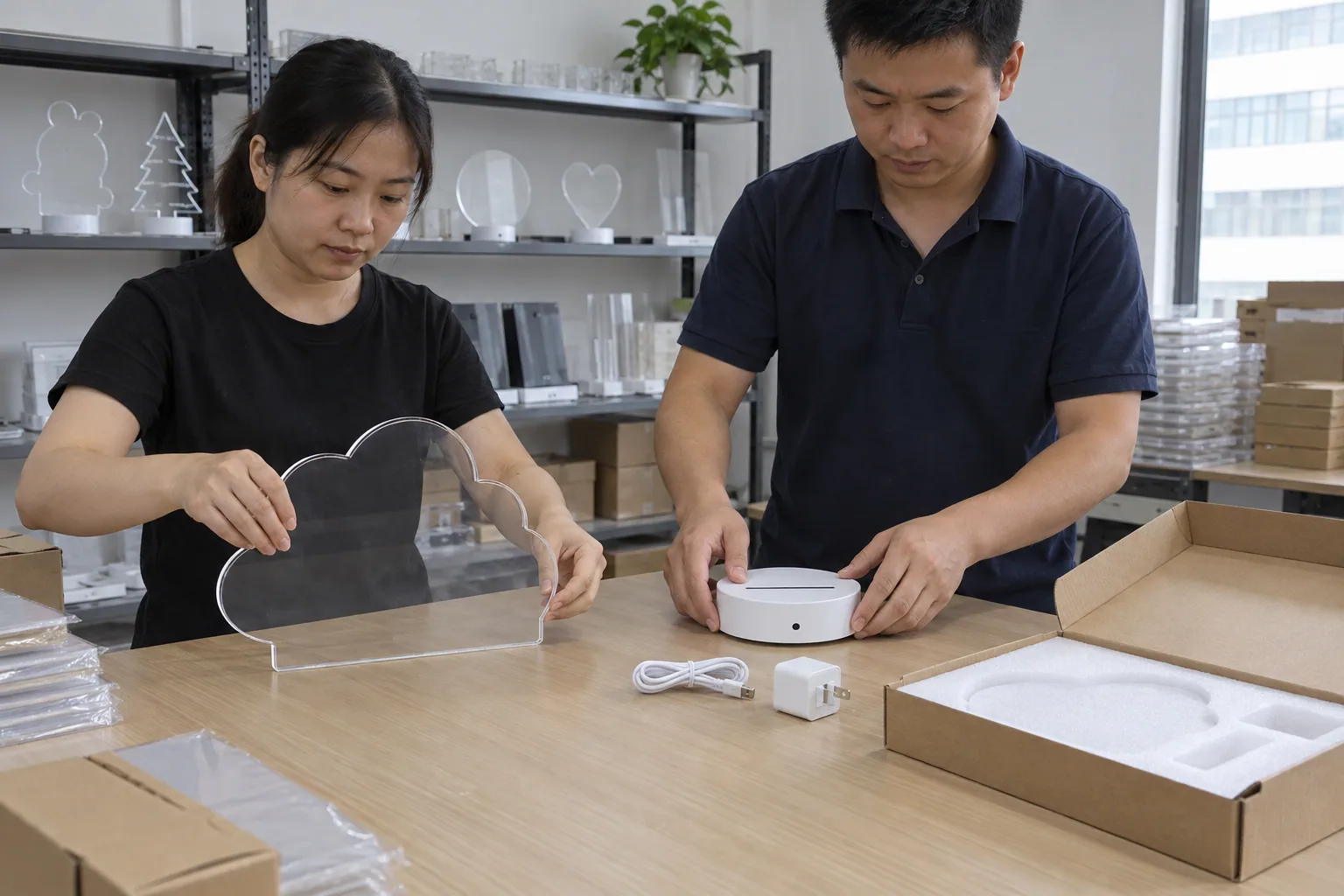
- Chinese factory staff document the board, base, and power items supplied for a UAE launch.
- ALT text
- Chinese factory employees identifying a drawing board base and power configuration
View AI image direction
Photorealistic documentary photograph for a LumDigi B2B article about UAE G-Mark vs ECAS: Scope Questions for LED Drawing Board Importers. Photorealistic documentary photo in a Chinese factory sample room: Chinese/Asian adult staff lay out a shaped LED board, light base, and optional power accessory for a UAE export set, candid professional work, realistic materials, landscape 3:2. No logos, certification marks, readable records, watermark, or overlay. Real acrylic texture, candid commercial setting, landscape composition, no readable logos, no certificates, no text overlay, no watermark.
Turn the article into a practical sourcing brief
Use the checkpoints above to document the product, evidence, packaging, and approval decisions relevant to your market. A clear brief helps suppliers respond to the same commercial question and gives your team a traceable basis for the next step.
Useful external references
- GSO: Toy safety regulation guidance
Regional guidance for toy scope, conformity, documentation, and distributor checks; confirm current UAE implementation.
- UAE MoIAT: ECAS conformity certificates
Official UAE service page for ECAS certificates and applicant/document prerequisites for regulated products.
- UAE MoIAT: Conformity services
Official portal for checking current conformity services and product-regulation scope.

EU LED Drawing Board Compliance Checklist for Toy and Gift Buyers
A B2B compliance and procurement research guide for EU toy, gift, and specialty-retail import teams: build a market-specific compliance review around the exact LED drawing-board configuration and intended product classification.
Read article
LED Drawing Board USB Power and Cable Sourcing Guide
A practical buyer guide for importers, private-label buyers, and product teams who need to select the power arrangement and supplied cable around the approved board, base, destination, channel, sample, and packed set.
Read article
EU PPWR Packaging Readiness for LED Drawing Board Importers
A B2B buying guide for EU importers, private-label brands, packaging teams, and distributors who need to inventory each packaging layer, identify the responsible economic operator, and obtain evidence for market-specific review before approving artwork or a packaging change.
Read article
LED Drawing Board After-Sales Triage Guide for Distributors
A B2B buying guide for distributors, retailers, and customer-service teams who need to triage customer questions using product identity, observed condition, packed contents, and buyer-owned support records.
Read article