
Australia Mandatory Incident Reporting: A Buyer Guide for LED Drawing Boards
The direct answer is to create a fast incident-escalation path that identifies the supplied product, preserves facts, and gets a reportability decision to the responsible Australian team, while avoiding waiting for a customer return or factory root-cause analysis before the supplier considers the ACCC reporting deadline.
1. Treat mandatory reporting as an importer operating process
Australian suppliers must report specified deaths, serious injuries, or serious illnesses associated with a consumer product they supplied. An importer should make the ACCC path, escalation owner, and evidence intake part of its operating model; the product label or marketing description does not decide whether a particular event is reportable.
The ACCC's current business page says a supplier must report an incident when a consumer good or product-related service it supplied has caused, or may have caused, death, serious injury, or serious illness. Its guidance also says that every party in the supply chain has an obligation to report when it becomes aware. Build the process around that threshold and use the official decision tools for real facts. Do not wait for a supplier to tell the retailer whether the Australian supplier has a legal duty.
For a shaped LED board, intake should distinguish a minor appearance concern from a potential injury, burn, electrical, sharp-edge, or other serious signal. Those examples are triage cues, not conclusions that a product defect exists. Identify the precise board, base, power arrangement, included items, packaging, age grading, and sales channel. Record who supplied the good in Australia and when they first learned the key facts. A responsible Australian legal or safety contact should decide the reporting route; LumDigi can provide factual supplier-held product information when requested.
The ACCC says the two-day requirement applies even if the event occurred overseas, and that the report is confidential and not an admission of liability. Verify the current official language rather than repeating a deadline from an old internal training deck.
- Use the ACCC decision guide rather than an informal email consensus.
- Capture the date each relevant person became aware.
- Route serious or uncertain signals to the named safety owner immediately.
2. Plan around the two-day reporting requirement
ACCC guidance says suppliers must make a mandatory report within two days of becoming aware of a qualifying incident. The ACCC encourages a report when the supplier is in doubt about the duty so it can meet the deadline; consult the current official guidance for a specific case.
A clock this short requires preparation before a complaint arrives. Set up a monitored safety mailbox, out-of-hours escalation route, and backup owner for weekends and public holidays. Customer service should be able to send a structured report to the safety lead without waiting for a return authorization. Preserve the original message, timestamp, channel, customer description, and subsequent clarification. The investigator may still be gathering facts when the initial report is due, so do not design an internal form that requires a complete factory diagnosis as a prerequisite to escalation.
The ACCC says a report is not an admission of liability and that more information may be provided later. Separate the reporting decision from the investigation and remedy decision. Record the basis for the initial notice, what information was available, what was missing, who authorized it, and how later information was supplied. If a business decides the event is not reportable, save the reasoning and source used. The law and official guidance control; this article should not be used to calculate an individual deadline or substitute for Australian legal advice.
The report should be completed to the best of the supplier's knowledge, with further information supplied later as appropriate. A process that blocks submission until every field is fully investigated can create unnecessary delay.
- Keep a reporting owner and backup contact available.
- Do not hold escalation until the returned sample is tested.
- Store the submission receipt and follow-up information with the case.

3. Include overseas events and foreseeable use in triage
ACCC materials explain that the obligation can apply to events outside Australia and to foreseeable misuse. An Australian importer should therefore screen credible reports from other markets, while still assessing the actual product, circumstances, and Australian legal criteria.
A supplier may hear first from a consumer in another country, a foreign retail chain, or a global marketplace. Route the signal to the Australian product-safety owner rather than relying on geography alone to exclude it. Record the original country, event date, product identity, and action taken in that market. Compare the reported product with the Australian version: shape, base, cable, battery configuration, accessories, packaging, and production references. Similar branding does not prove identical configuration, while a shared component may justify a closer review.
Foreseeable misuse is a legal consideration under the ACCC guidance, but an ordinary importer should not attempt to adjudicate the phrase without advice. The support team can record how a product was actually used and preserve the instructions and warnings supplied. A supplier can help confirm product construction, production period, or an inspection record. Do not use a supplier's preliminary hypothesis to close the Australian reporting question. Keep overseas findings and Australian decisions in linked but clearly separated records.
The ACCC encourages voluntary reports for some near misses that do not meet the mandatory threshold. Voluntary reporting should remain a deliberate decision under current guidance rather than an automatic label placed on every customer-service complaint.
- Screen reports from all markets for the same or related product.
- Capture actual use and the supplied instruction version.
- Ask Australian counsel to assess statutory triggers and scope.
4. A practical six-step importer workflow
A workable Australian process is: receive and timestamp the signal, identify the supplier and product, preserve evidence, escalate to the legal/safety owner, assess the ACCC threshold and deadline, then report and continue the investigation as instructed.
At intake, give the reporter a calm acknowledgement and avoid promises about cause, remedy, or safety. Assign a unique case ID and ask for the board shape, order, photographs, base and power option, package, and event facts. Preserve original product images and do not ask the consumer to recreate a dangerous condition. Next, identify inventory, distribution, marketplace listings, and the supplier contact. The responsible owner can decide whether stock should be held or other immediate controls are appropriate; each action needs a named approver and timestamp.
If a report is made, track the follow-up as a distinct workstream: obtain supplier records, examine a sample under a defined plan, consider whether independent technical expertise is needed, and update the ACCC if required. Keep regulatory reporting, a product recall, insurance notification, and customer support decisions linked but not conflated. A report does not automatically determine liability, establish a defect, or require a particular remedy. Use current official guidance and advice for the factual case, and document the basis for each decision.
An Australian distributor who first receives a safety report should have a written route to the supplier or importer and should retain when it passed the information along. A contract handoff does not mean the reporter can assume no further obligations apply to it.
- Acknowledge without speculating.
- Separate notification, investigation, stock control, and remedy decisions.
- Assign owners and timestamps to every follow-up action.
5. What product and supplier records help the review?
The importer should be able to connect the complaint to the commercial product, shipment, and supplier version. A supplier's records can support that factual link if the buyer has agreed on stable model, order, and revision identifiers before sale.
Collect product identity, dimensions, materials as specified, LED base revision, input/power method, included accessories, package and instruction version, purchase order, production window, carton or shipment reference, and sales market. Record which fields are confirmed by an invoice, sample, drawing, or supplier response. A generic photo may be insufficient to distinguish two versions. If there is no individual unit or lot code, use alternate references such as order, date, shape, packaging photograph, and channel, and state the traceability limit openly.
During supplier onboarding, ask how a factory can retrieve its own production and inspection records, what tests are actually performed, and who handles an urgent investigation request. Do not advertise a test that was not agreed and performed. If a returned board is reviewed, document its condition and the method used; a sample review is not proof about an entire production lot. Factory testing, shipment inspection, and destination-market compliance assessment are different evidence types and should be described accurately.
If a board is returned, do not discard its retail packaging, insert, or power accessory before the safety owner decides what should be preserved. Keep custody and storage appropriate to the item and the investigator's instructions.
- Map complaints to a configuration, purchase order, and production window.
- Confirm retention and retrieval capability with the supplier.
- Distinguish observations from verified test findings.
6. Align the supply chain without transferring legal accountability
Retailer, marketplace, distributor, and factory contracts should make urgent safety contacts and information exchange clear. They support timely action, but an Australian supplier's statutory responsibilities remain with the business on which the law places them.
Place an escalation contact in retailer and distributor onboarding documents. Tell front-line teams what language signals an immediate safety escalation and where to send the report after hours. Agree that marketplace staff will preserve a listing, variant, and order identifier where relevant. Set a rapid fact-sharing route with the supplier, including who can confirm a board version and what non-sensitive records can be returned. Use contract terms reviewed by Australian counsel for notification timing, cooperation, record access, and confidentiality.
Do not make a purchase contract say only 'supplier responsible for all compliance' and assume that removes the Australian buyer's own duties. Instead, identify each party's factual tasks, incident contacts, evidence format, and corrective-action communication. The importer controls the consumer response, market scope, regulator contact, and legal decisions. Supplier participation can help establish what product was made or inspected, while the ACCC and legal advisers provide the governing authority and interpretation.
Track both the regulator-facing case and internal corrective actions. A timely report alone does not prove a product review or a remedy is complete; separately document the next review and closure criteria.
- Put safety escalation contacts in each channel's operating guide.
- Agree factual record-sharing and response owners with the supplier.
- Have local counsel review the allocation of duties and communications.
7. Readiness checklist before a seasonal product launch
Before launch, confirm that Australian support can identify the importer, collect complete complaint facts, locate supplier and distribution records, and place a potential serious incident before a decision-maker immediately.
Run a tabletop exercise using separate scenarios: a marker missing from a box, acrylic damage in transit, an illumination complaint, and a hypothetical serious safety event. The purpose is to test whether staff route each scenario correctly, not to simulate a real regulator submission. Check that the team knows which event details are essential, how to timestamp awareness, who has authority to decide, where evidence is stored, and how the supplier is contacted. Review the public-facing customer-care email and ensure it reaches a monitored queue.
Review the process when a board configuration, packaging insert, warehouse, marketplace, or distributor changes. Verify that product imagery and actual packed contents remain aligned so support agents can recognize the unit. Keep official ACCC links in internal training and refresh local instructions against the current government page. For product selection, give the supplier the Australian market and intended use so the buyer can plan samples and records before quotation; do not treat this article as product certification or a legal compliance determination.
Train seasonal and temporary customer-support workers with a one-page escalation aid and a named backup. A short, working contact path can matter more than a long procedure nobody can find.
- Exercise the intake route before the first shipment.
- Recheck contact ownership and data access after channel changes.
- Keep a current ACCC reference and obtain Australian advice for actual events.
8. Conclusion: prepare the report path before selling
Australian LED drawing board importers should have a clear reporting owner, two-day escalation capability, cross-market incident screen, and supplier record request process. Use the ACCC's current tools to evaluate real incidents.
A prepared business does not wait for certainty before preserving facts and escalating a serious signal. It identifies who supplied the product, captures the date of awareness, makes a reportability decision promptly, submits a required report, and continues a controlled investigation. This sequence protects the integrity of the response without claiming that every complaint is a defect or every event has the same remedy.
If you are sourcing LED drawing boards for Australia, share the channel, product version, packed set, expected support route, and records your business needs the factory to retrieve. LumDigi can discuss board configuration and supplier-side information for a project. The Australian supplier remains responsible for determining legal duties and coordinating any report, recall, customer communication, or corrective action with its qualified advisers.
This overview is not legal advice. The responsible supplier should check the current Australian Consumer Law, ACCC guidance, and qualified local advice for the particular product and incident.
- Make escalation routine and testable.
- Keep confirmed facts apart from early hypotheses.
- Use the current ACCC guidance for each real event.
Frequently asked questions
What incidents must an Australian supplier report to the ACCC?
The ACCC says a supplier must report a death, serious injury, or serious illness associated with a consumer good or product-related service it supplied, where the event was caused or may have been caused. Use the current ACCC decision guidance for the actual facts.
How quickly must a mandatory report be made in Australia?
Current ACCC business guidance says within two days of becoming aware of a qualifying incident. The responsible business should use the official current form and guidance, and seek local advice where applicability is uncertain.
Does the Australian reporting process apply to an incident overseas?
The ACCC's guidance says overseas incidents can be in scope. An Australian supplier should promptly assess whether the same product and facts meet the applicable criteria rather than exclude a report solely because it happened abroad.
Can a board manufacturer decide whether the Australian importer must report?
A manufacturer can provide product, production, and inspection facts. The Australian supplier must assess its own statutory duties with the current ACCC guidance and qualified Australian advisers.
Image planning for this topic
These notes document the role and intended context of the two visuals used in this guide.
Show a buyer decision context for Australia Mandatory Incident Reporting: A Buyer Guide for LED Drawing Boards.
- Placement
- hero
- Caption
- An Australian importer triages an LED drawing board customer report using a dated, configuration-specific record.
- ALT text
- Australian importer reviews an illuminated acrylic drawing board and complaint record
View AI image direction
Photorealistic documentary photograph for a LumDigi B2B article about Australia Mandatory Incident Reporting: A Buyer Guide for LED Drawing Boards. Use case: photorealistic-natural. Asset type: editorial blog photograph. Scene: an Australian retailer or importer product manager at a desk with a shaped illuminated acrylic drawing board, a blank complaint intake form, and a softly lit laptop. The person calmly records product identity and a report, no accident is depicted. Natural Australian office light, authentic materials, landscape 3:2 documentary photography. No readable text or personal data, no ACCC insignia, no brand logos, no certificates, no text overlay, no watermark. Real acrylic texture, candid commercial setting, landscape composition, no readable logos, no certificates, no text overlay, no watermark.
Show practical factory or shipment-review context for Australia Mandatory Incident Reporting: A Buyer Guide for LED Drawing Boards.
- Placement
- after-key-considerations
- Caption
- Chinese Asian product staff and an overseas buyer review an LED board sample and blank order record during supplier fact-finding.
- ALT text
- Chinese factory staff and overseas buyer review a heart-shaped LED drawing board sample
View AI image direction
Photorealistic documentary photograph for a LumDigi B2B article about Australia Mandatory Incident Reporting: A Buyer Guide for LED Drawing Boards. Use case: photorealistic-natural. Asset type: editorial blog photograph. Scene: Chinese Asian factory employees and an overseas buyer examine a heart-shaped LED acrylic drawing board beside a neutral blank production reference sheet in a sample room. All visible employees are Chinese/Asian adults. Candid, collaborative documentary photography, realistic acrylic reflections, practical soft light, landscape 3:2. Documents unreadable, no government marks, no logos, no safety claim, no overlay text, no watermark. Real acrylic texture, candid commercial setting, landscape composition, no readable logos, no certificates, no text overlay, no watermark.
Turn the article into a practical sourcing brief
Use the checkpoints above to document the product, evidence, packaging, and approval decisions relevant to your market. A clear brief helps suppliers respond to the same commercial question and gives your team a traceable basis for the next step.
Useful external references
- ACCC Product Safety: Make a mandatory report
Current Australian regulator guidance on reportable deaths, serious injury or illness, supply-chain responsibilities, and the two-day deadline.
- ACCC Product Safety: Submit a voluntary report
Official explanation of near-miss and voluntary product-safety reports where a mandatory duty is not determined.
- GS1 Product Image Standard
Primary guidance for consistent product-image identification and digital assets.

LED Drawing Board After-Sales Triage Guide for Distributors
A B2B buying guide for distributors, retailers, and customer-service teams who need to triage customer questions using product identity, observed condition, packed contents, and buyer-owned support records.
Read articleLED Drawing Board Retail Return Reason Guide
A B2B buying guide for retailers, marketplace sellers, and distributors who need to classify return information against the actual SKU, batch, customer description, and available evidence.
Read article
Recall Readiness and Lot Traceability for LED Drawing Board Importers
A practical importer workflow for complaint intake, product and lot identification, distribution records, and timely escalation of potential consumer-product concerns.
Read article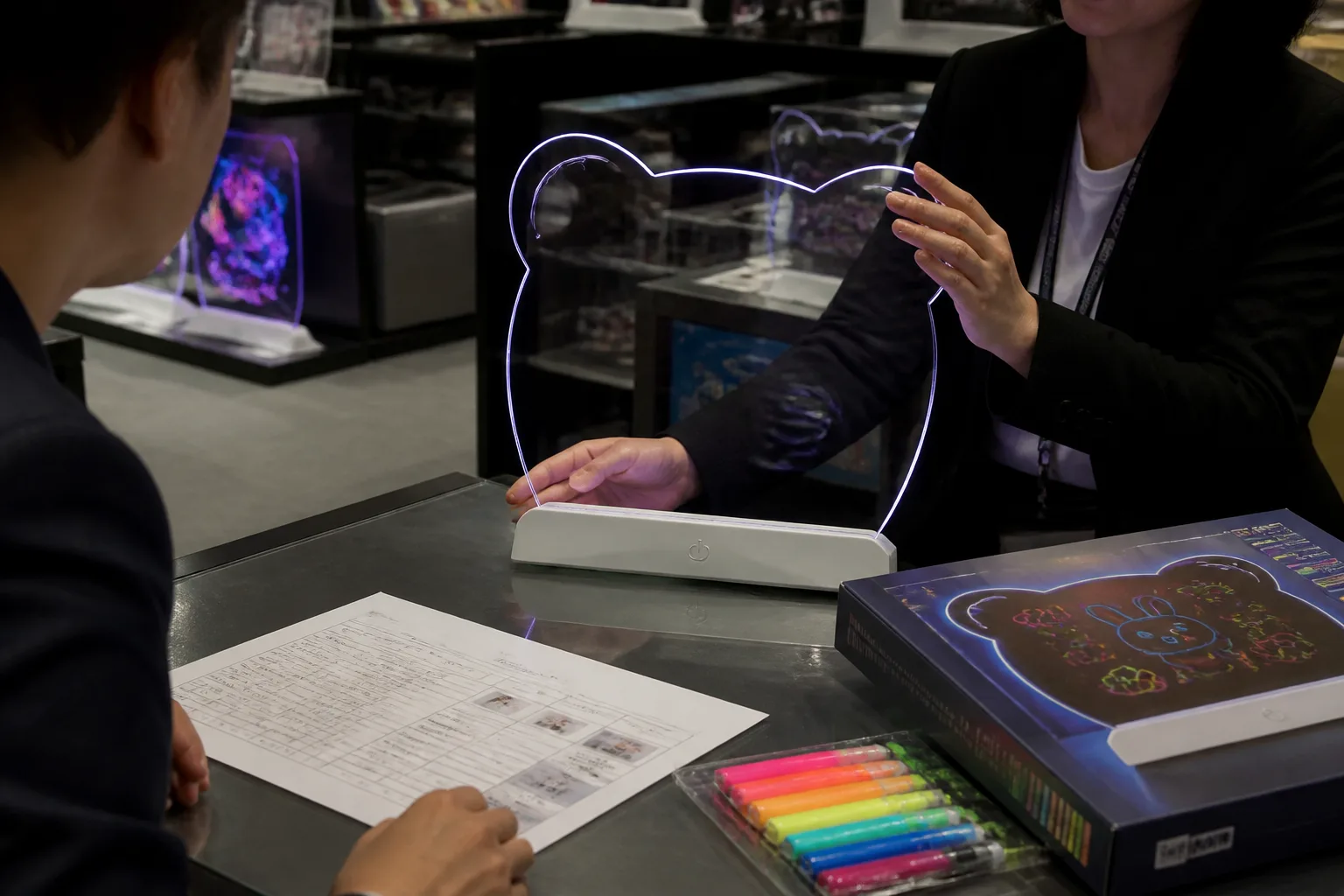
LED Drawing Board Supplier Evidence Request Guide
A practical B2B guide for importers and sourcing managers who need to request configuration-specific product, packaging and production evidence from a supplier.
Read article