Approve a combination of pen, surface, and care
Qualify the actual marker formulation, colors, panel surface, and approved cleaning method together. Use a written pattern, identified samples, recorded dwell conditions, consistent wiping, and photographs before and after. This creates useful purchasing observations; it does not establish toxicological safety, universal erasability, or a lifetime performance guarantee.
1. Identify the whole marker-surface system
Compatibility is a property of the selected pen, ink, surface finish, application, and care method. The broad label fluorescent marker does not establish that every marker works on every clear panel.
Ask the supplier to identify the marker formulation or controlled item reference, color assortment, tip design, panel material, coating if any, and approved cleaning instructions. Keep those fields together in the sample record. A change to a marker supplier or surface treatment can affect behavior even when the carton artwork remains unchanged. A useful buyer review begins by defining the exact combination that will be sold, including replacement markers if they are part of the planned range.
Review the sample's intended market and age presentation separately. A good-looking fluorescent stroke or easy removal does not establish toxicological safety, small-parts safety, or regulatory compliance. The CPSC art-materials FAQ illustrates that art-material assessment and labeling have their own requirements in the United States. Use appropriate local review for the destination while the functional protocol answers the narrower question of writing and cleaning performance.
Use a model such as the Butterfly LED Fluorescent Board as an identified sample reference, then confirm the actual marker assortment supplied with it. A shape name does not specify ink formulation or a surface coating. Ask whether the sample and production set use the same controlled components and whether any planned substitution will be disclosed before approval.
- Record controlled references for marker and panel.
- Include coatings and care instructions.
- Assess functional compatibility and safety evidence as distinct questions.
2. Agree the review objective before choosing test conditions
Decide which customer task the protocol represents and what observations matter. The buyer and supplier should agree conditions and acceptance criteria before comparing results.
A retail drawing activity, a staffed shop demonstration, and an after-school session may have different writing and reset routines. Describe the intended task, how long marks may remain, who wipes the panel, and which care items are supplied. Select representative conditions with the supplier or a qualified test provider. Do not present an arbitrary dwell period or number of wipes as a recognized industry standard unless a relevant standard actually specifies it.
Prepare a worksheet with sample identity, panel condition, marker reference and color, pattern, application method, dwell interval, ambient conditions where relevant, cleaning method, observations, and reviewer. If the buyer plans a comparative exercise, use the same sequence for candidates. A written plan allows a disagreement to focus on a specific observation rather than on vague terms such as easy erase or premium ink.
A protocol can compare two candidates without declaring either universally superior. The buyer may prioritize easy reset for a shop demo, while another application prioritizes the appearance of a fixed activity pattern. State that priority in advance and make the decision within the observed conditions. This prevents a commercial preference from being dressed as an unsupported laboratory conclusion about all fluorescent markers.
- State the real application and reset routine.
- Agree conditions and criteria in advance.
- Label buyer-defined protocols accurately.
3. Prepare panels and markers consistently
Start from identified, representative panels and the actual proposed marker assortment. Record protective-film removal, initial surface condition, and any preparation recommended by the board manufacturer.
A new acrylic panel may arrive with protective film, manufacturing residue, fingerprints, or a coating that changes how it should be handled. Follow the supplied preparation instructions and document what was done. Do not compare one cleaned sample with another still carrying film. Use separate areas or panels where cleaning from an earlier trial could affect the next mark. Keep untested controls where useful so surface changes are easier to identify.
Prepare markers according to their actual instructions, including any priming or mixing step if specified. Record whether a marker is new or previously used and keep caps on when not in use. Different colors can have different visible behavior, so test the supplied assortment rather than selecting only the most attractive stroke. Identify the sample set in photographs and retain the packaging or reference that connects it to the proposed production order.
Keep one area untouched as a visual reference if the agreed method calls for it, and avoid reusing a previously cleaned area without recording that history. Residual cleaner or repeated wiping can affect a later observation. The reviewer should know which marks were applied to a fresh surface and which belong to a repeated-use exercise, rather than mixing both into one ambiguous photograph.
- Use representative panel and marker samples.
- Record film removal and initial condition.
- Review all supplied colors, not only one convenient pen.
4. Use a pattern that reveals the intended writing behavior
A repeatable pattern can include thin and broad strokes, curves, filled areas, and controlled overlap. Choose elements that represent the intended activity without turning the exercise into an unsupported performance claim.
Separate writing observations from optical measurements
Mark each area using the same sequence and a documented approach to pressure and stroke count. Observe line continuity, visible beading, excessive spreading, nib feel, and whether the surface appears affected. Some variation may arise from the user, so repeat the task where needed and document the limitations. Keep appearance under ordinary light separate from appearance with the board illuminated. They answer different questions about drawing and presentation.
For an LED board, record the selected light mode and power setup when viewing the pattern. Camera exposure can affect apparent color and glow, so use consistent conditions for comparative images. A stronger photographed glow does not by itself establish superior ink chemistry or optical efficiency. If a numerical claim is important, commission an appropriate measurement rather than deriving a percentage from image brightness.
If the product includes several nib sizes or colors, map each to the intended activity. A broad fill and a fine outline may demand different handling without implying a defect. Ask users to follow the supplied instructions and record deviations neutrally. A practical trial should reveal whether the set is understandable for its intended use, while age suitability and safety require their own responsible assessment.
- Use the same pattern and application sequence.
- Observe line behavior before judging glow.
- Record illumination and camera conditions for comparison.
5. Record dwell time, wiping method, and residue
Removal depends on how the mark was applied, how long it remained, the surface, and the approved cleaning method. Compare these factors consistently and describe actual residue rather than writing a broad guarantee.
Choose dwell conditions from the planned use and record the start and removal time. Follow the board maker's care guidance for cloth, moisture, and cleaner. The PLEXIGLAS care guide is a useful material reference, but the finished board may include coatings, printing, adhesive, electronics, or other parts requiring different care. Obtain instructions for the actual product. Never substitute an aggressive cleaner merely to produce a better sample result.
Observe residue under consistent ordinary and angled light, then record whether it appears as remaining ink, smearing, surface haze, or a possible scratch. Photograph before and after with the same background. If a cleaning step changes the surface, stop the trial and seek technical review. The supplier should investigate unexpected findings with the relevant material and marker information; procurement should not assume the cause from a single image.
A residue scale can be buyer defined, but its terms should be illustrated and agreed before the review. For example, the team can define what it means by visible under normal viewing and visible only under a specified angled light. These are proposed observation categories, not results or universal thresholds. An agreed description makes supplier discussions more useful than a single pass label.
- Record mark dwell conditions and cleaning sequence.
- Use only the approved product-care method.
- Describe residue and surface condition separately.
6. Qualify replacement markers and production changes
A refill or substitute marker needs its own compatibility review when formulation, supplier, tip, color, or instructions change. A familiar barrel shape is not evidence that the ink is unchanged.
For a replenishment program, request a controlled marker reference and a change-notification arrangement. Identify which replacement set is intended for each board model and include the approved care information. If the supplier cannot substantiate formulation identity, treat the new set as a candidate rather than as an automatically equivalent replacement. This protects the customer's drawing routine and helps support teams give a specific response when a user reports residue.
Connect production checks to the qualified combination. Factory testing can confirm the supplied marker assortment, panel reference, and selected functional observations under an agreed plan. Shipment inspection can check contents and run defined sample observations. Neither process establishes that all future third-party markers are compatible. Use the marker replenishment guide for assortment logistics and retain this protocol as the evidence for the specific pen and panel pairing.
For refill packaging, include the board compatibility reference and approved care statement where appropriate. A customer should not have to infer compatibility from barrel color alone. If the seller offers a generic replacement set, verify what evidence supports the stated range of boards and surfaces. Keep the original and replacement sample records available so the next purchasing team can see the basis of the offer.
- Identify qualified replacement sets by reference.
- Require notice of formulation and supplier changes.
- Limit compatibility wording to what was actually reviewed.
7. Turn observations into a useful approval record
An approval record should identify the combination, conditions, findings, acceptance decision, limitations, and change triggers. It should make a sample review repeatable without claiming more than the exercise established.
Use a simple status for each observation: accepted under stated conditions, further evidence required, or rejected with a documented reason. Attach photographs, the worksheet, and any relevant material or laboratory records. State whether the decision concerns appearance, writing, removal, supplied contents, or another defined topic. Keep safety and regulatory conclusions in their appropriate files with the responsible professional's input, rather than folding them into a commercial wipe-test signoff.
An illustrative finding might be that one candidate left visible residue after the buyer's defined dwell and wipe sequence. That is an example of how to describe a finding, not a report about LumDigi or any actual marker. The next step would be to investigate sample identity, surface condition, method, and formulation with the supplier. This approach produces actionable questions while avoiding an unsupported universal statement that a particular ink is always good or bad.
When a sample fails a buyer-defined criterion, record the exact issue and ask for a corrective proposal. The proposal might involve a different marker, a surface change, revised instructions, or a narrower claim, but the responsible technical team should choose the response. Recheck the revised combination rather than accepting a verbal assurance that the problem has been fixed across every future production unit.
- Keep evidence and acceptance decision together.
- State scope and limitations in the signoff.
- Use findings to define the next supplier question.
| Record field | Useful content |
|---|---|
| Combination | Panel, coating, pen reference, and color |
| Method | Pattern, dwell, cloth, moisture, and cleaner |
| Observation | Writing, residue, and surface condition |
| Decision | Approval scope, owner, and change triggers |
8. Conclusion: release the qualified combination
Approve a defined marker and panel system with an honest record of the conditions reviewed. Keep replacement markers, care instructions, and future component changes connected to that decision.
A useful protocol does not need dramatic equipment or invented pass rates. It needs clear product identity, representative tasks, consistent observations, and responsible review of unexpected results. That evidence can improve RFQs, sample approvals, packing checks, and support records. It also makes it easier to distinguish a product mismatch from an unapproved third-party marker or a cleaning method outside the supplied instructions.
For a LumDigi enquiry, share the board model or shape, market and intended application, marker assortment, expected reset routine, care requirements, and any replacement-marker program. Ask which combination is offered and what sample evidence is available. If a special formulation or long dwell claim is required, state it explicitly and agree an appropriate review before production rather than relying on a catalogue phrase.
Store the completed worksheet, photos, supplied-item list, care method, and approval statement together. Identify who can authorize a new formulation or panel surface. The resulting record can support factory and shipment checks while preserving the limited scope of a buyer sample review. It also gives customer support a factual reference when a question concerns an unapproved third-party pen or an unusual cleaning method.
- Approve pen, surface, and care as one defined combination.
- Retain the sample record and limitations.
- Requalify material or marker changes before release.
Frequently asked questions
Can any fluorescent marker be used on an acrylic LED board?
Do not assume universal compatibility. Ink formulation, surface finish, coating, dwell time, and cleaning method can affect the result. Use the board maker's approved marker and care instructions, and review any replacement set on representative samples before making a compatibility claim.
Does an easy wipe test prove that a marker is non-toxic?
No. Functional removal and toxicological assessment answer different questions. A wipe review can document appearance and cleaning behavior under stated conditions. Any non-toxic, child-safe, or regulatory claim needs appropriate evidence and review for the actual formulation and destination market.
What should happen when the marker supplier changes?
Ask for the changed reference, formulation information available, colors, tip, and instructions. Review compatibility with the actual panel and approved care method, assess relevant safety documentation, and update the sample approval and packaging records before treating the new set as equivalent.
Image planning for this topic
These notes document the role and intended context of the two visuals used in this guide.
Show a recorded marker pattern
- Placement
- hero
- Caption
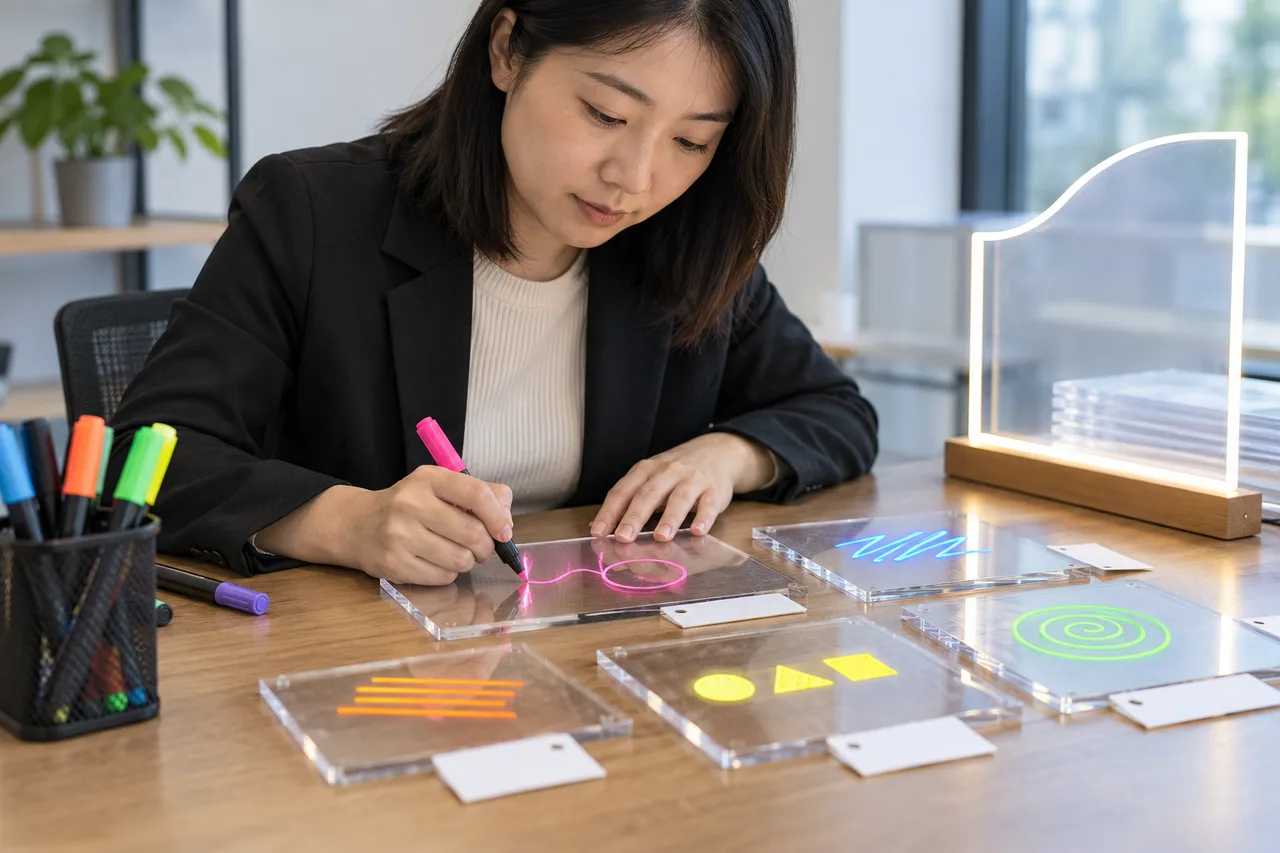
- Illustrative AI-generated photograph: a buyer prepares repeatable color strokes on separate identified acrylic samples.
- ALT text
- Asian buyer applying fluorescent marker test strokes to clear acrylic panels
View AI image direction
Use case: photorealistic-natural. Asset type: editorial image for a LumDigi B2B LED drawing board article. An adult Asian product buyer at a clean desk draws separate neon marker lines, loops, and small filled shapes on several clear acrylic sample panels. Plain marker barrels, blank sample tags, a shaped LED board nearby. Natural texture, no visible result claims or readable labels. Landscape 3:2, real acrylic textures, modest natural light, candid professional photography. If workers appear, they are Chinese/Asian adults. No invented logos, certification marks, readable documents, numerical test results, watermark, or text overlay. Show an illustrative procurement or sample-review scene, not proof of an actual test or shipment.
Show a controlled wiping observation
- Placement
- after-second-section
- Caption
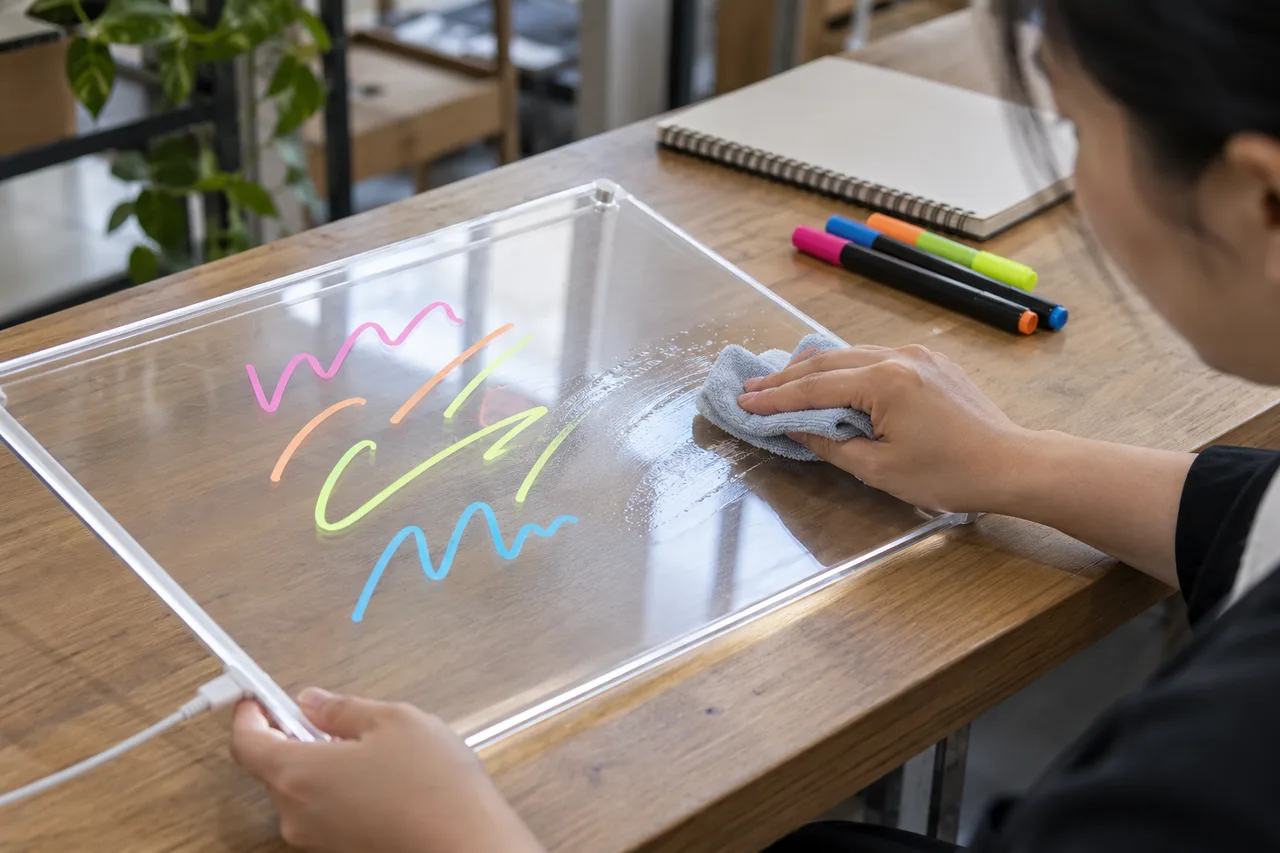
- Illustrative AI-generated photograph: a Chinese sample reviewer uses a soft cloth on a panel while documenting visible residue.
- ALT text
- Chinese sample reviewer wiping fluorescent strokes from a clear acrylic panel
View AI image direction
Use case: photorealistic-natural. Asset type: editorial image for a LumDigi B2B LED drawing board article. Close documentary photo of an adult Chinese sample reviewer's hands wiping part of a transparent acrylic drawing panel with a soft damp cloth while adjacent fluorescent strokes remain visible. A plain notebook and capped markers sit on the bench. Show ordinary observation rather than a claimed pass result. Landscape 3:2, real acrylic textures, modest natural light, candid professional photography. If workers appear, they are Chinese/Asian adults. No invented logos, certification marks, readable documents, numerical test results, watermark, or text overlay. Show an illustrative procurement or sample-review scene, not proof of an actual test or shipment.
Turn the article into a practical sourcing brief
Use the checkpoints above to document the product, evidence, packaging, and approval decisions relevant to your market. A clear brief helps suppliers respond to the same commercial question and gives your team a traceable basis for the next step.
Useful external references
- PLEXIGLAS: cleaning and maintenance
Material manufacturer's care guidance; confirm applicability to the actual finished board and coating.
- CPSC: Art Materials FAQ
Official U.S. art-material review and labeling context, distinct from a functional wipe test.

Which Markers and Surface Materials Work Best with a LED Drawing Board?
A practical buyer guide to LED drawing board markers and materials decisions, with clear questions for product fit, specifications, proof, and everyday care.
Read article
LED Drawing Board Marker Replenishment Guide for Retailers
A B2B buying guide for retailers, distributors, and ecommerce sellers who need to plan marker replenishment around the approved board, marker set, package information, and customer-support process.
Read article
LED Drawing Board Quality Control Checklist Before Shipment
Convert the approved sample and order specification into a practical inspection plan covering product identity, visible workmanship, function, contents, packaging, and reporting.
Read article
LED Acrylic Drawing Board Factory Capacity Discussion Guide
A practical B2B guide for importers and sourcing leaders who need to document capacity questions around a planned configuration, quantity and timing context.
Read article