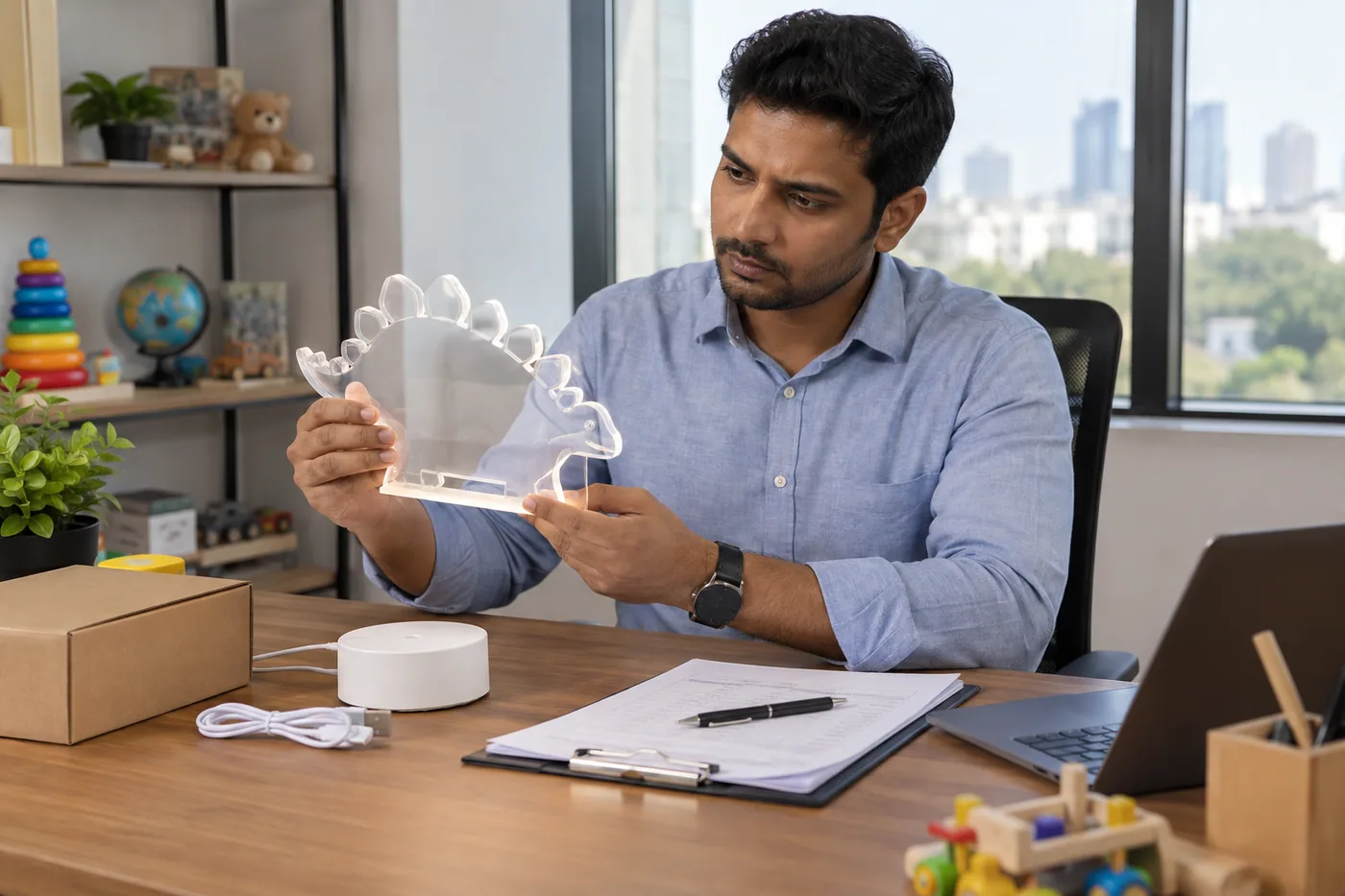
India BIS Toys Quality Control Order: A Sourcing Guide for LED Drawing Boards
The direct answer is to screen the product and factory against the current BIS Quality Control Order, standards, licensing scope, and shipment timing before approving an India launch, while avoiding assuming a low-voltage LED board is outside toy QCO or using a licence that covers a different factory, product type, or standard.
1. Confirm toy scope and product configuration before asking for a BIS mark
India's BIS compulsory-certification list includes both non-electric and electric toy categories. An LED acrylic drawing board should be screened by intended use, construction, power source, age, and set contents; the buyer should not decide the standard solely from a low-voltage cable or product title.
Begin with the actual product as offered: acrylic board, LED base, USB or battery power, cable or adapter if supplied, markers, packaging, instructions, age presentation, and marketing claims. The current BIS list shows toy entries for IS 9873 (non-electric toys) and IS 15644 (electric toys), but a commercial product may require expert interpretation to determine its applicable category and standards. Send the full description and sample to an India-qualified compliance professional before selecting the test plan.
The same board may be sold with different accessories or power arrangements across markets. Create an India-specific SKU matrix and document which component is part of the toy, which is an accessory, and whether the retail set changes the regulatory analysis. The seller's intended age and product instructions matter. A certificate for a similar drawing toy or a test report for one panel is not proof that the assembled, packaged LED product is covered by the same scope.
BIS describes its general certification scheme as voluntary but explains that government Quality Control Orders make certification compulsory for listed products. Therefore the correct question is whether the actual product is covered by an order, not whether BIS certification is generally voluntary.
- Provide the full set and intended use to the compliance reviewer.
- Separate board, base, adapter, cable, markers, and package variants.
- Get a written standard and category determination before quotation is finalized.
2. Read the current Toys QCO and amendments, not a saved summary
BIS's compulsory list identifies the Toys Quality Control Order and its amendments, including a transition facilitation order dated 25 June 2026. Importers should open the current Gazette notifications and confirm effective dates and scope for their planned goods.
A QCO can incorporate standards and amendments that affect which products may be manufactured, imported, distributed, or sold and when. A supplier's old presentation may refer to an earlier version of the order. Use the BIS list as a starting index, then review the linked order and official amendment text, effective dates, product scope, exemptions if any, and transition conditions. Record the retrieval date and the exact clause relevant to the import plan.
Do not translate the phrase 'transition facilitation' into a blanket extension. Its application depends on the notification's conditions and covered party, product, and timing. Ask an Indian compliance adviser or BIS for interpretation if the shipment crosses a transition date or uses a non-standard toy category. Keep the conclusion separate from the factory's factual description. If the launch schedule changes, repeat the legal status check rather than relying on a prior purchase approval.
The BIS compulsory list retrieved for this guide contains both non-electric and electric toy entries and references amendments, including a Transition Facilitation (Quality Control) Order, 2026 dated 25 June 2026. Read the Gazette instrument itself for its precise legal effect.
- Check current orders and amendments at BIS and the Gazette.
- Record the applicable effective date and any transition conditions.
- Have a local specialist review a time-sensitive shipment.

3. Verify the foreign manufacturer's BIS licence at factory and product level
BIS states that products covered by compulsory orders generally require the Standard Mark under a valid licence, and BIS provides a Foreign Manufacturers Certification Scheme. Buyers should verify the licensee, factory address, product scope, and status rather than accept an unrelated certificate image.
For a China-based supplier, ask which legal entity holds the relevant licence, which manufacturing location is included, what products and standards appear in the licence scope, and whether the licence is current. A brand owner, trading company, and factory may be different entities. Match the factory shown in the official licence record to the location producing the ordered LED board. A certificate held by another factory or for another product family cannot safely be assumed to cover the shipment.
BIS FMCS materials describe certification for foreign manufacturers. The manufacturer should coordinate the application and factory requirements directly through the valid scheme; the importer can review the public or official evidence and ask clarifying questions. Do not use a BIS Standard Mark in artwork before the proper licence and scope are confirmed. If the product changes, verify whether the license scope or testing evidence changes. Ask for document numbers and official database records, not a cropped image that hides the holder and product details.
BIS FMCS materials explain the route for foreign manufacturers. An importer should not assume a distributor or brand has the manufacturer's licence when the actual producing factory is elsewhere.
- Match the licence holder and actual factory address.
- Confirm the exact product and Indian Standard scope.
- Check status with BIS before approving marks or shipment.
4. Align sample testing with the production item
A buyer should make the test sample representative of the production configuration. The BIS route and applicable standards determine formal testing; internal factory checks support quality control but should not be presented as BIS certification or independent laboratory evidence.
Freeze the sample reference and record its board shape, panel, base revision, power input, included accessories, artwork, and packaging. Ask the testing laboratory and local adviser which specimens, variants, and documents are required for the product category. Testing a bare acrylic panel does not necessarily answer questions about the energized base, bundled markers, or consumer package. Keep laboratory samples and factory samples distinct and retain the chain of identity from the approved sample to the factory order.
Factory testing may be useful for agreed observations such as illumination, switch operation, accessory count, or visual workmanship. State what method was used and which sample was checked. It does not establish that a product meets each BIS standard unless the recognized certification process and evidence support that conclusion. If the final board uses a different cable or battery compartment, notify the reviewer before bulk production. Ensure the importer receives the final lab and certification status before goods are released for Indian market placement.
The term 'electric toy' may need technical interpretation for a low-voltage illuminated product. Provide a complete design and power description to the local reviewer rather than making a classification from voltage alone.
- Let the lab define the formal sample and test scope.
- Link production sample approval to the exact licensed model.
- Describe factory observations accurately and separately from certification.
5. Prepare the importer's evidence and shipment file
The importer should hold a product-specific compliance file that connects the licence and testing evidence to purchase orders, invoice descriptions, labels, and actual shipped model. Documentary consistency helps resolve questions without changing records after the goods arrive.
Prepare a controlled pack containing the product brief, photos, dimensions, power and accessory details, approved sample revision, manufacturer and factory, relevant licence and test references, artwork approval, and a mapping to each SKU. Ask a broker whether a particular import code, certificate, or filing is required for the planned entry and confirm the current government procedure. Do not rely on a seller's HS code to answer product-safety scope; customs classification and BIS conformity are distinct reviews.
Before dispatch, reconcile carton markings, model labels, product quantity, and document descriptions against the approved scope. If the license or report lists a family, keep evidence that the model belongs to it. A third-party shipment inspection can check agreed quantity and identity but cannot fix a missing legal licence. Hold the goods or seek direction if an unexpected revision appears. Preserve the final document versions and the name of the person who released the purchase order.
A QCO transition provision may concern the date of manufacture, import, or other specified event. Save the exact notification and obtain a written interpretation when the order affects a shipment in progress.
- Keep product conformity and customs classification as separate workstreams.
- Reconcile shipment documents to the licensed model and factory.
- Stop and resolve any product or licence mismatch before sale.
6. Keep online claims and Indian consumer information controlled
An Indian listing should reflect the actual certified product, age positioning, contents, and applicable marks. Sellers must coordinate packaging, warnings, retailer data, and images with local review instead of copying the global listing unchanged.
Create a master product page record for India with approved title, description, age, included items, power option, package shots, and evidence references. Review every image to ensure it shows the same board shape and base version. An online claim such as 'BIS approved' should only be used when the current licence and scope support it and local counsel approves the wording. Keep the record for each marketplace offer and seller account so variant changes do not reintroduce obsolete claims.
Packaging may require market-specific information and language, and the applicable Indian rules determine exactly what appears on product, retail pack, or insert. Use local regulatory review and translation, then proof at actual print size. If a package change accompanies a new age range or power component, return to the scope reviewer. A seller should not use the manufacturer's global artwork as evidence that India-specific duties are complete.
A product test report has a scope, date, laboratory, model, and standard. Confirm those facts against the licence and production item before using it to support a product claim.
- Review listing language and age statement against the approved route.
- Use only verified marks and licence references.
- Version-control India-specific artwork, image, and offer data.
7. India buyer checklist before sample order and launch
Before committing to Indian retail, confirm toy scope, applicable QCO and standards, the exact foreign factory licence, formal testing needs, package information, and a product-to-shipment evidence trail. Recheck amendments and transitions on the planned import date.
Ask the local reviewer: Is the product within toy scope? Which standards apply to the item and its power arrangement? Which factory and models must appear on the licence? What sample and factory assessment steps are required? What exact transition provision applies on the expected import date? Which label and consumer information are required? What record must the importer retain? Keep the response in writing with the official source links and a clear owner for unresolved questions.
Then align commercial and technical work: send the sample brief to LumDigi, request the board and packing configuration, agree how revisions are approved, and keep production conditional on local compliance gates. The importer can specify a pre-shipment inspection against order contents and approved sample, but do not substitute inspection for BIS certification. If legal interpretation, licence eligibility, or mark use remains uncertain, pause release and obtain qualified India-specific advice.
BIS licence and mark use should be checked in the official system; do not rely on a supplier's artwork image or third-party database summary as the only verification.
- Use a local scope and standards review before artwork signoff.
- Verify the named factory and model in the current BIS licence.
- Recheck official amendments and shipment timing before import.
8. Conclusion: verify the QCO route at the model and factory level
For India, the key sourcing task is to connect the actual LED board classification, applicable toy standard, foreign factory licence, current QCO status, and packaged model. Do not infer exemption or approval from a similar product or a supplier claim.
BIS's current list includes both electric and non-electric toy standards and shows amendments that buyers must review. A product specialist should decide the exact route from the design and intended use. Once confirmed, retain evidence that the manufacturer, factory, model, test, package, and imported version all align.
If India is your target market, tell LumDigi the intended channel, age and use positioning, board and power configuration, packaging plan, and compliance questions. We can provide supplier-side specifications and coordinate product facts. The Indian importer, BIS, laboratory, and qualified local adviser own applicable classification, certification, licensing, labeling, and import-release decisions.
This is a procurement guide, not Indian legal advice or a classification. Consult current BIS notices, an appropriately qualified Indian compliance professional, and the relevant testing body.
- Check the current BIS list and actual amendments.
- Match scope at the factory and model level.
- Keep independent supplier facts distinct from certification conclusions.
Frequently asked questions
Does an LED drawing board fall under India's Toys Quality Control Order?
The answer depends on intended use, age, construction, claims, and the product configuration. BIS lists distinct electric and non-electric toy standards. Have an India-qualified professional determine the applicable category for the exact product.
Can a Chinese manufacturer use a BIS licence held by another factory?
Do not assume so. Verify the actual licensee, manufacturing location, product family, model, standard, and current licence status with BIS. The foreign-manufacturer scheme has specific requirements.
What changed in India's toy QCO in 2026?
BIS's current compulsory-certification list references a Transition Facilitation (Quality Control) Order dated 25 June 2026. Buyers should review the official notification itself to determine whether and how it applies to their product and timing.
Is a factory inspection enough to meet BIS requirements?
No. Factory inspection can document agreed observations. Formal certification, testing, licensing, and mark use must follow the applicable BIS order and scheme.
Image planning for this topic
These notes document the role and intended context of the two visuals used in this guide.
Show a buyer decision context for India BIS Toys Quality Control Order: A Sourcing Guide for LED Drawing Boards.
- Placement
- hero
- Caption
- An Indian buyer maps an LED drawing board power design to the BIS toy category requiring local confirmation.
- ALT text
- Indian buyer compares an illuminated acrylic board and product scope checklist
View AI image direction
Photorealistic documentary photograph for a LumDigi B2B article about India BIS Toys Quality Control Order: A Sourcing Guide for LED Drawing Boards. Use case: photorealistic-natural. Asset type: editorial blog photograph. Scene: an Indian product sourcing manager compares a shaped illuminated acrylic drawing board, its low-voltage base and a neutral blank technical checklist in a calm office. The scene communicates a product-scope decision, not a certification result. Real acrylic reflections, natural daylight, editorial business photography, landscape 3:2. No BIS logos, no readable standards, no certificate, no text overlay, no watermark. Real acrylic texture, candid commercial setting, landscape composition, no readable logos, no certificates, no text overlay, no watermark.
Show practical factory or shipment-review context for India BIS Toys Quality Control Order: A Sourcing Guide for LED Drawing Boards.
- Placement
- after-key-considerations
- Caption
- Chinese Asian factory staff and an overseas buyer review neutral production and product-version records for an India sourcing file.
- ALT text
- Chinese production staff and Indian buyer inspect an LED acrylic board sample
View AI image direction
Photorealistic documentary photograph for a LumDigi B2B article about India BIS Toys Quality Control Order: A Sourcing Guide for LED Drawing Boards. Use case: photorealistic-natural. Asset type: editorial blog photograph. Scene: Chinese Asian manufacturing staff and an overseas Indian buyer review a board sample, LED base, plain markers, and a blank production record in a practical factory sample room. All visible factory employees are Chinese/Asian adults. Candid documentary photography, natural light, realistic textures, landscape 3:2. No readable documents, no BIS mark, no logos, no certificates, no approval claim, no text overlay, no watermark. Real acrylic texture, candid commercial setting, landscape composition, no readable logos, no certificates, no text overlay, no watermark.
Turn the article into a practical sourcing brief
Use the checkpoints above to document the product, evidence, packaging, and approval decisions relevant to your market. A clear brief helps suppliers respond to the same commercial question and gives your team a traceable basis for the next step.
Useful external references
- BIS: Products under compulsory certification
Current BIS list includes non-electric and electric toy entries, the Toys QCO, standards, and amendment references including a 2026 transition order.
- BIS: Foreign Manufacturers Certification Scheme FAQs
BIS explains when compulsory products require a licence and identifies the foreign-manufacturer certification route.
- BIS: Toys Quality Control Order, 2020
Primary order text; buyers should also check all current amendments and transition notices.

LED Drawing Board Factory Testing: What Buyers Can Ask to See
A B2B quality research guide for quality teams and sourcing buyers: define practical factory-testing observations that relate to the ordered configuration.
Read article
LED Drawing Board Supplier Evidence Request Guide
A practical B2B guide for importers and sourcing managers who need to request configuration-specific product, packaging and production evidence from a supplier.
Read article
LED Drawing Board Buyer Documentation Checklist for Market Review
A practical B2B guide for importers and compliance coordinators who need to organize product information and questions for the buyer's own market review and qualified advisors.
Read article
How to Set an AQL Sampling Plan for LED Drawing Board Orders in 2026
A B2B buying guide for importers, quality managers, distributors, and private-label buyers who need to define the inspection lot, attributes, sampling standard and edition, defect classes, acceptance rules, and escalation process before production release.
Read article