Indonesia SNI for LED Drawing Board Toys: A Buyer Scope and Standards Guide
The direct answer is to verify the current mandatory-SNI list and exact product/HS scope, then request evidence for the relevant toy standards and importer process, while avoiding confusing publication of an SNI standard with a current mandatory obligation for every LED board or assuming the supplier owns local registration.
1. Separate an SNI standard from mandatory SNI status
Indonesia publishes SNI standards for toy safety, including electrical-toy topics. A published standard does not by itself prove that every LED board is currently subject to mandatory certification.
The first procurement question is not simply which SNI number appears on a supplier report. Ask whether the exact product category and tariff code are listed in the current mandatory-SNI regulation, which ministry administers it, and which importer obligations follow. Use the Ministry of Trade's current mandatory products resource and the applicable industrial regulation; ask local counsel or an Indonesian conformity specialist to confirm. Consult the official Indonesia resource alongside the exact product facts.
Keep three facts distinct: the SNI standard's current edition, whether that standard is mandatory for the item, and whether a particular sample has evidence of conformity. The product description should identify the intended use, age, materials, power, accessories, and tariff hypothesis. The importer owns the market decision; the factory provides accurate product facts.
A standard catalog may mark an SNI as current without indicating whether every product under a broad HS chapter must obtain certification. Verify the legal instrument that creates the mandatory obligation.
The product record should preserve the link between sample, report, factory, brand, importer, and tariff description. If any one changes, identify which conclusions depend on it.
Use controlled product identifiers in quotation, order confirmation, pack proof, and inspection request. Consistent references make it easier to connect Indonesian paperwork to the shipped goods.
Use a written product description that explains the board's function and consumer-facing claims. If a customs broker proposes a code based on material alone, ask the importer to confirm whether the intended play use or power components need a separate classification review.
- Check current mandatory list and underlying regulation.
- Record standard status separately from product applicability.
- Confirm the HS and product category with the local importer/broker.
2. Identify the toy category and HS-code boundaries
Mandatory toy requirements can use defined product categories and tariff references. Map the complete drawing-board set to the current official list instead of extrapolating from a broad toy heading.
An LED drawing board may be presented as a children's activity product, a learning aid, or a display item. The way it is designed and marketed matters. A tariff number is a useful customs data point but should not replace a product-scope analysis. The buyer should document the product function and complete package before requesting a local determination. Use an identified model such as the Butterfly LED Fluorescent Board and confirm its current supplied configuration before applying this workflow.
Check whether the board, electronic base, supplied adapter, and markers are classified together or raise distinct questions. If the set includes a power accessory, identify its model and ratings. If the product description is uncertain, ask the Indonesian authority or a qualified local specialist to clarify rather than relying on a supplier's HS code.
For a product family, compare shapes and electrical parts and ask whether a certificate or report covers the entire family. Do not infer model coverage from branding alone.
Ask the lab whether the report is for type testing, surveillance, or a specific certification scheme. The document's purpose is as important as its title.
If the current list contains an HS category but the board's classification is uncertain, ask the customs broker and product regulator separately. One decision does not automatically answer the other.
Before accepting an Indonesian certificate, identify its holder and covered factory. A private-label brand may differ from the certificate owner; ask the local scheme administrator how that relationship should be documented rather than copying another brand's mark.
- Document intended use and consumer presentation.
- Map components to the product and tariff description.
- Retain written classification advice and its assumptions.
3. Select relevant toy standards by product facts
BSN lists current toy standards covering mechanical, flammability, chemical, and electric-toy safety. Ask a local specialist which standards and editions are relevant to the specific configuration.
Evidence for the Indonesia review
A clear acrylic panel, LED base, marker set, and power source create different technical questions. The relevant test plan depends on materials, intended age, foreseeable use, and applicable local regulation. Do not order a full suite only because a generic checklist mentions it; ask the lab to tie each test to the regulation, standard edition, and submitted sample.
SNI 8579:2018 is listed as an electric-toy safety standard, and other SNI ISO 8124 standards address toy safety topics. Verify current catalog status, amendments, and whether a standard is mandatory for this product. A report should identify the tested model, components, sample date, method, results, and any limitations.
Ask whether the local testing or certification body requires Indonesian-language documents, original reports, legalized copies, or a local applicant. Confirm before the goods are booked.
A battery-powered version may raise chemical, mechanical, or electrical questions distinct from a USB-only model. Share a physical sample and exact power documentation with the local reviewer.
For a repeat order, verify that the standard edition and mandatory list remain current. A previous customs release is not a general exemption for future models.
A test-plan request should state whether the sample is complete with its base, cable or batteries, markers, and packaging. A partial acrylic panel cannot answer every question about the finished child's toy, and an assembled sample may have a different report scope.
- Check the current BSN catalog and regulation references.
- Match each test to the product's risk and local rule.
- Confirm the tested sample is the offered SKU.
4. Confirm the Indonesian applicant and local records
The local product owner or importer should confirm whether certification, importer registration, NPB, or other records apply to the exact item. Do not assume the manufacturer can complete an importer-side step.
Ask the Indonesian buyer which entity is the importer of record, product owner, license holder, and party responsible for labeling or registration. The Ministry of Trade maintains a mandatory-SNI list resource, and its recent notice directs businesses to updated information on products and NPB. The local team should check the actual current list and legal instrument, not a third-party screenshot.
Prepare business and shipment records only after confirming the applicable route. Align the invoice, packing list, model names, batch data where available, and certificate references. If a certificate is held by another entity or factory, ask whether the Indonesian importer may rely on it and what authorization or scope evidence is needed.
Keep age grade and intended-use evidence consistent across package, marketplace listing, and instruction insert. These facts can influence a toy classification review.
Do not assume a foreign test report is automatically accepted for mandatory SNI. Ask the Indonesian scheme owner or recognized body which report formats and laboratories are eligible.
Have the buyer own the local declaration and ensure the factory supplies only facts it can prove. This reduces the risk of an overbroad marketing statement.
If an SNI number is shown in a supplier file, verify the edition and whether it remains listed as current in BSN's catalog. Then separately check the legal regulation that makes an item or HS group mandatory.
- Name the local importer and product owner.
- Verify current NPB or importer records where applicable.
- Keep supplier documents and local approvals distinct.
5. Request a useful supplier evidence package
Ask the factory for traceable product facts, not a blanket SNI guarantee: product identity, components, materials, ratings, sample photos, and the exact reports available.
A supplier package should identify the model and revision, silhouette, acrylic panel, base, connector, power item, marker contents, packaging, and product labels. Request controlled photos and a sample list. If there are existing test reports, ask for the standard number, edition, lab, report date, sample identity, model coverage, and limitations. Share these facts with the local Indonesian reviewer.
During a factory sample review, record fit, visible finish, normal operation under specified conditions, marker set, and packed contents. A production check can verify that the ordered version matches the approved sample. These observations support procurement and file control; they do not establish mandatory SNI status or replace required local certification.
If the buyer supplies the adapter, record that arrangement clearly and ask whether it is covered by the product file or needs separate review.
Maintain a dated regulatory source log. Include the mandatory list page, relevant regulation, HS reference, and the local reviewer's conclusion.
Compare the package contents with product photography and sales copy. An optional accessory shown prominently should be identified as optional if not included.
For shipment reconciliation, link invoice lines and carton counts to product variants. Ask the importer which batch and registration numbers belong on documents and avoid inventing identifiers that the factory does not maintain.
- Ask for a complete configuration record.
- Request report scope rather than certificate thumbnails.
- Label factory observations as supplier records.
6. Tie Indonesian labeling and product data to the approved sample
Confirm local-language, importer, product identity, and marking requirements with the Indonesian product owner before packaging release. Ensure the final printed pack shows the exact set being shipped.
Packaging and e-commerce copy should consistently identify the product and included contents. If age claims, warnings, instructions, importer details, or SNI references are required, the local reviewer should approve the exact wording and placement. Never print a standard mark or number based on a draft report or an unrelated variant.
For private label, retain the Indonesian artwork, translation review, barcode/model map, approved sample photos, and production revision. A change to the power system, markers, carton, or age statement can affect the product file. The importer should decide whether to re-open local review and tell the factory before printing.
A current government notice should be read with its underlying regulation and list attachment. A summary graphic is a starting point, not the complete scope determination.
Sample inspections should identify which parts were checked and whether the final production sample was used. A visual review cannot verify chemical composition or certification status.
A pre-shipment report should use a limited scope and show findings. Do not convert a pass on workmanship into a claim of SNI conformity.
When the same drawing-board platform is sold as a child's toy and as a promotional display, keep separate listing and age evidence. The local reviewer should see each offer as it will be placed on the market.
- Use buyer-approved local copy and marking artwork.
- Reconcile barcode and model variant.
- Stop print release when the sample and pack diverge.
7. Make a scope-based order-release decision
Before production or import, confirm the current list, applicable product and HS scope, relevant standard editions, local applicant, evidence acceptance, and shipment process in writing.
A release record can be a one-page decision log: product description, intended use, model, components, tariff hypothesis, standard references, official sources checked, local reviewer, requirements confirmed, documents pending, and shipment owner. Mark each conclusion as confirmed or open. This creates a defensible workflow without pretending the supplier has issued a legal determination.
Refresh the decision after a change to intended use, base, power, accessories, market listing, or importer. Also recheck the current mandatory list at each launch. This guide is informational, not Indonesian legal advice; confirm current rules through the Ministry of Trade, relevant technical ministry, BSN, and qualified local professionals.
Where a shipment includes samples, confirm whether they are for certification, demonstration, or sale and what records apply to each purpose.
Private-label artwork should not include an SNI claim unless the importer has confirmed its use for that exact item and certificate.
This guide is a decision framework, not legal advice; local requirements must be confirmed before import.
A market file should record who confirmed whether NPB or another registration applies, the date of confirmation, and which official list was checked. This turns a one-time email into a traceable procurement decision.
Indonesia SNI planning requires two separate checks: whether the product's exact category is currently subject to mandatory SNI, and which toy standards and editions apply to the marketed set. Keep the importer, local certificate, sample, test report, and shipment data tied to one model.
- Keep confirmed facts separate from assumptions.
- Recheck official lists before each order.
- Get written local confirmation before relying on an exemption or route.
Frequently asked questions
Does an SNI standard automatically mean an LED board needs mandatory certification?
No. Verify mandatory status and product scope in the current regulation and list; a published standard and mandatory obligation are distinct facts.
Should an importer consider SNI 8579 for an LED drawing board?
It is a current electric-toy safety standard in official standards information. Ask a local reviewer whether it applies to the exact product and current mandatory route.
Who confirms the Indonesian import route?
The local importer or product owner should confirm current requirements with relevant Indonesian authorities and qualified local specialists.
What evidence can the factory provide?
It can provide model, component, material, power, sample, packaging, and report facts. It cannot replace local classification or certification decisions.
Image planning for this topic
These notes document the role and intended context of the two visuals used in this guide.
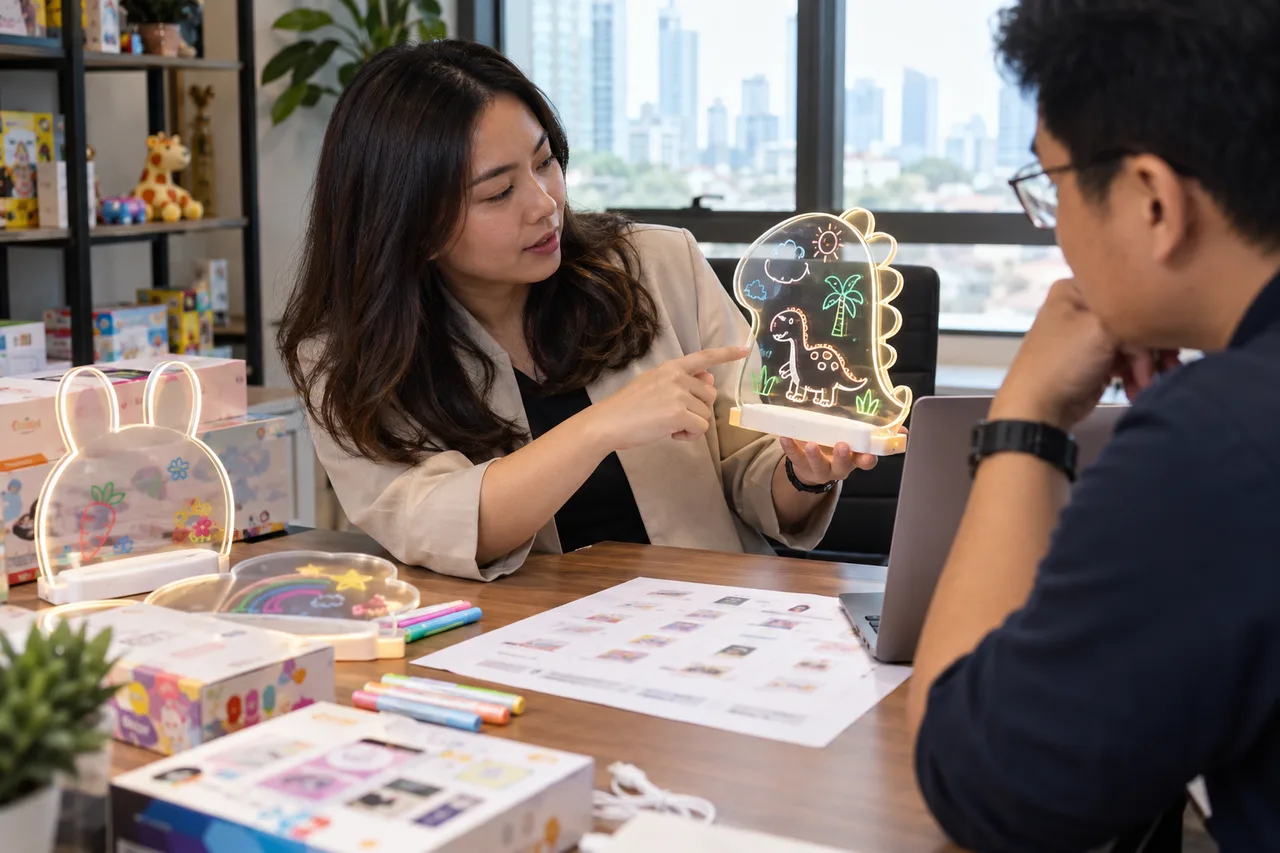
Show a buyer decision context for Indonesia SNI for LED Drawing Board Toys: A Buyer Scope and Standards Guide.
- Placement
- hero
- Caption
- Illustrative AI-generated photograph: An Indonesian buyer compares an LED board product description with the current mandatory-SNI scope checklist.
- ALT text
- Indonesian importer reviewing a shaped LED drawing board and SNI scope records
View AI image direction
Photorealistic documentary photograph for a LumDigi B2B article about Indonesia SNI for LED Drawing Board Toys: A Buyer Scope and Standards Guide. Photorealistic documentary photograph in a Jakarta importer office: an adult Indonesian product buyer reviews a shaped LED acrylic drawing board beside a printed category list with all text blurred and a neutral laptop. Calm import-planning meeting, daylight, realistic product finish, landscape 3:2. No SNI mark, government logo, readable text, certificates, watermark, or overlay. Real acrylic texture, candid commercial setting, landscape composition, no readable logos, no certificates, no text overlay, no watermark.
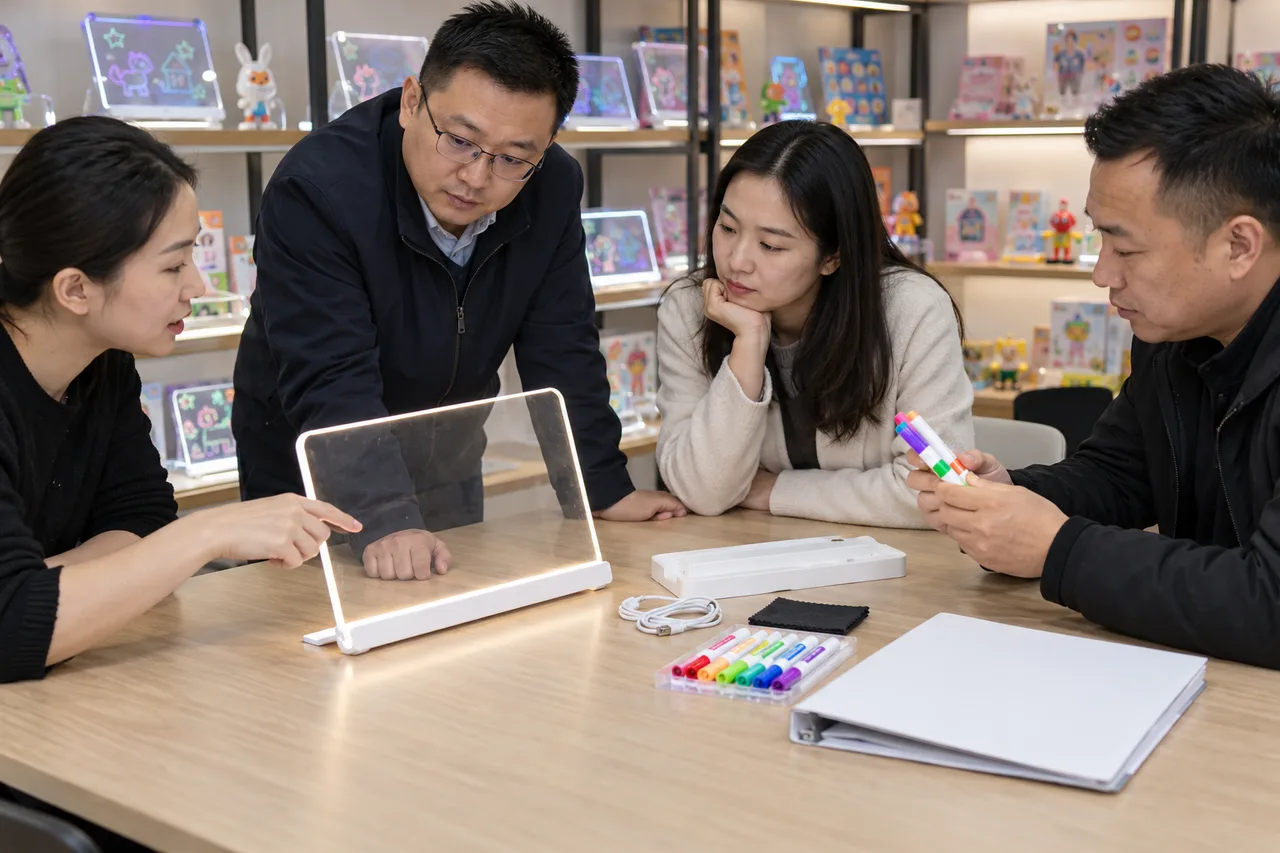
Show practical factory or shipment-review context for Indonesia SNI for LED Drawing Board Toys: A Buyer Scope and Standards Guide.
- Placement
- after-second-section
- Caption
- Illustrative AI-generated photograph: Chinese factory staff match a board sample and report references before responding to an Indonesian importer.
- ALT text
- Chinese factory staff reviewing an LED drawing board sample and technical report references
View AI image direction
Photorealistic documentary photograph for a LumDigi B2B article about Indonesia SNI for LED Drawing Board Toys: A Buyer Scope and Standards Guide. Photorealistic documentary photograph in a Chinese factory sample room: Chinese/Asian adult employees compare an identified LED drawing board, base, power cable, marker set, and a plain test-report folder for an Indonesian buyer. All writing unreadable, honest documentary setting, landscape 3:2. No fabricated test results, SNI mark, certificates, logos, watermark, or overlay. Real acrylic texture, candid commercial setting, landscape composition, no readable logos, no certificates, no text overlay, no watermark.
Turn the article into a practical sourcing brief
Use the checkpoints above to document the product, evidence, packaging, and approval decisions relevant to your market. A clear brief helps suppliers respond to the same commercial question and gives your team a traceable basis for the next step.
Useful external references
- Indonesia Ministry of Trade: mandatory SNI products
Official current-list resource for products subject to mandatory SNI.
- Indonesia Ministry of Trade: 2026 mandatory-SNI and NPB list notice
Official notice dated October 2026 directing businesses to the current mandatory-products list.
- Indonesia Ministry of Industry: standards service listing
Government standards service listing toy and electric-toy standards; mandatory status still needs separate verification.
LED Drawing Board Product Document Room Guide
A B2B buying guide for importers, sourcing managers, and private-label operations teams who need to maintain a controlled project file that names documents, versions, owners, purpose, and open questions.
Read article
How to Build a LED Drawing Board Product Specification Sheet
A practical B2B guide for B2B teams aligning suppliers, quality reviewers, packaging teams, and sales channels who need to create one readable source of truth for the exact board configuration, set contents, packaging, and verification requirements.
Read article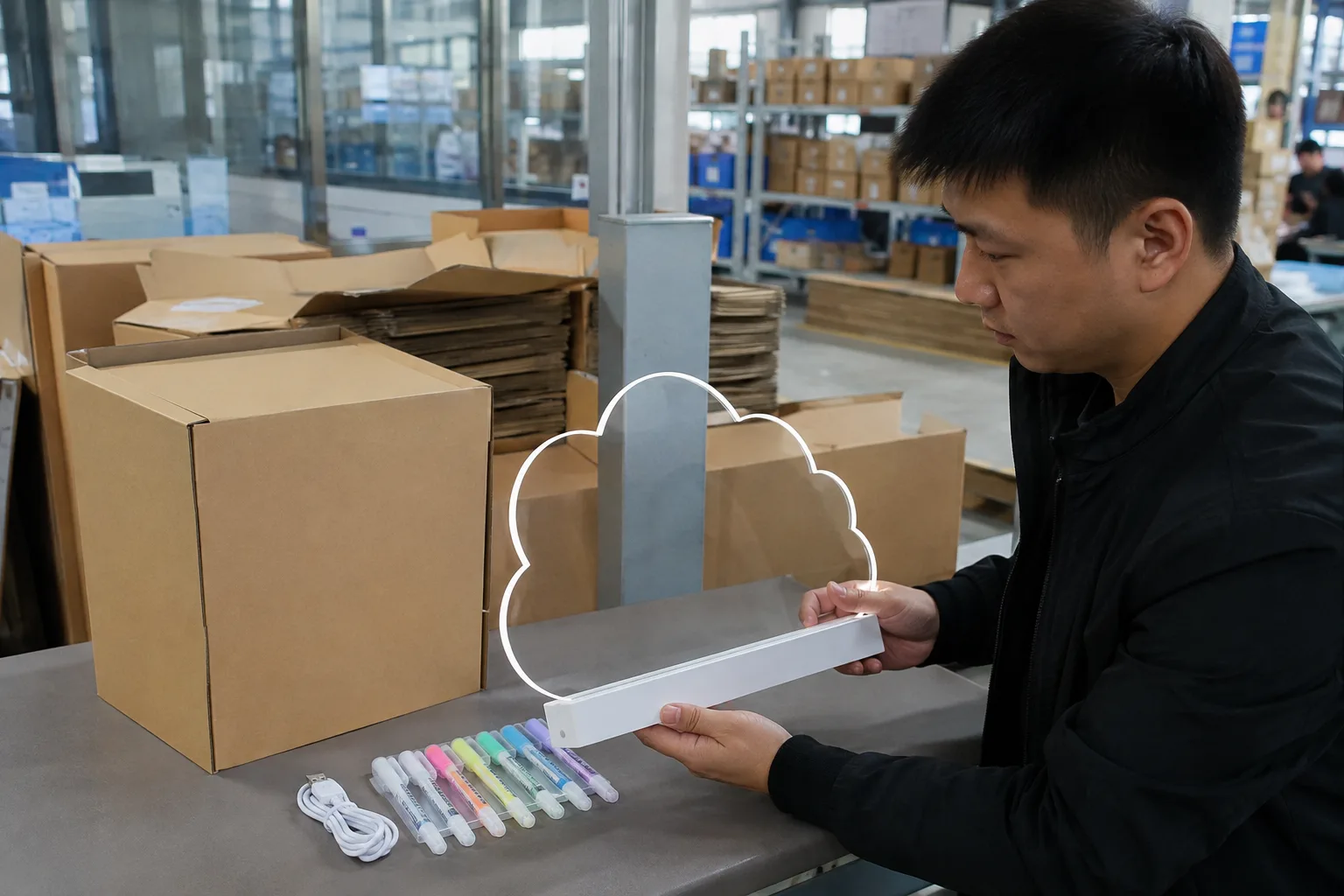
LED Drawing Board Importer–Factory Communication Guide
A B2B buying guide for importers, sourcing managers, and private-label brands who need to run project communication from a shared configuration, evidence list, and decision register.
Read article
Malaysia MySAFE Toy COC: An Importer Workflow for LED Drawing Boards
A B2B buying guide for Malaysian toy importers, distributors, product owners, and private-label teams who need to confirm which MySAFE activity applies to the intended supply or sample transaction, then align the tested configuration and supporting records.
Read article