
Compare specified grades and documented claims
Compare the actual proposed PMMA grades, not the labels virgin and recycled alone. Request material identity, recycled-content basis and scope, supplier documentation, optical and fabrication requirements, and representative finished samples. Substantiate any environmental claim separately and state whether it concerns the panel, packaging, or complete product.
1. Ask for a grade, construction, and supplier identity
Virgin and recycled describe material sourcing characteristics, not a complete panel specification. Identify the actual grade, manufacturing route, surface, thickness, and construction proposed for the finished product.
A recycled-content sheet can use different feedstocks, processing methods, and layer arrangements. A clear material with a recycled core and virgin outer layers is not the same construction as every other recycled PMMA product. The proTerra material page provides one manufacturer-specific example. Use it to understand why grade and construction matter, not to assign that brand's properties or content to an unrelated drawing board.
Request the manufacturer's material reference, supplier, controlled specification, relevant data sheet, and evidence connecting the purchased sheet to the finished panel. State whether the proposed material is for a new development or an offered production model. Do not describe recycled PMMA as an available LumDigi option until the selected configuration has been confirmed. The RFQ should establish the facts needed for a decision rather than announce a material substitution in advance.
An RFQ can ask suppliers to propose a material grade that meets a defined product brief and a separately defined recycled-content requirement. That is more useful than demanding recycled acrylic without specifying clarity, fabrication, drawing, care, and evidence needs. Ask the manufacturer to identify uncertainties and sample work. A proposal remains a candidate until the actual supply and finished-product suitability have been reviewed.
- Identify the actual material grade and construction.
- Connect supplier documents to the proposed panel.
- Confirm availability before making product claims.
2. Define exactly what a recycled-content claim covers
A recycled-content statement should identify the component, percentage basis, material source definition, and evidence. The panel's content does not automatically describe the electronics, base, markers, packaging, or entire set.
Ask whether a percentage refers to the sheet mass, one layer, the panel after fabrication, or the complete finished product. Request the calculation basis and supporting supplier records. Identify pre-consumer or post-consumer terminology as used by the applicable scheme or market guidance. If the supplier uses a certification or allocation approach, ask a qualified reviewer what it supports and how the consumer wording should describe it.
The FTC Green Guides summary advises specific, supported environmental claims and qualification when only part of a product or package contains recycled material. Apply that principle to a drawing-board set: a statement about its panel should name the panel. Avoid a broad eco-friendly or fully recyclable claim unless appropriate evidence supports the actual product and intended market.
Use a component mass map when the claim involves a percentage. The panel, base, electronic assembly, cable, markers, and packaging should not be silently combined or excluded from a calculation. Have the responsible reviewer define the basis that fits the proposed wording and relevant market guidance. Record calculations as calculations and retain the supplier records used as inputs rather than presenting an estimate as measured product content.
- Name component and percentage basis.
- Retain the calculation and material records.
- Review consumer wording for the destination market.

3. Review optical suitability on a finished sample
A material's recycled origin alone does not determine the finished board's clarity, color, haze, light behavior, or marker presentation. Review the specified grade in the actual shape and base.
Evaluate what the customer will actually see
Build a comparison using identified samples and the same background, room light, marker pattern, base, power setup, and viewing position. Observe clarity in the unlit state and the intended visual effect when lit. Record visible inclusions or color differences using agreed criteria. If a measured optical specification is necessary, ask a qualified provider to select a suitable method and report sample identity and conditions.
Do not borrow a material maker's optical or weathering claim for a different grade or finished assembly. A sample observation can support a purchasing impression under recorded conditions, while a formal performance claim needs its own evidence. If a material candidate looks acceptable but lacks traceable production supply, keep that risk visible. A successful prototype is useful, but it does not establish continuing batch consistency or the source of every later sheet.
A reference model such as the Butterfly LED Fluorescent Board can help the team specify the intended geometry and activity. It does not establish that a recycled grade is used or available. Ask whether a development sample can be proposed for that direction and what controlled material information would accompany it. Keep the existing product facts separate from a future material concept.
- Compare the material in the actual optical arrangement.
- Use representative finished samples.
- Substantiate numerical or long-term claims separately.
4. Include fabrication and drawing-surface requirements
The candidate material must suit the proposed cutting, finishing, printing or engraving, base fit, marker use, and care method. A sheet-level comparison is incomplete without the finished process.
Ask the manufacturer to review process suitability before substituting a grade. Panel thickness, flatness, edge treatment, fit at the base, and any permanent graphic can influence the product. A coextruded surface or coating may require a different review from a homogeneous sheet. Keep the material and fabrication record connected so a technically acceptable raw sheet is not assumed to be a direct replacement without checking the actual product.
Review marker writing and removal on the intended surface and follow the finished-product care instructions. If printing or engraving is used, obtain a physical proof with that process. Record any limits the manufacturer identifies. The acrylic thickness and edge-finish guide supports the wider panel specification, while this material RFQ adds recycled-content identity and claim evidence.
If a sheet has distinct surface and core layers, ask how cutting and edge finishing expose that construction and whether the proposed graphic method is supported. The supplier or material maker should provide appropriate technical guidance. Do not infer identical marker removal, print adhesion, or optical behavior from the name PMMA alone. Review the candidate through the actual fabrication and use sequence with its specific care method.
- Review the material through the actual fabrication route.
- Confirm base fit and surface behavior.
- Keep material, process, and care revisions connected.
5. Keep chemical and market evidence product-specific
A recycled-content statement does not replace relevant chemical, toy, electrical, or destination-market evidence. Determine requirements for the actual finished configuration and material sources.
The buyer should ask its responsible market reviewer which evidence is required for the panel, base, inks, markers, electronics, and any other accessible material. Request supplier records that identify the grade and scope rather than a generic statement that recycled acrylic is safe. If a material source or formulation changes, determine whether existing reports still represent the product. Use the REACH and SCIP documentation guide for relevant EU record questions.
Keep environmental marketing, material identity, and product-safety review as distinct workstreams. Evidence can be related, but no single recycled-content certificate automatically resolves all three. The factory should provide factual records it controls and identify unavailable information. Local importers, qualified laboratories, and relevant specialists should make the appropriate regulatory or technical decisions for the target market.
A material dossier should identify which data belongs to the sheet manufacturer and which evidence concerns the assembled board. A chemical record for a raw sheet does not automatically represent inks, base plastics, electronics, or markers added later. Use a complete component map so the qualified market reviewer can determine relevant work. Keep missing information visible and ask for a route to resolve it before artwork release.
- Identify requirements for the actual finished product.
- Review report coverage after material changes.
- Keep recycled content separate from safety conclusions.
6. Ask how material identity is maintained in production
The buyer needs a practical link from approved material to incoming sheet, production record, and finished panel. Traceability should describe records that actually exist rather than a broad assurance.
Ask which supplier identifiers appear on incoming material, how the factory records grade and lot information, and how it keeps material candidates separate. Define what records can be shared during a factory review and what the buyer expects at shipment. Do not demand a serial number per panel if the production system does not maintain one; instead agree the actual achievable record and state its limitations.
Factory testing can check material reference, panel dimensions, visible condition, fit, and defined functional observations. Shipment inspection can compare sampled goods and records to the released order. A visual check cannot independently verify recycled-content percentage. If the claim is central to the product offer, define documentary verification or an appropriate independent assurance process with a qualified provider before printing it on the pack.
Ask how offcuts, mixed material, and candidate grades are managed on the factory floor. The answer should describe real records and separation practices the supplier can demonstrate. Procurement should avoid promising perfect traceability unless the actual system supports that claim. Agree what can be verified during a factory review and what documentary evidence the buyer needs for the component-level environmental statement.
- Map actual incoming and production records.
- Agree practical retention and access.
- Use documents or assurance for content claims rather than appearance.
7. Compare commercial terms with the evidence workload
Quote comparison should include the named material, minimum quantities, sample work, documentation, process changes, and change-control obligations. Do not assume a recycled grade is automatically cheaper or more expensive.
Ask for comparable scenarios based on the same shape, base, marker set, packaging, market, quantity, and acceptance scope. Identify any material-specific tooling, fabrication, sample, or purchasing constraint the supplier confirms. Record quoted assumptions and validity rather than inventing a universal price premium. If the material is proposed for future development, separate prototype costs and open technical questions from a production-ready order.
Review the claim and evidence plan before the brand commits to a launch. Documentation, artwork approval, sample review, and supply continuity can affect practical readiness even when the panel looks good. A carefully scoped claim about a specified component may be more supportable than a broad product-wide sustainability message. The buyer should approve the wording, source records, and change triggers together with the commercial configuration.
Evaluate continuity as well as the first sample. Ask whether the proposed grade has a stable commercial source, which specifications will control future orders, and what happens if that source becomes unavailable. A substitute should follow the same technical and claim review before production. This makes the environmental requirement part of purchasing control rather than a marketing note that can disappear when supply conditions change.
- Compare quotes on the same finished set.
- Include evidence and sample work in the plan.
- Approve only supportable component-level wording.
| RFQ topic | Evidence to request |
|---|---|
| Material identity | Grade, construction, manufacturer, supplier reference |
| Recycled content | Component scope, percentage basis, supporting records |
| Product suitability | Finished sample and agreed technical review |
| Production control | Incoming record, change notice, and retention plan |
8. Conclusion: select a grade and a defensible claim
A material decision should connect the actual PMMA grade, finished-product performance requirements, supply records, and precise environmental wording. Recycled origin is one important attribute, not the entire specification.
The buyer can move forward when the candidate has an identified source, an agreed sample review, relevant market evidence, and a practical production record. Keep limitations visible and use current supplier information. Do not promise equal performance, a carbon reduction, or product-wide recyclability simply because a sheet includes recovered feedstock. Those are separate claims requiring suitable data and a defined comparison basis.
For LumDigi, state whether recycled PMMA is a requirement for a new project, which component the claim concerns, and what evidence your brand or retailer needs. Share the board direction, market, activity, graphic method, and volume scenario. LumDigi can confirm whether a suitable configuration can be proposed and what sample and documentation work is needed before any offer is described as production ready.
Do not infer carbon reduction from recycled-content percentage alone. A comparative environmental claim needs its own appropriate data, system boundary, comparison, and review. The buyer can still make a precise, substantiated component statement where supported. Keep broad sustainability messages out of the approval record until the responsible team has the evidence needed to explain what they mean for the actual product and market.
- Specify actual grade and product requirements.
- Approve claim scope and supporting records.
- Confirm offered availability and production control before launch.
Frequently asked questions
Is recycled PMMA always optically worse than virgin PMMA?
No universal conclusion follows from those labels alone. Compare the actual grades, construction, relevant data, and finished samples under consistent conditions. A material maker's claims for its own product do not establish the properties of another sheet or an assembled drawing board.
Can a recycled panel make the whole board eco-friendly?
A panel-level recycled-content fact does not by itself substantiate a broad whole-product environmental benefit. Identify the component, percentage basis, evidence, and destination-market wording. Claims about carbon, recyclability, or overall benefit need their own appropriate support and qualifications.
Can shipment inspection verify recycled content visually?
Appearance alone cannot establish a recycled-content percentage. Inspection can check product identity, visible condition, and available records within an agreed scope. The content claim needs traceable material documentation or an appropriate assurance process selected for that purpose.
Image planning for this topic
These notes document the role and intended context of the two visuals used in this guide.
Show a material-grade comparison
- Placement
- hero
- Caption
- Illustrative AI-generated photograph: a buyer compares clear acrylic samples and their material references before selecting a grade.
- ALT text
- Asian buyer comparing two clear acrylic sheet samples with blank material reference cards
View AI image direction
Use case: photorealistic-natural. Asset type: editorial image for a LumDigi B2B LED drawing board article. Adult Asian product buyer holds two clear acrylic sample panels beside blank material reference cards on a light desk. A shaped LED board and plain raw-material folder are nearby. Neutral realistic appearance, no recycling symbols or claims that a sample is environmentally superior. Landscape 3:2, real acrylic textures, modest natural light, candid professional photography. If workers appear, they are Chinese/Asian adults. No invented logos, certification marks, readable documents, numerical test results, watermark, or text overlay. Show an illustrative procurement or sample-review scene, not proof of an actual test or shipment.
Show finished-sample evaluation
- Placement
- after-second-section
- Caption
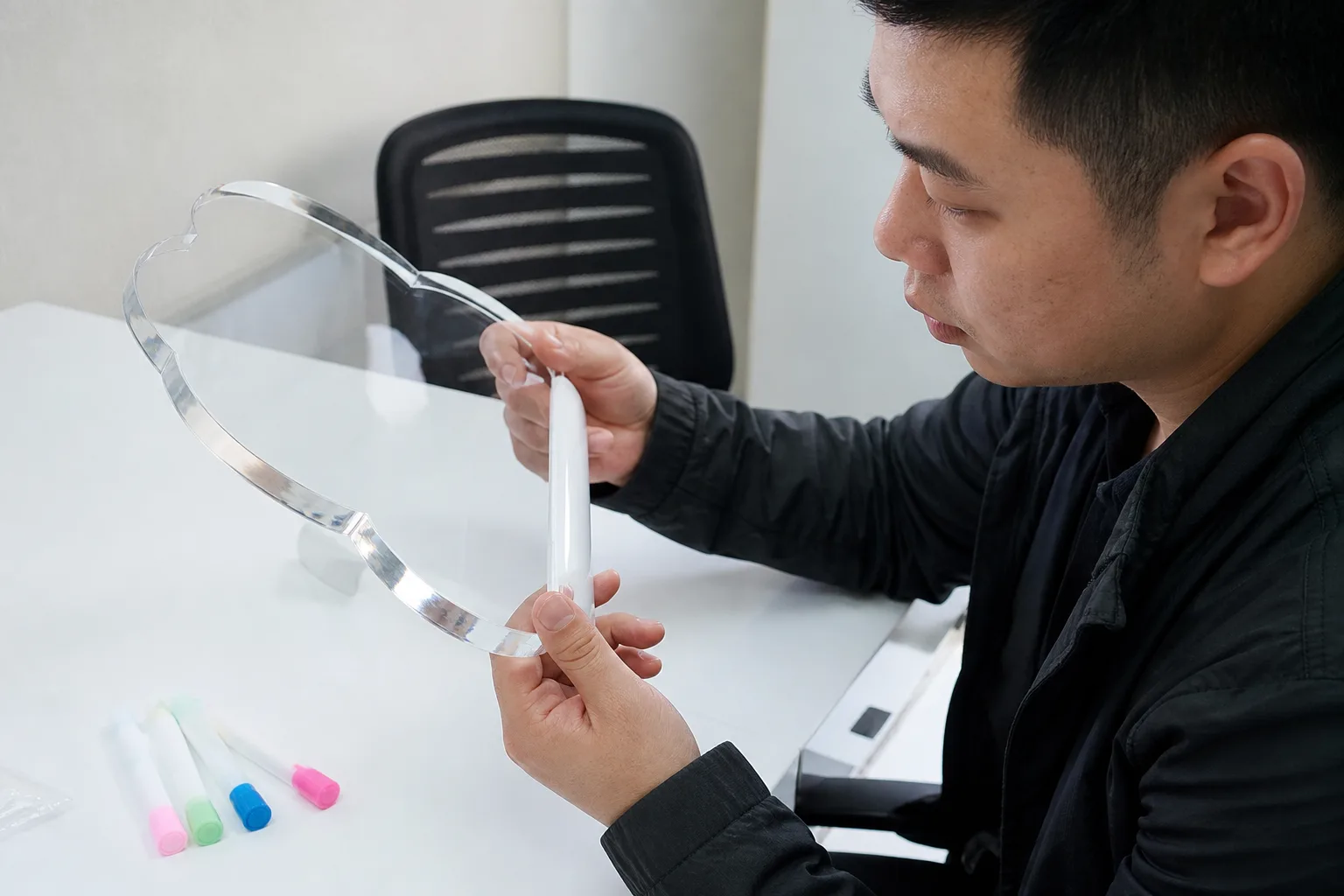
- Illustrative AI-generated photograph: Chinese staff inspect a shaped acrylic panel’s clarity and fit in the intended base.
- ALT text
- Chinese factory staff inspecting the clarity and base fit of an acrylic LED panel
View AI image direction
Use case: photorealistic-natural. Asset type: editorial image for a LumDigi B2B LED drawing board article. Chinese/Asian adult factory sample staff inspect a transparent butterfly-shaped acrylic panel against a neutral light background and check its fit in a slim LED base. Candid practical observation, real edge reflections, no readout or certification mark. Landscape 3:2, real acrylic textures, modest natural light, candid professional photography. If workers appear, they are Chinese/Asian adults. No invented logos, certification marks, readable documents, numerical test results, watermark, or text overlay. Show an illustrative procurement or sample-review scene, not proof of an actual test or shipment.
Turn the article into a practical sourcing brief
Use the checkpoints above to document the product, evidence, packaging, and approval decisions relevant to your market. A clear brief helps suppliers respond to the same commercial question and gives your team a traceable basis for the next step.
Useful external references
- PLEXIGLAS: proTerra material information
A primary example of a specific recycled-PMMA product and construction; it is not evidence that LumDigi uses this material.
- FTC: Environmental Claims and Green Guides
Official U.S. guidance on specific, supported environmental and recycled-content claims.
LED Drawing Board Acrylic Thickness and Edge Finish Guide for B2B Buyers
A practical B2B guide for private-label buyers, specialty retailers, import managers, and product developers who need to choose an acrylic and edge-finish direction only after reviewing the selected shape, light path, intended handling, sample, and packed configuration.
Read article
REACH and SCIP Documentation for LED Drawing Board Importers: A Buyer Checklist
A component-level workflow for requesting REACH and SCIP evidence, checking importer responsibilities, and keeping material records tied to the exact LED board revision.
Read article
How to Substantiate LED Drawing Board Claims Before Publishing a Listing
A B2B buying guide for ecommerce sellers, brand managers, importers, and retailer content teams who need to classify each express or implied claim, identify the evidence and scope that support it, and remove or qualify unsupported wording before publishing.
Read article
Laser-Engraved vs Surface-Printed Acrylic Artwork: A Custom LED Board Buying Guide
A customization guide for brands choosing a permanent graphic method without confusing a sample effect with a guaranteed finished-product result.
Read article