
Choose the product by what the user draws on
For drawing directly on a transparent panel with compatible fluorescent markers, consider an edge-lit acrylic board. For seeing a reference through paper, consider a tracing lightbox with an illuminated working area. Confirm the actual optical design and demonstrate the intended task on a sample before requesting a bulk quotation.
1. Define the drawing task before naming the category
A category brief should describe the working surface, reference material, user action, and expected result. The phrase LED drawing board is used for different products and cannot by itself tell a factory what the buyer needs.
Write a short use sequence. For a marker board, a user takes a compatible pen, draws directly on the panel, views the illuminated strokes, and wipes the surface as instructed. For a tracing aid, the user places a source image and paper on a lit area, sees the reference through the paper, and draws on the paper. These sequences require different optical arrangements, accessories, and consumer explanations. Treat them as separate product briefs even when a catalogue groups them together.
Ask the buyer's merchandising or education team to identify the intended outcome before comparing photographs. A glowing animal outline may suit a gift display, while a flat white working area may suit paper tracing. Neither task establishes that the product is safe, suitable for an age group, or available in a particular size. Those points require the selected model's information. Start with LumDigi's product range and identify a specific board rather than assuming the whole range performs both tasks.
Consider an illustrative bookstore brief that asks for a gift encouraging reusable drawings, and a separate illustrator's brief that asks for tracing through paper. Even if both teams use the phrase light-up pad, their sample tasks should differ. Record the distinction before sourcing so the supplier can recommend a relevant category. This is a planning example, not a claim about a customer project or a prediction of sales performance.
- State what the user draws on: panel or paper.
- State what the user needs to see: glowing strokes or a reference image.
- Keep task suitability separate from unverified age and safety claims.
2. Understand where the light enters and leaves
An edge-lit panel receives light at an edge or base; a tracing surface provides light behind the paper. The path and distribution of light determine the visible effect, so request a plain description of the actual model.
A sample should reveal the useful light path
Clear acrylic can guide light, and local scattering or a suitable optical structure allows light to become visible. The material manufacturer's edge-lighting guide explains these principles for its own grades. That reference helps explain the category, but it does not prove a particular drawing board uses the same sheet formulation or produces uniform surface illumination. Ask the supplier which material and lighting arrangement are actually supplied.
A tracing lightbox may itself use edge LEDs and a diffuser internally, yet its useful output is an illuminated area behind paper. For procurement, distinguish the internal light source from the consumer-facing task. A board described as edge lit is not necessarily a transparent marker board, and an acrylic marker panel is not necessarily an evenly lit paper-tracing surface. Ask for an unedited operating video that shows the whole product, the paper if any, and the room lighting.
Ask the supplier to sketch a simple cross-section or explain the light path in plain language. The drawing should identify the LEDs, panel, diffuser if present, drawing face, and reference-paper position if supported. A clear diagram can expose misunderstandings earlier than an elaborate render. It should describe the offered construction and avoid assigning proprietary optical materials or hidden layers that the manufacturer has not confirmed.
- Request the light-source and panel arrangement.
- Confirm whether the working area is transparent, diffuse, or opaque.
- Avoid assigning a material brand or performance level from a photo.
3. Test the paper task with the buyer's own materials
If tracing is part of the intended offer, evaluate actual source images and paper combinations on the candidate unit. A bright photograph of the product cannot establish visibility through every paper weight or printed reference.
Prepare a small set of representative paper samples and source images, identified by the buyer. Use the same stack order, viewing distance, room conditions, and power setup on every candidate. Record whether the user can follow fine and broad reference lines without repeatedly moving the paper. The exercise is a proposed application check, not a standardized optical test. Choose acceptance criteria from the customer's actual use rather than inserting an arbitrary brightness number into an RFQ.
If the supplier's product is intended only for direct drawing on acrylic, the correct result may be that paper tracing is outside its stated purpose. Capture that limitation clearly. Do not ask the factory to demonstrate an improvised paper task and then market it as a supported feature. A focused product offer is easier to explain than a long feature list that mixes unrelated use cases. For a paper-tracing launch, request a model specifically designed and documented for that task.
For paper evaluation, keep a blank control sheet and a source image with both fine and broad lines. The buyer can then distinguish limited reference visibility from a paper-positioning problem. Record the materials rather than calling them ordinary paper, since that phrase is not reproducible. If the supplier recommends a particular paper range, ask for its basis and confirm the recommendation in the proposed consumer instructions.
- Use representative paper and original artwork.
- Keep power, ambient light, and viewing position consistent.
- Describe an unsupported tracing task accurately in the buying decision.
4. Test direct drawing as a different application
For a transparent fluorescent board, sample review should focus on stroke visibility, writing feel, compatibility, removal, and the product's intended drawing routine. These observations do not translate automatically into paper-tracing performance.
Use only the marker formulation proposed for the retail set and record its identity and color assortment. Draw a repeatable simple pattern with straight lines, curves, filled areas, and overlapping colors. View the marks with illumination on and off in a normal application setting. Note the surface condition before writing and follow the supplier's care instructions for removal. If the sample is coated, identify the coating rather than calling all clear surfaces equivalent.
Keep observations attached to the exact panel, marker, cleaning method, and time before wiping. An easy-to-erase mark on one sample does not prove that all inks work or that indefinite dwell time has no effect. If spare markers will be sold later, plan their qualification as part of the offer. The existing markers and surface-materials guide can support the wider selection discussion, while the current article resolves which optical category to source.
Direct-on-panel tasks also involve hand position, marker access, and the need to see previous strokes. Observe whether the user naturally writes on the intended face and understands the wiping routine. A shaped outline can be attractive while changing available drawing space, so use an activity appropriate to the sample. Keep a photo of the completed pattern with the panel reference to support later product-copy review.
- Identify marker, panel, and care method together.
- Evaluate lit and unlit presentation.
- Avoid promising universal marker compatibility.
5. Compare usable work area, support, and handling
Usable drawing area is the part the user can comfortably work on, not simply the outer silhouette or carton dimensions. Compare support, access, orientation, and the actual setup for the intended task.
For a shaped acrylic board, decorative ears, points, or a narrow top may reduce the practical area available for a drawing even when the outline appears large. For a tracing surface, borders, controls, cable routing, and the position of a reference sheet can affect the working area. Ask for dimensions that identify the measured region and use a representative activity to test it. Keep any measurement as a product fact rather than a promise of a particular educational outcome.
Observe how a user supports the product and resets it after drawing. Is it designed to sit upright in a base or lie flat? Where are the pens stored? Can paper be placed without interfering with controls? Is the cable visible or under strain? Installation preparation should cover only the supplied model and approved power arrangement. A tabletop trial is useful for deciding assortment fit, while engineering or safety assessment remains a separate task for the responsible party.
Use the same physical work surface for each candidate and note whether its finish creates reflections behind a transparent board. A busy background can make lines difficult to see even when the product works as intended. This is useful application information for retail photography and demonstration planning. It does not justify an unsupported statement that the optical output is weak or that the product fails a safety requirement.
- Request working-area and outer dimensions separately.
- Check intended orientation and support.
- Review cable position and accessory storage during the task.
6. Compare the categories in one procurement matrix
A clear comparison uses task-specific fields and allows a limitation to remain visible. Do not rank a marker board poorly because it was never designed to be a paper-tracing lightbox.
Build a matrix with columns for intended activity, drawing medium, optical layout, working area, illumination modes, included supplies, care, power, packaging, and evidence status. Add separate rows for each physical candidate. Use confirmed, unconfirmed, or not supported as deliberate values. This avoids converting missing data into a favorable feature and prevents a decorative product image from being treated as an optical measurement.
For a mixed retail collection, the two categories may serve different shelf roles. One can be presented as reusable illuminated art on a clear panel, while another is presented as a paper-tracing tool if documented for that purpose. Keep product names, images, inserts, and sales training consistent with those roles. Reconcile the matrix with the sample comparison process before an order decision so the chosen category and the chosen model remain connected.
Include a column for consumer explanation in the matrix. Ask a merchandiser to describe the product in one accurate sentence without using the broad word tablet. If the sentence suggests a screen, paper illumination, or battery operation that the model does not provide, revise it. This small exercise can reveal category confusion before it appears in a marketplace title or a retailer's product-data feed.
- Compare supported tasks rather than broad marketing labels.
- Record missing facts explicitly.
- Give each category a clear consumer explanation.
| Buying question | Transparent marker panel | Paper-tracing lightbox |
|---|---|---|
| Drawing medium | Compatible markers on the panel | Pencil or other tools on paper |
| Useful optical output | Visible illuminated marks or artwork | Light behind the paper stack |
| Core sample task | Draw, view, wipe as instructed | See reference and trace on paper |
7. Write the RFQ so quotes describe comparable goods
Use the task brief and selected optical layout to define a comparable quotation. Include only features the buyer actually needs and ask suppliers to identify unsupported assumptions.
An RFQ should state the intended customer and channel, target market, activity, drawing surface, reference materials if relevant, desired working area, preferred orientation, power arrangement, accessories, packaging objective, and quantity scenarios. Attach the sample test pattern or activity sheet. Ask each supplier to identify the quoted model, full contents, current specification, and sample conditions. A shared brief makes price differences easier to interpret because the products being quoted have a common purpose.
Keep factory testing and shipment inspection linked to the chosen category. A panel/base assembly check and a paper illumination review answer different questions. The buyer should state which observations it wants, who approves the sample, and which product or power substitutions require notice. Do not add invented service life, luminance, or testing outcomes to complete a comparison table. A useful quotation can identify open engineering questions and give the buyer a practical path to resolve them.
For a concrete reference, identify a model such as the Cloud LED Fluorescent Board and ask which drawing activity and contents apply to that offer. The product page is a starting point for a model-specific enquiry, not evidence that every requested feature is available. Keep any proposed alternative category on a separate RFQ line so sample and price discussions remain comparable.
- Attach the intended activity and supplied-item list.
- Ask for one identified model per quote line.
- Define sample approval before discussing a bulk release.
8. Conclusion: select a useful task, then a controlled model
Source an edge-lit marker board for a supported direct-on-panel activity and a tracing lightbox for a supported paper-tracing activity. Verify the actual design, sample, and supplied configuration before making category claims.
The strongest category decision usually comes from a modest demonstration using the customer's real materials. Observe the task from setup to reset, record what the sample does, and note limitations in plain language. This produces useful evidence for product selection and reduces the need for broad claims. It also helps retail staff and ecommerce copywriters explain the product without confusing the shopper about paper, pens, or the working surface.
For LumDigi, share whether the intended product is a shaped fluorescent acrylic drawing board, a display-style board, or another category you are considering. Identify the activity, market, power preference, and packaging direction. LumDigi can confirm facts for its offered models and help define a sample request. Confirm availability and specifications for the selected model rather than treating this category comparison as a promise that every product is offered.
A final signoff can state the category, supported task, sample code, required accessories, observed conditions, limitations, and approved wording. Let purchasing and marketing approve the same record. If the source category changes later, reopen the task review rather than only replacing the hero image. This keeps the product promise attached to evidence and gives the next buyer a useful reference for a repeat order.
- Match the optical category to the customer task.
- Retain an identified sample and a clear limitations record.
- Use the same category description in quote, pack, and listing.
Frequently asked questions
Can a transparent fluorescent drawing board replace a tracing lightbox?
Only if its actual design supports the tracing task and a representative sample demonstrates it. A product intended for markers on a clear panel should not automatically be described as a paper-tracing aid. Confirm the task, paper stack, working area, and supplier-supported use before making that offer.
Can both products use LEDs at the edge?
Yes, the location of internal LEDs alone does not define the consumer category. A tracing unit can use edge lighting internally and deliver a diffuse white working area, while a transparent panel can show glowing marks. Compare the useful output and task rather than only the LED position.
What is the most useful sample request?
Request the complete model, supplied power arrangement, accessories, instructions, and packaging reference. Include the buyer's intended activity and representative materials. Ask for an operating video and then review a physical sample under recorded conditions so the comparison can be repeated.
Image planning for this topic
These notes document the role and intended context of the two visuals used in this guide.
Show the two product tasks
- Placement
- hero
- Caption
- Illustrative AI-generated photograph: a clear shaped LED marker board and a separate white tracing lightbox are reviewed for different drawing tasks.
- ALT text
- Buyer comparing a transparent LED marker board with a white tracing lightbox and paper
View AI image direction
Use case: photorealistic-natural. Asset type: editorial image for a LumDigi B2B LED drawing board article. An adult Asian retail buyer at a product sample table compares a transparent cloud-shaped edge-lit acrylic board with neon marker strokes and a separate rectangular white tracing lightbox beneath two sheets of plain unbranded paper. Both are plausible physical objects; retain a clear distinction between the transparent marker panel and the white backlit paper surface. Landscape 3:2, real acrylic textures, modest natural light, candid professional photography. If workers appear, they are Chinese/Asian adults. No invented logos, certification marks, readable documents, numerical test results, watermark, or text overlay. Show an illustrative procurement or sample-review scene, not proof of an actual test or shipment.
Show panel and base arrangement
- Placement
- after-second-section
- Caption
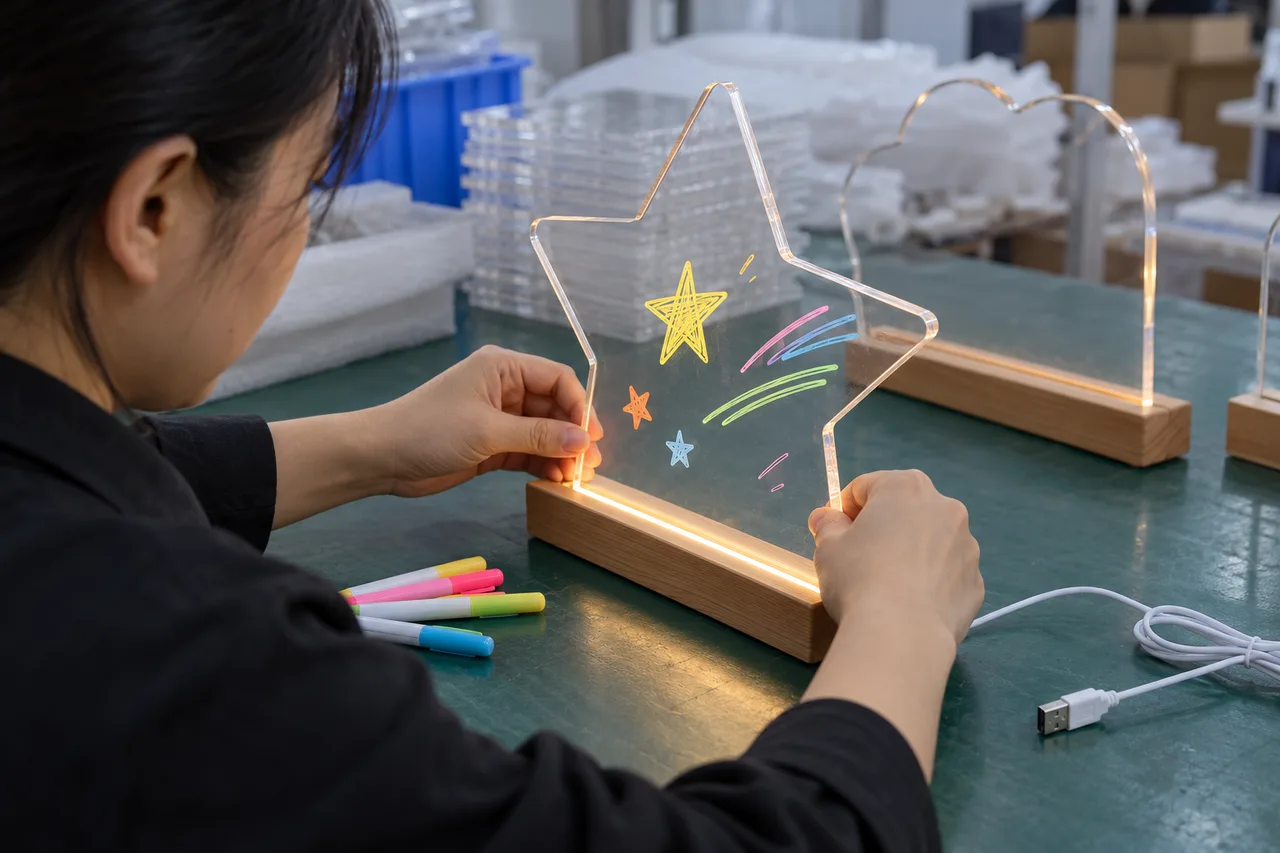
- Illustrative AI-generated photograph: a sample reviewer inspects how the acrylic panel meets the LED base.
- ALT text
- Close view of a clear acrylic drawing panel seated in an LED base
View AI image direction
Use case: photorealistic-natural. Asset type: editorial image for a LumDigi B2B LED drawing board article. Close documentary view of an adult Chinese sample-reviewer's hands positioning a clear star-shaped acrylic drawing panel in its slim LED base on a factory sample bench. Show realistic lower-edge contact, a few fluorescent marker strokes, a USB cable lying separately, and restrained light spill. Landscape 3:2, real acrylic textures, modest natural light, candid professional photography. If workers appear, they are Chinese/Asian adults. No invented logos, certification marks, readable documents, numerical test results, watermark, or text overlay. Show an illustrative procurement or sample-review scene, not proof of an actual test or shipment.
Turn the article into a practical sourcing brief
Use the checkpoints above to document the product, evidence, packaging, and approval decisions relevant to your market. A clear brief helps suppliers respond to the same commercial question and gives your team a traceable basis for the next step.
Useful external references
- ACRYLITE: light-guiding edge-lit sheet
Material manufacturer's explanation of a specific edge-lighting sheet; its performance is not a specification for LumDigi boards.
- ACRYLITE: edge-lighting technical information
Primary explanation of light guiding and scattering in acrylic grades.
LED Fluorescent Board vs LCD Writing Tablet: A B2B Product Comparison
Choose the format that matches your retail story by comparing how illuminated acrylic boards and LCD writing tablets are used, displayed, packed, and specified.
Read article
Which Specifications Matter Most When Choosing a LED Drawing Board?
A practical buyer guide to LED drawing board specifications decisions, with clear questions for product fit, specifications, proof, and everyday care.
Read article
LED Drawing Board Buyer Sample Matrix Guide
A B2B buying guide for importers, product developers, and private-label teams who need to create a sample matrix that ties each observed product variation to its evidence, purpose, and approval status.
Read article
Can Alcohol Clean an Acrylic LED Drawing Board? A Buyer Guide to Cleaner Approval and Crazing
A care-instruction and sample-review guide for importers investigating haze, fine cracks, and unsupported cleaning recommendations.
Read article