
Request a scoped assessment tied to the actual product
Ask a competent provider to identify applicable EMC requirements and any relevant ESD-immunity assessment for the offered board. Evidence should identify the product revision, operating configuration, method and evaluation criteria. A grounded workbench, wrist strap or normal power-on demonstration does not prove that a finished drawing board passed an ESD-immunity test.
1. Separate handling protection, normal function and immunity
Handling precautions aim to protect sensitive electronics during work, while a finished-product immunity assessment addresses a defined disturbance under a specified method. A routine function check answers another question. Ask which activity a supplier is describing before treating its evidence as proof of a purchasing requirement.
A factory photograph may show a neat mat, a wrist strap and a careful operator assembling an LED base. That image can illustrate an organized workspace, but it does not reveal whether a particular finished model was assessed for electrostatic-discharge immunity. Similarly, a board that lights normally during shipment inspection has demonstrated an observed function under those conditions, not every possible disturbance response. Classify evidence by the question it answers. This helps a buyer acknowledge useful production information without attaching a larger technical conclusion than the evidence supports.
The IEC 61000-4-2:2025 scope concerns equipment immunity to specified electrostatic-discharge situations and expressly distinguishes that subject from device sensitivity during handling and packaging. That distinction is central to the buyer's request. Do not ask the supplier to substitute an assembly-area photograph for the needed assessment, and do not reject a handling-control record because it was never intended to prove finished-unit immunity. Keep the records in different parts of the product file with clear labels and owners.
- Name the question each evidence item answers.
- Do not equate handling controls with a finished-unit test.
2. Identify applicable scope before requesting a test level
Have a competent technical provider determine which product and market requirements apply, and what role an ESD assessment has within them. A basic test-method reference does not by itself establish every product's required severity, pass criteria or complete conformity route.
A method number is not a complete product approval
The IEC publication provides a common method framework; its official scope does not prescribe the tests and severity for every apparatus. A buyer should therefore provide the intended market, product function, supplied configuration, intended environment and relevant retailer requirements before requesting a test plan. Ask the provider to identify the basis for its recommended scope. Do not choose a discharge number because another supplier printed it in a sales presentation. An impressive level without a relevant method, configuration and evaluation criterion can be commercially misleading.
The European Commission's EMC overview describes the framework's concern with emissions and immunity. It is context for a qualified applicability review, not a conclusion that one generic report satisfies every LED drawing board's EU obligations. Other product rules may also matter. Ask the responsible party to explain how the proposed assessment fits the complete product file. Keep engineering scope, market conformity and a buyer's additional commercial requirement separate so each can be reviewed on its own basis.
- Provide the actual market and product context.
- Ask for the basis of the chosen method and criteria.

3. Define the exact configuration to be assessed
Identify the board model, base and controller revision, supplied power arrangement, cables, accessories and operating states relevant to the assessment. The competent provider should determine the representative setup. A report becomes difficult to use when the buyer cannot connect its configuration to the goods being ordered.
Prepare a configuration sheet before the sample leaves the supplier. Record the product designation, available drawings or revisions, power ratings and offered modes. Identify whether the quoted version is USB powered, rechargeable or another confirmed option. List the actual supplied cable and any relevant source or adapter assumptions. Do not add an unconfirmed battery or accessory merely to make the configuration seem more complete. Ask which external items the assessment requires and who supplies them, then retain their identities with the sample record.
Include the panel and normal accessories where they are relevant to the offered finished product, while allowing the provider to determine the appropriate setup. If the model has several modes, ask how the plan selects operating states and what the conclusions cover. A supplier may offer a family of shaped panels with one base, but shared appearance or product naming does not automatically establish the same assessment scope. Have the responsible reviewer decide which variations are represented rather than extending evidence across the whole catalogue by assumption.
- Link sample identity to the purchase specification.
- Have relevant variants and modes assessed for scope.
4. Agree how behavior and recovery will be evaluated
A useful plan identifies what will be observed during and after the assessment and how those observations are judged. Let the competent provider select relevant evaluation criteria. Normal illumination, control response, retained state and other functions should be considered in the context of the actual product and applicable requirements.
Give the provider a plain description of intended operation: how the unit starts, selects modes and behaves during ordinary use. Identify any function the buyer considers essential and ask whether the proposed criteria address it appropriately. The plan should explain what records will be produced if the unit changes state, resets or needs intervention. Do not declare that every temporary change is acceptable or that any visible interruption proves a failure. Those conclusions depend on the chosen criteria, method and product context, not on a buyer's improvised rule.
Arrange responsibilities before testing: who supplies representative units, who confirms the configuration, who receives the report and who authorizes an engineering response if needed. Avoid asking factory staff to create unofficial discharge experiments for a video. Improvised sparks, uncontrolled handling or arbitrary equipment settings are not a substitute for a defined professional assessment and may damage evidence or create hazards. A carefully scoped plan gives purchasing a useful decision point without turning a request for information into an unreviewed workshop experiment.
- Define observation and evaluation responsibilities.
- Do not substitute improvised discharge demonstrations.
5. Review whether the report answers the purchasing question
Check identity, scope, method, configuration, conditions, observations and conclusions together. A pass word or certificate image is not enough. Ask a qualified reviewer to assess relevance and any limitations, including whether the report covers the actual offered revision and proposed market use.
Start by reconciling the report's sample identifiers and photographs with the product configuration sheet. Check the referenced method and edition, the setup description and the scope of the reported evaluation. Identify the provider and follow an appropriate verification process if authenticity matters. Keep any missing pages or unclear references as open questions. A buyer does not need to reinterpret technical waveforms independently, but should not discard the context needed by a competent reviewer. A complete report is more useful than an isolated screenshot of a favorable conclusion.
Read limitations before copying the outcome into sales copy. A report may cover particular modes, units, accessories or conditions. It might not establish every variant's conformity or the whole product's safety status. If evidence comes from a component supplier, ask whether and how it supports the finished assembly; do not assume equivalence. The supplier evidence-request guide can organize the request, while the specialist decides technical sufficiency. Record the reviewer's conclusion and outstanding conditions rather than marking the entire product file complete because one document arrived.
- Match identity and scope before using a result.
- Preserve limitations and technical-review decisions.
| Evidence item | Useful question | Unsupported shortcut |
|---|---|---|
| Assembly ESD controls | How are sensitive parts handled? | The finished board passed immunity testing |
| Routine function inspection | Does this unit perform the agreed observed functions? | It meets every EMC requirement |
| Scoped immunity report | What configuration and criteria were assessed? | Every similar-looking model is covered |
6. Investigate unexpected behavior without guessing a cause
If a sample behaves unexpectedly, record its state, setup and observed sequence and follow the appropriate support or technical-review process. A reset after handling does not, by itself, establish ESD as the cause. Preserve the unit and original evidence instead of repeatedly recreating an uncontrolled event.
Ask neutral questions: which model and revision, which approved power arrangement, which operating mode and what happened immediately before the change? Retain original photos or video and the operator's description. If there is damage or a potentially unsafe condition, follow the product's safety instructions and obtain appropriate assistance; do not continue operating the unit merely to gather more footage. Keep the support remedy separate from root-cause analysis. A replacement decision under a commercial policy does not automatically confirm a specific electrical mechanism.
A technical reviewer may need to distinguish power interruption, control operation, connection changes, software behavior and disturbance response. Provide facts rather than preselecting the cause in a complaint form. Avoid proposing an internal modification or a component substitution before the responsible engineering review. For a general support framework, use the after-sales triage guide. Its role is organizing information and escalation, not diagnosing a particular circuit from a message. Once the investigation has a supported conclusion, connect the corrective action to the actual configuration and verify its scope.
- Preserve the unit and original observation record.
- Separate a commercial remedy from a technical cause finding.
7. Keep evidence relevant through production and changes
Connect technical evidence to the released design and require notice of relevant changes. A new controller, enclosure arrangement, cable or source configuration may need review. Factory testing and shipment inspection should verify agreed production facts without claiming to reproduce a specialist immunity assessment unless that method is actually part of their scope.
Define a change-notification process for the offered electrical assembly and its supplied arrangement. Ask the responsible reviewer which proposed differences could affect existing evidence and what additional assessment is appropriate. Do not assume that an equal connector or identical outer base establishes an equivalent internal design. Record the reason a change is accepted and identify which documents and samples are superseded. The component change-control guide provides a broader purchasing framework; this article applies that discipline to the relevance of immunity-related evidence.
For pre-shipment work, give the inspector the released model and configuration references and the observable checks that belong to the plan. The inspector can reconcile supplied items and agreed functions, while specialist records retain their own technical purpose. If a retailer requires a specific document before release, make its review a separate approval gate. Keep confidentiality and document access controlled appropriately without hiding essential scope from the responsible buyer. This arrangement supports traceable purchasing and avoids a last-minute request to turn a routine inspection into a different kind of test.
- Review changes against the evidence scope.
- Keep routine inspection and specialist assessment distinct.
8. Conclusion: request evidence with an identifiable scope
A meaningful ESD-immunity request names the product, configuration, applicable assessment basis and decision it should support. Distinguish handling precautions from finished-unit evidence and normal function from disturbance response. Use qualified review for technical conclusions and keep unsupported universal pass claims out of the catalogue.
Before approving the file, ask whether another purchasing colleague could identify exactly what was assessed and why it matters to this order. They should be able to find the sample designation, setup, report, review conclusion and any remaining conditions. If the only evidence is a factory photograph or a normal power-on clip, label it accurately and request what is missing. If the report is relevant but limited, retain that limit rather than expanding it to every shape, power option and future revision. Clear boundaries make the evidence more useful, not less.
Use a model such as the Cat LED Fluorescent Board to begin a specific configuration discussion with LumDigi. Confirm the current offered version and destination requirements before requesting technical documents. The Why Us page introduces the quality approach, while the actual assessment file should identify the product and claim under review. A focused request lets the supplier and competent provider respond to the same question, creating a clearer path from sample evaluation to a documented bulk-order decision.
- Request evidence for a named decision and revision.
- Approve only claims supported by the reviewed scope.
Frequently asked questions
Does a factory wrist strap prove a board passed an ESD-immunity test?
No. A handling precaution and a finished-product immunity assessment have different purposes. A workspace image may illustrate production practice, but it does not identify a finished model's test setup, evaluation criteria or outcome. Request evidence appropriate to the purchasing requirement.
Is IEC 61000-4-2 a complete product certification?
It is a test-method publication with a defined scope, not a universal product approval certificate. A competent provider should identify applicable requirements, relevant methods and criteria for the actual product and market. One method reference does not settle the whole conformity file.
Can one report cover every shape and power option?
Do not assume so. Ask the responsible technical reviewer which variations are represented and what differences affect relevance. Evidence should be connected to actual product and configuration references, with any limitations retained in the buyer's approval record.
Does passing a routine lighting check prove EMC conformity?
No. A normal function observation is useful within its own scope, but does not establish all emissions and immunity requirements. Ask a competent reviewer what assessment and documentation are applicable. Keep the routine inspection record separate from specialist technical evidence.
Image planning for this topic
These notes document the role and intended context of the two visuals used in this guide.
Prepare an immunity-evidence request
- Placement
- hero
- Caption
- Illustrative AI-generated photograph: a buyer and engineer identify the proposed electrical configuration.
- ALT text
- Asian buyer and Chinese engineer reviewing an LED board configuration before technical assessment
View AI image direction
Use case: photorealistic-natural. Asset type: editorial photograph for a LumDigi B2B LED acrylic drawing board buying guide. A Chinese adult engineer and an Asian importer sit at a clean technical meeting bench reviewing a clear cat-shaped LED acrylic drawing board, supplied USB cable and plain blank configuration sheet. Modest real electronics workspace. No certificates, sparks, test numbers or pass stamps. Landscape 3:2, real acrylic material texture and believable human anatomy, candid authentic commercial photography rather than a glossy AI render. Any employees are Chinese/Asian adults. No invented logos, watermarks, readable certificates, text overlays or numerical test results. This is an illustrative planning scene, not proof of an actual LumDigi test or customer project.
Distinguish handling control from immunity testing
- Placement
- after-second-section
- Caption
- Illustrative AI-generated photograph: a technician handles an unpowered LED base on an organized bench.
- ALT text
- Chinese technician handling an unpowered LED drawing board base on an ESD workbench
View AI image direction
Use case: photorealistic-natural. Asset type: editorial photograph for a LumDigi B2B LED acrylic drawing board buying guide. A Chinese adult electronics technician at an organized grounded workbench gently handles an unpowered enclosed LED board base beside a clear acrylic panel and supplied cable. Neat ESD mat and properly fitted wrist strap, ordinary tools in background. No sparks, exposed live mains or test gun firing. Landscape 3:2, real acrylic material texture and believable human anatomy, candid authentic commercial photography rather than a glossy AI render. Any employees are Chinese/Asian adults. No invented logos, watermarks, readable certificates, text overlays or numerical test results. This is an illustrative planning scene, not proof of an actual LumDigi test or customer project.
Turn the article into a practical sourcing brief
Use the checkpoints above to document the product, evidence, packaging, and approval decisions relevant to your market. A clear brief helps suppliers respond to the same commercial question and gives your team a traceable basis for the next step.
Useful external references
- IEC 61000-4-2:2025
Official scope of the electrostatic-discharge immunity test-method publication, including its distinction from component handling sensitivity.
- European Commission: EMC Directive
Official context on electromagnetic emissions, immunity and the purpose of the EU EMC framework; applicability requires product-specific review.

IEC 62115 vs IEC 60598: Is an LED Acrylic Board a Toy, a Luminaire, or Another Product?
A classification brief for buyers who encounter both toy and lighting standards in supplier documents for superficially similar LED acrylic products.
Read article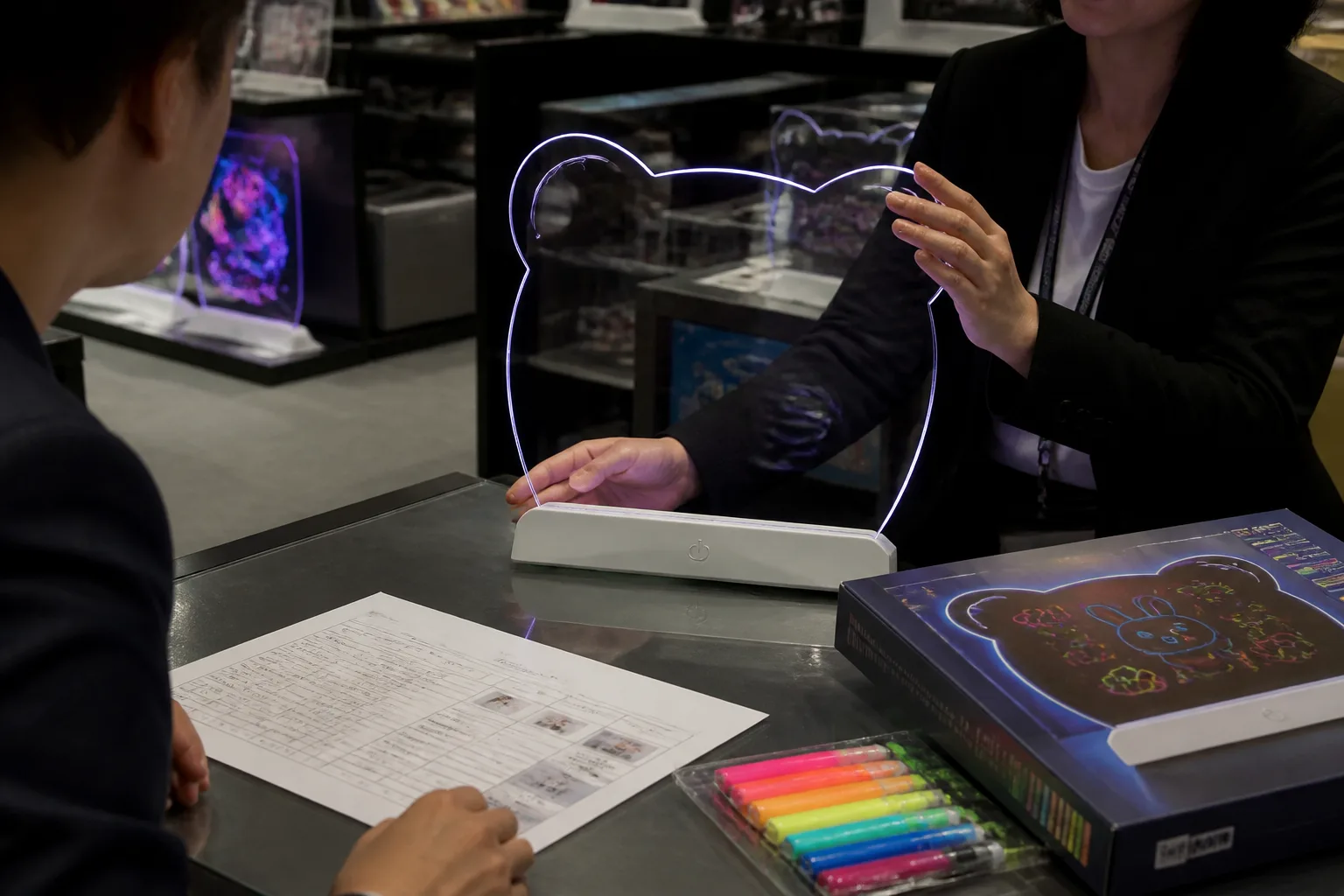
LED Drawing Board Supplier Evidence Request Guide
A practical B2B guide for importers and sourcing managers who need to request configuration-specific product, packaging and production evidence from a supplier.
Read article
LED Drawing Board Component Change Control Guide for Private-Label Importers
A practical B2B guide for private-label importers, procurement managers, distributors, and quality teams who need to use a controlled change record to determine whether a proposed component difference affects the agreed product, evidence, packaging, customer information, or next approval step.
Read article
Can Alcohol Clean an Acrylic LED Drawing Board? A Buyer Guide to Cleaner Approval and Crazing
A care-instruction and sample-review guide for importers investigating haze, fine cracks, and unsupported cleaning recommendations.
Read article