Ask what quantity was measured and how
Electrical watts describe power, illuminance describes light arriving at a surface, and luminance describes light in a viewing direction from an area. They are not interchangeable. Compare drawing boards using the same identified model, mode, power supply, ambient light, measurement geometry, and stated quantity; a photo alone provides no calibrated brightness result.
1. Identify the quantity behind a brightness number
Before comparing figures, ask whether the number is electrical power, luminous flux, illuminance, luminance, or a qualitative observation. A unit without a defined quantity and setup is incomplete procurement information.
Photometry describes visible light using several related but different quantities. The CIE photometry reference provides the definitions and conventions. In a purchasing discussion, the practical consequence is simple: a number measured at a desk cannot automatically describe the apparent brightness of a marker line on a transparent panel. Ask the supplier to name the quantity, unit, instrument, measured area, and operating conditions before placing the number in a comparison table.
Do not make a unit conversion unless the necessary physical information is available. A lux value cannot be turned into a reliable luminance value by changing the label, and an electrical input rating cannot be relabeled as optical output. Keep qualitative descriptions such as bright, soft, or vivid in a separate field from measured data. They may help describe a sample impression, but they need context and do not create a calibrated product specification.
An illustrative supplier comparison might contain a power rating from one candidate and a lux reading from another. The buyer should leave those values in separate columns and request the missing measurement definitions. The table is not ready for a numerical ranking merely because both figures are available. This approach protects the comparison from a false precision that can otherwise make an unsupported purchase decision appear objective.
- Ask for quantity, unit, and method.
- Keep impressions distinct from measured results.
- Do not convert figures without a valid physical basis.
2. Use watts to understand input, not the visible result
Electrical watts indicate power under stated conditions. They do not directly tell the buyer how bright a board, marker stroke, or working area will appear.
Two products with similar power input can produce different visual results because of LED arrangement, optical coupling, panel geometry, driver behavior, materials, colors, and operating modes. Conversely, a product with a higher input does not necessarily provide a more useful drawing experience. Ask whether a wattage is a maximum nameplate rating, a measured value in one mode, or a supply capability. Those meanings belong in different fields of a specification.
A power test should identify the unit, input source, cable, selected mode, warm-up state if relevant, and measurement point. For USB products, a supply's rating describes what the source can provide under its conditions; it is not automatically the board's consumption. The buyer can request a suitable electrical review, but should avoid imposing a made-up efficiency figure when neither the optical output nor the actual input has been measured for the model.
Ask whether a power number refers to the base alone or the complete supplied arrangement. Cable losses, source behavior, and selected light mode can affect the electrical observation. The qualified provider should choose appropriate instruments and safe methods. Procurement can make the request reproducible by identifying the tested configuration, but should not improvise electrical connections or convert a supply's capacity into a claim about board consumption.
- Distinguish supply rating from measured board input.
- Record mode and power arrangement.
- Evaluate useful visual output separately from electrical power.
3. Interpret a lux reading as light arriving at a plane
Illuminance describes light incident on a surface. A lux measurement needs a defined plane, position, orientation, and ambient-light condition to be meaningful.
Lux measurements need a location and a purpose
A meter laid on a desk beside the board can be influenced by room lighting, the meter's angle, reflections, and distance from the LEDs. That result may describe the application environment or a specific incident-light test, but it does not directly establish the luminance of the acrylic face. Ask what surface the measurement represents and whether the board's own light was isolated from ambient illumination. A reported value without geometry is difficult to reproduce.
Illuminance can still be useful when evaluating a classroom or retail display setup. The buyer may record the ambient condition so samples are viewed consistently. Treat that as application context rather than a ranking of board performance. If the intended task involves paper, the relevant illuminated surface may differ from a transparent marker board's visible lines. Define the question first, then choose a method with a qualified measurement provider.
If ambient illuminance is recorded, photograph the sensor location and room setup. A change in ceiling lights, daylight, desk position, or sensor direction can make a later sample observation difficult to compare. Include the date and relevant conditions in the worksheet. This is especially useful when remote teams review samples in different offices and assume that their photographs represent the same viewing environment.
- Document the measurement plane and sensor orientation.
- Record ambient lighting and reflections.
- Explain what buyer decision the lux value supports.
4. Define luminance by area and viewing direction
Luminance concerns light associated with an area in a particular viewing direction. On a transparent board, marker strokes, blank acrylic, the base, and reflections can have very different appearances.
A buyer commissioning a luminance comparison should specify the region of interest. Is the measurement of a fluorescent stroke, an engraved feature, a diffuse panel area, or the LED base? The answer changes what the number means. A small bright line cannot be used to represent the whole writing surface without explanation. Record the viewing direction, distance where relevant to the instrument, measurement field, marker pattern, and the state of the background behind the clear panel.
Color mode also matters. A red, blue, green, or changing-light mode may produce a different measured and perceived result. If the product is compared in several modes, keep their results separate rather than quoting the largest value as a universal specification. A technically useful report can state its scope plainly and include photographs of the setup without using the photo as the measurement itself.
A transparent panel's blank area can reveal a background rather than an emitting surface. Tell the measurement provider whether the question concerns that area, a marker stroke, or a fixed engraved feature. A sampling spot that includes several regions may produce a result that answers none of the buyer's intended questions well. Ask the provider to document its measurement field and the reasoning for selecting it.
- Name the measured region and viewing direction.
- Use a repeatable marker pattern or surface state.
- Report separate modes rather than one unexplained maximum.
5. Build a repeatable comparative sample setup
For a buyer's comparative review, keep sample identity, marker pattern, room, background, power, orientation, viewing position, and observation sequence consistent. The goal is a repeatable purchasing comparison within a defined scope.
Prepare an application sheet before samples arrive. List the model and revision, acrylic shape, base, input source, cable, control mode, marker formulation, drawing pattern, background, and room-light setting. Use the same sequence for every sample, and record changes. If the test is a buyer observation rather than a calibrated laboratory procedure, label it that way. Honest scope makes the findings more useful than an unsupported pass or fail label.
Include a normal-use view and a more controlled view where appropriate. A retail buyer may need to know how the product looks on an ordinary shelf, while a technical reviewer may need to reduce reflections for a specific optical question. Keep those two tasks separate in the file. The sample evaluation guide supports the broader review, and the present setup adds the optical variables that generic sample comparisons can miss.
Use a simple model reference such as the Star LED Fluorescent Board when discussing a sample, and confirm its actual offered base and modes. Record any sample-to-sample differences before interpreting optical observations. A controlled sample name prevents a discussion about the brightest photographed variant from being applied to a different shape, panel size, or LED assembly in the eventual purchase order.
- Use one written comparison sequence.
- Record changes in conditions or components.
- Label buyer observations and calibrated measurements accurately.
6. Review photographs without treating them as a meter
Exposure, camera processing, white balance, background, and editing can change apparent glow. Product photos help identify the model and use context; they do not independently substantiate a brightness number.
A dark room and a long exposure can make faint light look intense, while daylight can make the same board appear restrained. Ask for images that include the surroundings and an unedited operating video with the complete setup visible. For side-by-side images, request consistent camera and room conditions. Do not infer eye comfort, reduced fatigue, educational benefit, or optical safety from a visually pleasing photograph; each such claim needs appropriate evidence of its own.
Marketing teams should receive the approved lighting description, product mode, and limitations along with the images. Avoid adding a brightness percentage or a comparative claim merely because one image looks more saturated. If postproduction changes the visible color or glow substantially, review whether the image still represents the product fairly. A useful photo library includes lit and unlit states and clearly identifies illustrative scenes that do not show a production sample.
For marketing images, retain an original camera file or documented source where practical. A later crop or retouch can remove the context that made a comparison meaningful. Ask the content team to preserve the selected mode and avoid adding glow that customers would not see under the stated conditions. Technical substantiation should remain in its own report rather than depending on image appearance.
- Request complete setup views and consistent exposure.
- Do not infer health or safety claims from imagery.
- Keep image processing separate from technical performance evidence.
7. Request a report that can support the intended claim
A procurement report should connect the quantity, method, sample, instrument, operating conditions, results, and limitations to the claim the buyer intends to make.
Tell the provider what decision the report should support: comparing two supplied models, describing an operating mode, or substantiating a defined specification. Ask the provider to choose an appropriate method and explain uncertainty or limitations. Record the sample's source and configuration and preserve the raw results where supplied. A report title or instrument photograph alone does not establish that a particular marketing claim is supported.
Factory testing may provide useful production checks once a method and acceptance criteria are agreed. Shipment inspection may confirm model identity, selected modes, and defined visible operation. These records should not be presented as independent optical certification. Review the proposed consumer wording through the claims evidence process, and keep any comparison limited to the conditions and products that were actually evaluated.
The buyer can add an evidence-status field to the product sheet: measured under a named method, manufacturer rating, buyer observation, or unknown. This labels the basis without implying that every field needs an independent laboratory test. When a retailer requests a specific value, the responsible product team can see immediately whether the existing record answers that exact request or additional work is needed.
- Define the claim before commissioning the measurement.
- Record sample, setup, method, result, and limitations.
- Approve wording only within the evidence's scope.
| Field | What to ask |
|---|---|
| Quantity | Which physical quantity and unit? |
| Geometry | Which area, direction, plane, and distance? |
| Operation | Which mode, supply, cable, and surface state? |
| Evidence | Which sample, method, instrument, and limitations? |
8. Conclusion: compare a defined optical question
Use watts for electrical input, lux for incident light on a defined plane, and luminance for light associated with an area and view. A useful specification names the quantity and records the setup.
A disciplined brightness brief can prevent a purchasing team from comparing unrelated numbers. It also allows the supplier to answer honestly when a measurement is unavailable. Keep missing data visible and choose the next practical step: a documented buyer application review, a better operating video, or a qualified measurement. An unanswered field is preferable to an impressive value that describes a different quantity, mode, or product.
For a LumDigi enquiry, identify the shape and base, intended room or display, power arrangement, marker pattern, and the brightness question you need to resolve. LumDigi can confirm available model information and discuss a sample review. Request any required measured specification explicitly; do not assume a catalogue image or this technical guide supplies product-specific photometric data.
At reorder, a new LED source, driver, panel geometry, ink, or light mode may change the relevance of a previous observation. Ask engineering which evidence should be reviewed and record the outcome. A comparable-looking unit is not automatically optically identical. Keeping the change note alongside the original setup record makes it easier to choose a proportionate next check without inventing a new universal brightness target.
- Choose the physical quantity that answers the task.
- Preserve conditions and sample identity.
- Keep performance wording consistent with verified evidence.
Frequently asked questions
Are nits and lux interchangeable for a drawing board?
No. A nit is commonly used for candela per square metre, a luminance unit, while lux is an illuminance unit. They describe different quantities. A valid relationship requires a defined optical situation and cannot be assumed from an isolated supplier number or product photograph.
Does higher wattage mean a better LED drawing board?
Not necessarily. Input power does not alone establish the useful visual output, drawing experience, or efficiency. Compare the intended task and optical behavior under consistent conditions, and confirm whether a wattage is a measured consumption value, a product rating, or the capability of a separate supply.
Can a factory video prove a brightness specification?
A video can document model, controls, and apparent behavior under visible conditions, but exposure and processing influence appearance. It does not replace a suitable measurement when a numerical claim is required. Ask for the quantity, method, geometry, sample, power setup, and limitations.
Image planning for this topic
These notes document the role and intended context of the two visuals used in this guide.
Show recorded viewing conditions
- Placement
- hero
- Caption
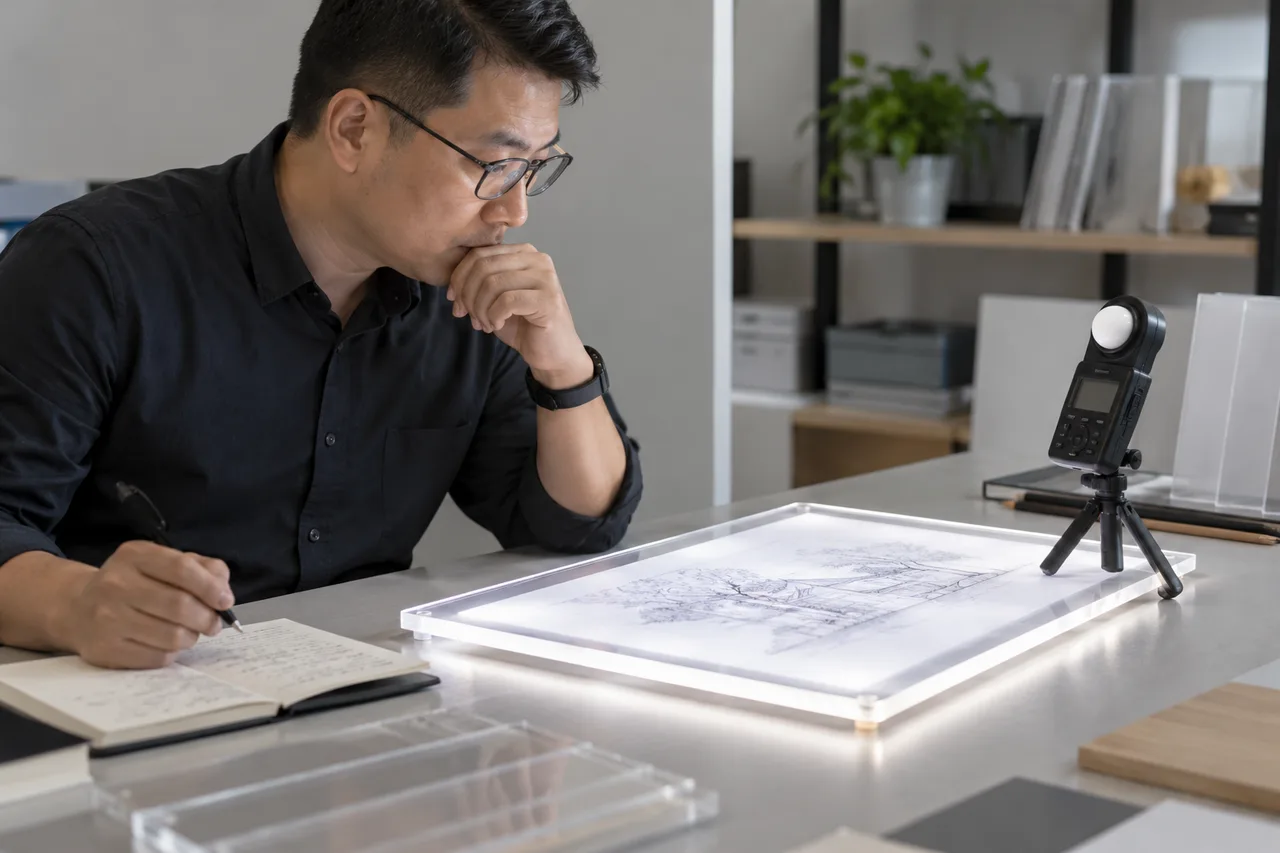
- Illustrative AI-generated photograph: a sample reviewer compares a lit acrylic board under controlled desk lighting.
- ALT text
- Chinese reviewer comparing an illuminated acrylic drawing board under a desk light
View AI image direction
Use case: photorealistic-natural. Asset type: editorial image for a LumDigi B2B LED drawing board article. An adult Chinese product reviewer studies a glowing clear acrylic drawing board on a neutral bench, with a small professional light meter facing the work area and a notebook whose writing is unreadable. Show ordinary controlled office illumination and no visible numerical meter result. Landscape 3:2, real acrylic textures, modest natural light, candid professional photography. If workers appear, they are Chinese/Asian adults. No invented logos, certification marks, readable documents, numerical test results, watermark, or text overlay. Show an illustrative procurement or sample-review scene, not proof of an actual test or shipment.
Show a photometric setup concept
- Placement
- after-second-section
- Caption
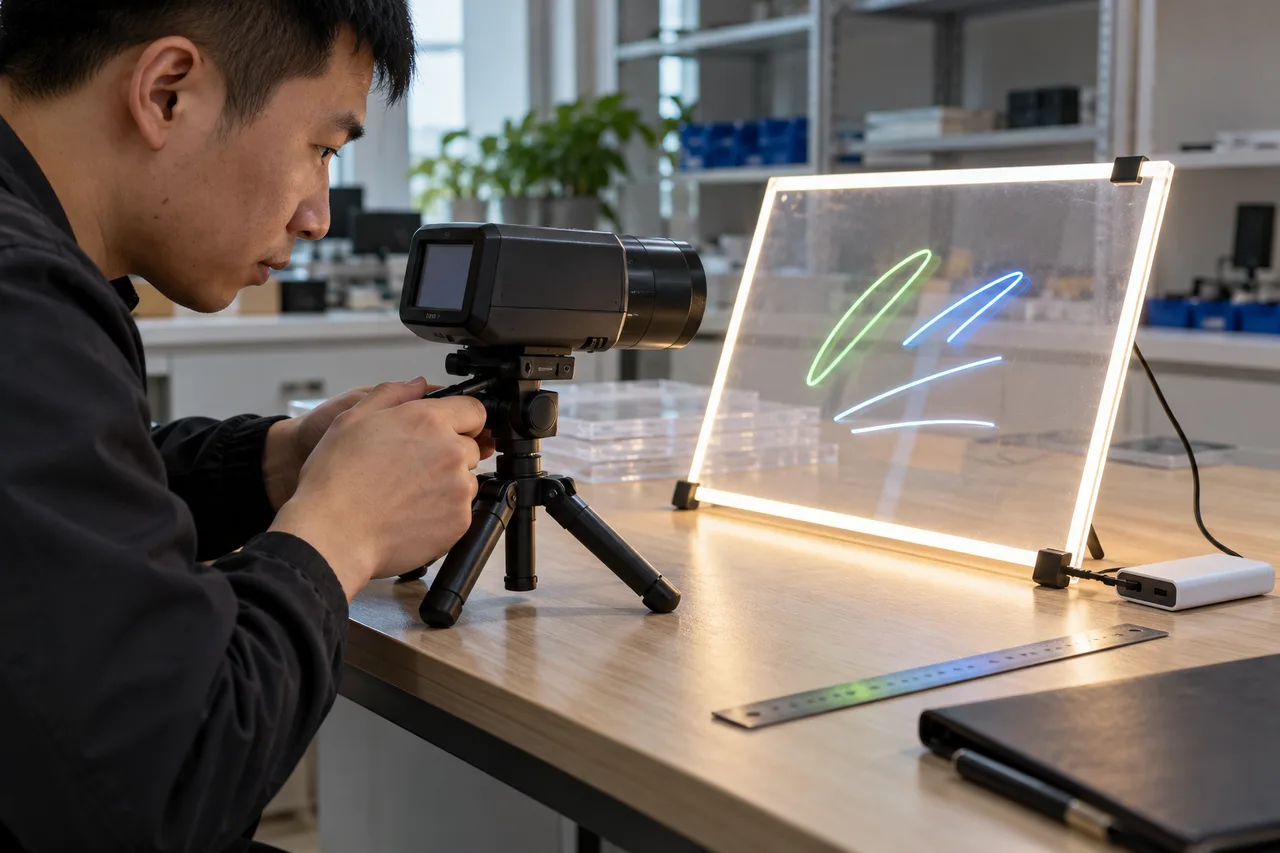
- Illustrative AI-generated photograph: instrument position and the board’s operating setup are prepared before a comparative review.
- ALT text
- Light-measurement instrument positioned beside a lit acrylic LED drawing board
View AI image direction
Use case: photorealistic-natural. Asset type: editorial image for a LumDigi B2B LED drawing board article. Close documentary photograph of a professional photometric instrument mounted on a small tripod and aimed at a simple transparent LED acrylic drawing board with sparse fluorescent strokes. A separate USB supply and ruler are on the bench, all scales unreadable. No suggestion of a certified result. Landscape 3:2, real acrylic textures, modest natural light, candid professional photography. If workers appear, they are Chinese/Asian adults. No invented logos, certification marks, readable documents, numerical test results, watermark, or text overlay. Show an illustrative procurement or sample-review scene, not proof of an actual test or shipment.
Turn the article into a practical sourcing brief
Use the checkpoints above to document the product, evidence, packaging, and approval decisions relevant to your market. A clear brief helps suppliers respond to the same commercial question and gives your team a traceable basis for the next step.
Useful external references
- CIE: The Basis of Physical Photometry
Authoritative definitions and principles for photometric quantities and units.
- CIE International Lighting Vocabulary
CIE vocabulary illustrating the distinction between luminance and illuminance quantities.
LED Drawing Board Brightness and Light Effects Guide for Product Buyers
A practical B2B guide for product developers and retailers who need to evaluate brightness and light-effect requirements against the exact sample and intended product application.
Read article
How to Substantiate LED Drawing Board Claims Before Publishing a Listing
A B2B buying guide for ecommerce sellers, brand managers, importers, and retailer content teams who need to classify each express or implied claim, identify the evidence and scope that support it, and remove or qualify unsupported wording before publishing.
Read article
How to Build a LED Drawing Board Product Specification Sheet
A practical B2B guide for B2B teams aligning suppliers, quality reviewers, packaging teams, and sales channels who need to create one readable source of truth for the exact board configuration, set contents, packaging, and verification requirements.
Read article
Can Alcohol Clean an Acrylic LED Drawing Board? A Buyer Guide to Cleaner Approval and Crazing
A care-instruction and sample-review guide for importers investigating haze, fine cracks, and unsupported cleaning recommendations.
Read article