Describe the colour task before choosing a number
For white-light operation, identify the intended white appearance and request appropriate colour evidence when needed. For RGB operation, define the actual modes and user controls. CCT, colour rendering and the visible colour of marker strokes are not interchangeable, so approve the complete board and accessories under recorded viewing conditions.
1. Separate white appearance, rendering and coloured effects
A colour brief should state whether the buyer wants a white light appearance, accurate appearance of illuminated objects, decorative coloured modes or a particular marker effect. These are different tasks. One number cannot describe all of them or approve the complete product.
An importer might request warm white because a lifestyle retailer wants a gentle-looking display. Another buyer might ask for RGB because the product must offer selectable decorative effects. A third may want a particular fluorescent marker colour to remain recognizable in product photography. Ask each team to describe the intended viewing task before specifying a technical metric. Write separate requirements for the light source, the drawing panel, the supplied marker set and the customer-facing mode controls. This keeps a retailer's visual preference from being confused with a laboratory performance statement.
Use the colour-temperature terminology note as a reference when discussing white-light terms. Its scope is not a promise about any drawing board. For LumDigi, begin with the offered model and ask which lighting options actually apply. A catalogue photograph may combine room lighting, camera processing and coloured ink. It cannot establish which LED channels are present or whether a named white setting is generated by a dedicated white source or a mixture of channels.
- Name the viewing task and lighting mode.
- Record the board and accessory configuration.
2. When is correlated colour temperature useful?
CCT is a way of describing suitable light-source colour relative to a reference temperature concept; it is not a universal label for every saturated colour. Ask a competent provider whether the metric applies to the actual mode before putting a Kelvin value into a purchase specification.
A Kelvin value does not replace a complete colour requirement
For a white-light option, a purchasing team can identify its intended warm, neutral or cool direction and ask the supplier how that direction is documented. Do not choose an exact numerical target from a photograph and then assume the available model meets it. If matching between production lots matters, agree an appropriate measured specification and sample approval process with the technical provider. The specification should identify the operating mode, power conditions, measurement method and the part of the assembly being assessed, rather than presenting a bare temperature number without context.
The CIE terminology note explains that temperature attribution has limits as a source departs from the relevant reference behaviour. This is why saturated red, green or blue modes should not simply be called different white-light temperatures. For those modes, describe the selected state and obtain suitable colour characterization if required. A buyer does not need to become a colour scientist to write an accurate brief: identify the purpose, request the supplier's evidence and avoid applying a familiar metric outside its appropriate scope.
- Use CCT only where it is technically appropriate.
- Define measurement conditions for numerical claims.
3. What can CRI or colour-fidelity information establish?
Colour-rendering metrics concern how a light source affects the appearance of test colours under specified methods. They are not measurements of acrylic edge glow, marker brightness, mode count or customer preference. Ask why a rendering metric is needed for this product before requesting a headline score.
The CIE's 2025 colour-quality statement recommends moving toward its general colour-fidelity index while reporting it alongside the established general rendering index during transition. That is a specific technical context for white-light characterization, not a reason to invent a score for a decorative board. If a buyer wants a numerical claim, request evidence for the actual light source and method. Do not copy a component's value onto a finished product without reviewing whether that attribution is valid.
Consider the task realistically. A shaped drawing board is generally being selected for its reusable panel and illuminated strokes, not necessarily as a general-purpose light for evaluating fabrics or artwork. If accurate external-object rendering is essential, ask whether the offered product is intended and documented for that role. Keep decorative appearance approval separate from a task-lighting requirement. A visually pleasing sample can support an aesthetic decision while leaving numerical rendering claims unconfirmed. This distinction makes the product page more useful and the quotation more honest.
- Ask what the rendering claim is meant to prove.
- Do not equate a rendering index with glow intensity.
4. Specify RGB operation as a user sequence
For a coloured-mode product, state the available choices, how they are selected and what the user sees after each action. Confirm whether modes are static or changing and what happens after power interruption. Do not infer the control sequence or available colours from the phrase RGB alone.
Ask for a short, continuous operating video showing the entire product and its controls. The operator should begin from the documented starting state, select each offered mode and identify whether the product remains in that state. If brightness control is available, ask whether it is separate from colour selection and whether it operates in every mode. Note any memory behaviour only if the supplier confirms it for the selected revision. These observations support an accurate feature description without assuming that every model shares the same circuit or controls.
Create an illustrative mode list using the supplier's actual names rather than promising a marketing number of colours. Distinguish selectable static states from combinations seen during an automatic transition. If the buyer needs a fixed brand-colour effect, ask whether that requirement is technically and commercially available, and request a physical sample. A screen-based brand colour or print reference is not automatically an achievable emitted-light specification. The custom design page can start that discussion, while the model-specific response establishes what can actually be offered.
- Document selection, persistence and reset behaviour.
- Confirm optional controls for the quoted revision.
5. Compare complete samples under controlled conditions
Approve white and coloured effects using the same panel, artwork, marker pattern, background, room light and power arrangement where possible. Record the conditions so differences can be interpreted. A preference made under one setup should not become an unconditional promise for every room or camera.
Prepare a simple comparison pattern containing the proposed marker colours and leave part of the panel blank. Observe the light source, panel edge and written strokes separately. Change one variable at a time when investigating an unexpected appearance. If a marker looks different, check that the pen formulation and colour identity are the same before attributing the difference to the LED. If a decorative shape directs light differently, record the geometry. A controlled application review should identify what was compared instead of declaring that one board has universally better colour.
Request permission before treating a sample as a retained production reference. Store its model code, lighting state, artwork and accessory references with the approval record. Samples can be damaged or altered during repeated use, so identify their condition when a later comparison is made. If numerical production matching is required, agree suitable measured controls rather than relying only on an aging visual reference. This allows purchasing to make a practical aesthetic choice while the technical team defines any measurement and acceptance method needed for repeat orders.
- Use the same marker pattern and viewing setup.
- Separate visual preference from a measured tolerance.
| Buyer question | Useful evidence | What it does not establish |
|---|---|---|
| Is the white appearance suitable? | Identified sample under recorded conditions | A numerical CCT tolerance |
| Does the control sequence fit the offer? | Continuous operating demonstration | All RGB boards behave identically |
| Are strokes visible as intended? | Actual panel and marker activity | Universal marker compatibility |
6. Keep photographs and colour claims in their proper roles
A photograph demonstrates a product presentation, not a calibrated measurement of its spectrum or colour quality. Control capture and editing for honest communication, retain representative assets and state what the image shows. Avoid claiming that a customer's display will reproduce the sample exactly.
Ask the photographer to retain a neutral reference, record the selected lighting mode and identify changes made during editing. Automatic white balance can make different white sources appear more similar, while exposure and saturation adjustments can exaggerate coloured strokes. A buyer should review the actual sample alongside the proposed marketing image and look for misleading changes. Do not digitally add a mode, intensify an edge effect beyond a reasonable representation or replace an unconfirmed marker assortment with a more attractive set in the hero photograph.
The brightness and effects guide can support general feature selection, while this article helps define the colour evidence. Keep product titles specific: a confirmed warm-white option can be described as such, but high colour accuracy, eye protection or laboratory-grade colour claims require their own suitable substantiation. If a photograph is illustrative or AI-generated, identify it transparently. Product imagery should help a buyer ask a better question, not silently stand in for a measurement report.
- Record mode and capture conditions.
- Do not manufacture product capabilities through editing.
7. Control colour-related changes before the next shipment
Connect the approved lighting option to the relevant product revision and evidence. A change in LED source, driver, mode program, panel finish or marker set may require review. Factory testing and shipment inspection should verify the agreed configuration without overstating what a simple visual check proves.
Ask which colour-related components and settings are controlled in the supplier's production record and which changes require notice. The purchasing file should link any supplied measurement evidence to an identifiable configuration. A report for a different channel, source or operating condition may not answer the current question. Have the competent reviewer assess relevance instead of assuming that the presence of a familiar metric on a report makes it applicable. Where the product is supplied in several lighting versions, keep their references separate in purchase orders and retailer data.
An inspector can document the offered modes and compare observable appearance under agreed conditions. That observation is not automatically a spectral measurement or a full colour-consistency assessment. If a numerical check is required, specify appropriate equipment, method and responsible provider before inspection. Retain exception photos with the operating setup and sample identity. When a disagreement occurs, distinguish an incorrect mode, a configuration change, camera processing and an actual measured colour difference. Different causes call for different evidence and should not be grouped into one vague colour defect.
- Tie evidence to the actual lighting revision.
- Define visual and instrument-based checks separately.
8. Conclusion: write an accurate colour brief, then verify it
The strongest colour specification states the intended task, lighting modes, relevant evidence and approval conditions. Use white-light metrics where appropriate, describe RGB operation clearly and review the complete drawing system. Keep unsupported scores and universal appearance promises out of the launch copy.
A final review should let purchasing, quality and marketing give the same explanation of the selected product. They should know which white or coloured option is being ordered, what the user can select, which markers are included and which evidence supports any numerical statement. If one team calls the item a colour-accurate lamp while another calls it a decorative drawing board, resolve the mismatch before ordering. The product may suit one role without being documented for the other, and a narrower accurate offer is easier for overseas buyers to assess.
For an example direction, review the Star LED Fluorescent Board and ask LumDigi which light configuration, controls and supplied contents apply to its current quotation. Use the luminance, illuminance and watts guide for separate brightness questions. A clear colour brief helps the supplier answer precisely, reduces avoidable sample revisions and keeps the final product description tied to confirmed facts rather than an impressive-looking but irrelevant list of technical terms.
- Give each claimed metric a purpose and evidence source.
- Approve model-specific wording before publication.
Frequently asked questions
Does a high CRI value mean fluorescent drawings will glow more brightly?
No. A rendering index and the visible effect of marker strokes describe different things. Review the actual marker, panel, lighting mode and viewing conditions for the drawing task. Request appropriate measured evidence for any separate colour-rendering claim rather than treating it as a glow score.
Can saturated RGB modes be specified only by CCT?
CCT is not a general identifier for every saturated colour. State the actual mode or desired colour effect and ask a competent provider which characterization is suitable. Avoid attaching arbitrary Kelvin values to red, green or blue settings in a quotation.
Is a supplier video enough to approve colour matching?
A video can document controls and give useful context, but capture settings and viewing displays affect appearance. Use identified physical samples for visual approval. If a numerical matching requirement matters, agree a suitable measurement specification and evidence for the actual product configuration.
Can a buyer claim that all boards have the same white appearance?
Only within a defined and supported specification. Identify which models, revisions and operating conditions the statement covers. A single accepted sample does not establish unlimited consistency across different LED sources, panels, lots or lighting modes.
Image planning for this topic
These notes document the role and intended context of the two visuals used in this guide.
Compare actual colour modes
- Placement
- hero
- Caption
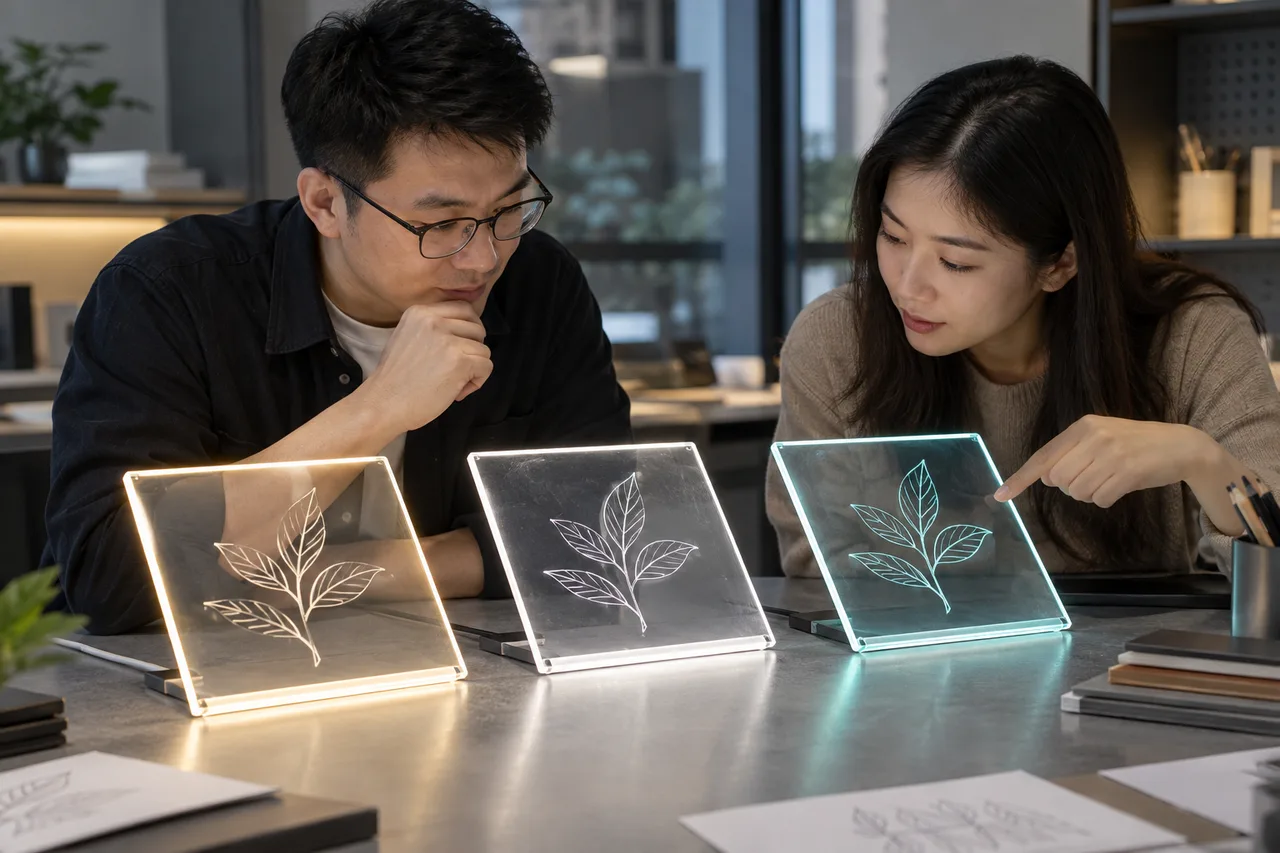
- Illustrative AI-generated photograph: sample boards are reviewed in white and restrained coloured modes.
- ALT text
- Asian buyers comparing white and colored edge lighting on acrylic drawing boards
View AI image direction
Use case: photorealistic-natural. Asset type: editorial photograph for a LumDigi B2B LED acrylic drawing board buying guide. Two Chinese adult buyers compare three small clear acrylic drawing boards on a grey tabletop, each with the same simple leaf line drawing, one warm white edge light, one neutral white, one subdued blue-green colored mode. Restrained plausible glow, real reflections, natural sample-room photography, no numerical colour claims. Landscape 3:2, real acrylic material texture and believable human anatomy, candid authentic commercial photography rather than a glossy AI render. Any employees are Chinese/Asian adults. No invented logos, watermarks, readable certificates, text overlays or numerical test results. This is an illustrative planning scene, not proof of an actual LumDigi test or customer project.
Separate appearance from measurement
- Placement
- after-second-section
- Caption
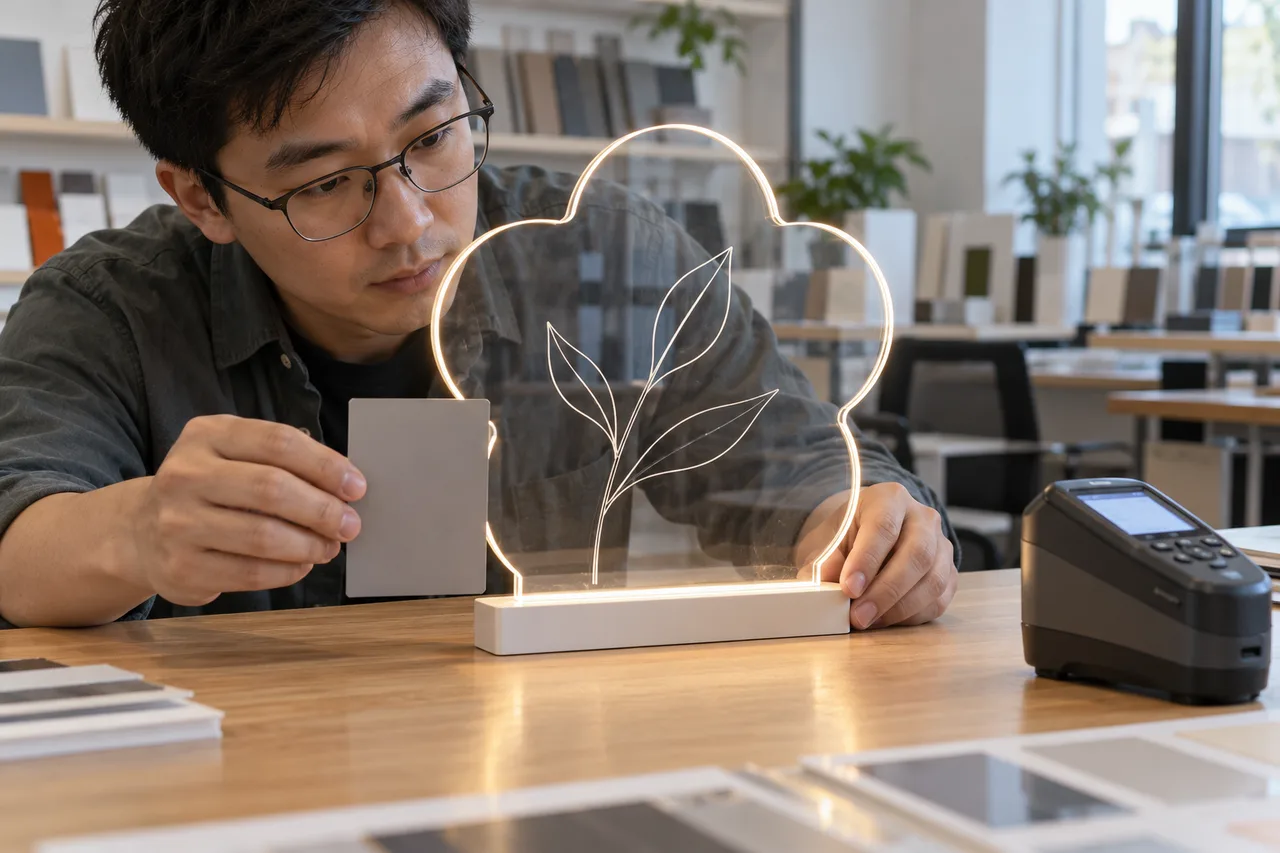
- Illustrative AI-generated photograph: a reviewer arranges a neutral reference beside a transparent flower-shaped board.
- ALT text
- Chinese sample reviewer with a neutral reference card beside a transparent flower LED drawing board
View AI image direction
Use case: photorealistic-natural. Asset type: illustrative editorial procurement photograph for a LumDigi LED acrylic drawing board colour-specification article. In a real sample room, a Chinese adult engineer arranges a small neutral grey reference card beside a VERTICAL TRANSPARENT CLEAR acrylic flower-shaped drawing panel standing in a narrow plain LED base, with a simple thin leaf marker drawing and modest warm-white edge illumination. The engineer and objects behind the panel are clearly visible THROUGH the acrylic face. An unbranded compact optical measuring instrument sits on the desk; its screen is unreadable. Documentary 3:2 landscape commercial photography, plausible hands, natural lighting and real reflections. This is NOT a lightbox, NOT an opaque glowing disk, NOT a flat tracing pad. No invented logos, certificates, readable numerical results, watermark or text overlay. An illustrative setup only, not proof of an actual test or product performance.
Turn the article into a practical sourcing brief
Use the checkpoints above to document the product, evidence, packaging, and approval decisions relevant to your market. A clear brief helps suppliers respond to the same commercial question and gives your team a traceable basis for the next step.
Useful external references
- CIE: terms related to Planckian radiation temperature
Technical note on colour-temperature terms and their applicability.
- CIE PS 002:2025 on colour quality metrics
Current CIE position on white-light colour-fidelity reporting and the distinction between metrics and overall preference.
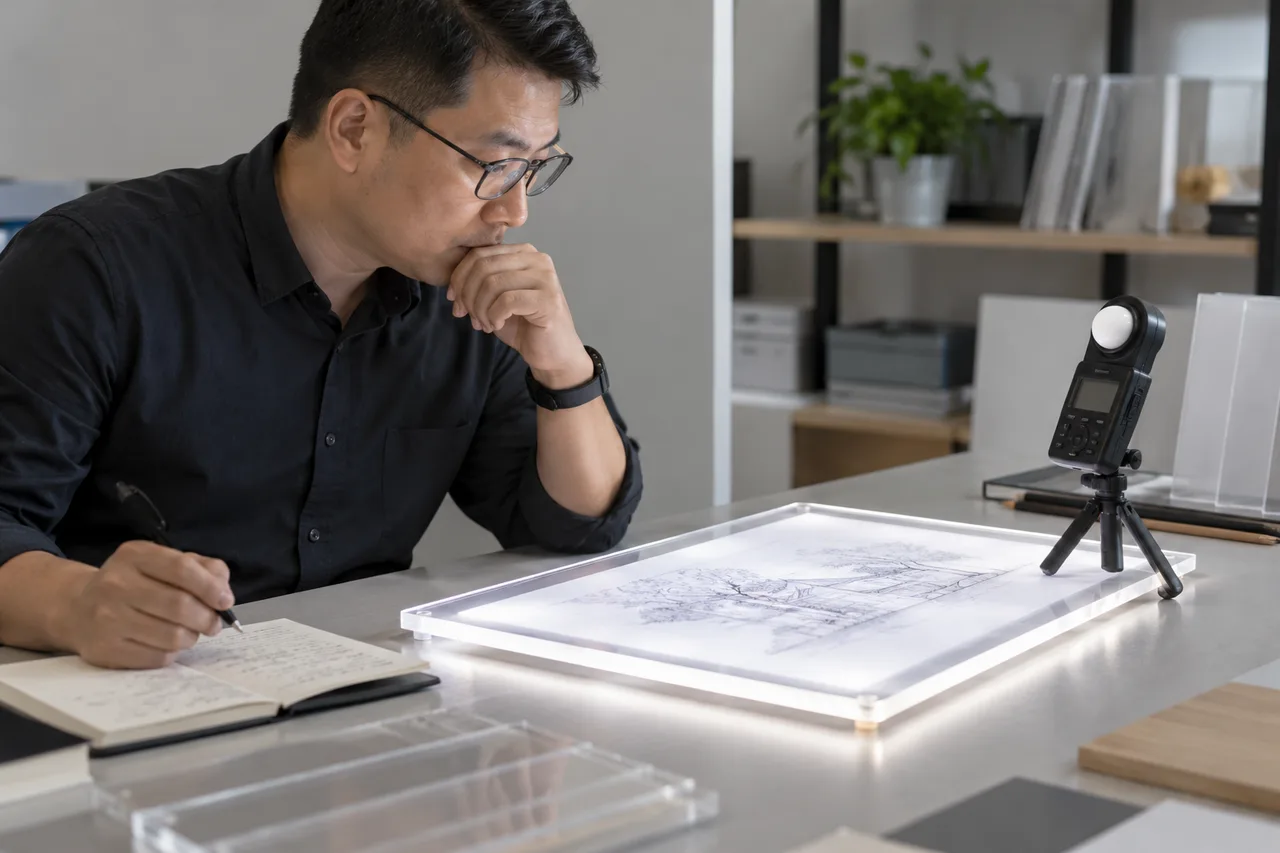
Luminance, Illuminance, and Watts: How Buyers Should Compare LED Drawing Board Brightness
A technical buying guide for teams that need comparable brightness evidence rather than photographs or unrelated electrical ratings.
Read article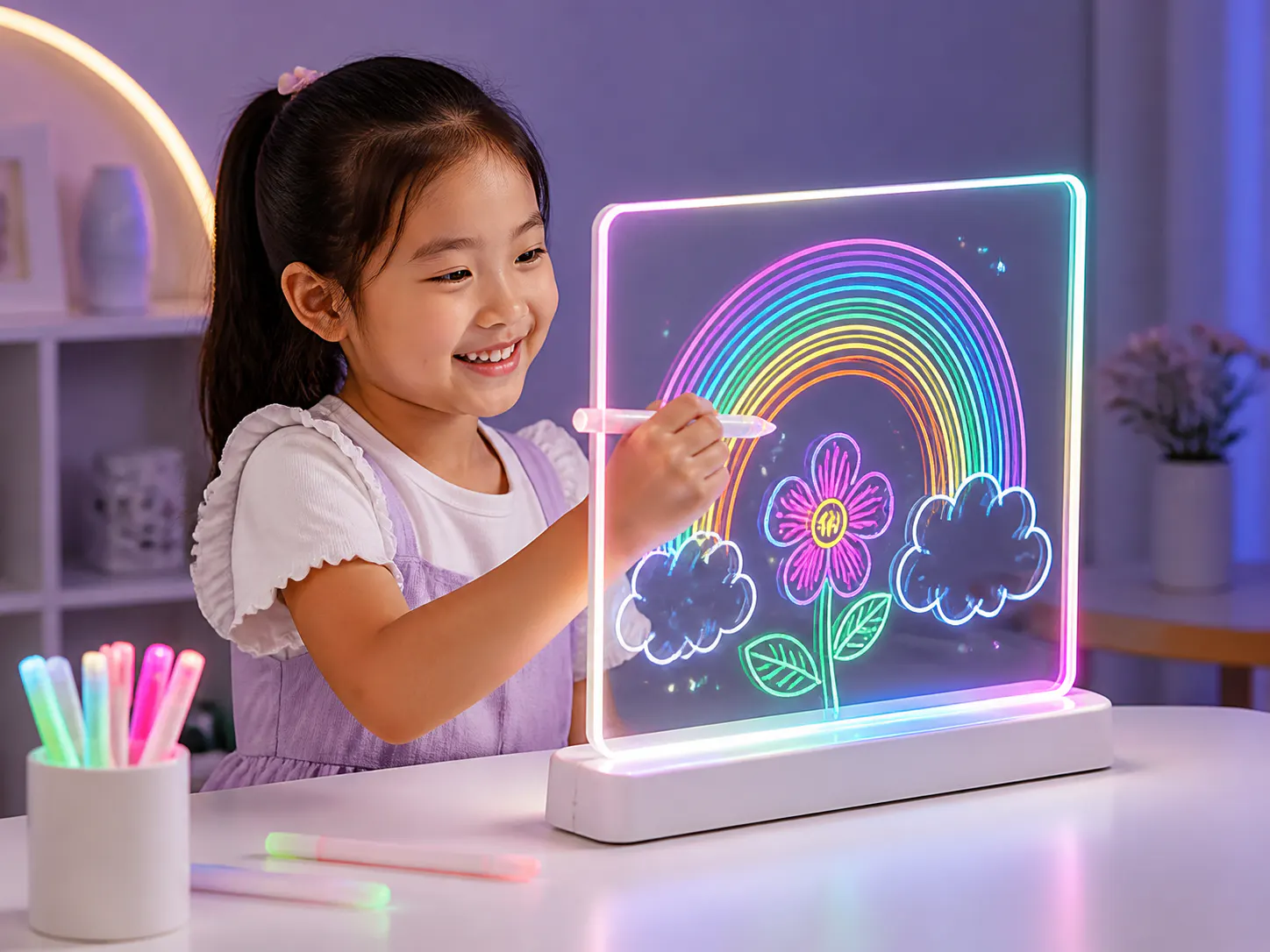
How Should I Set Brightness, Color, and Light Effects on a LED Drawing Board?
A practical buyer guide to LED drawing board brightness and colors decisions, with clear questions for product fit, specifications, proof, and everyday care.
Read article
LED Drawing Board Colour and Finish Approval Guide
A practical LumDigi guide for private-label buyers and product managers who need to approve colour and finish from a named physical configuration, sample record, image set, and packing proof.
Read article
Can Alcohol Clean an Acrylic LED Drawing Board? A Buyer Guide to Cleaner Approval and Crazing
A care-instruction and sample-review guide for importers investigating haze, fine cracks, and unsupported cleaning recommendations.
Read article