Confirm the supplied light source; do not infer UV from the product name
The term fluorescent drawing board does not establish that the product uses ultraviolet light. Identify the actual LED source and the supplied ink system, and review how the complete board produces its visible effect. Do not infer UV emission, its absence or photobiological safety from a glowing image, a colour name or a simple demonstration.
1. Separate the product name from its physical mechanism
Fluorescent can describe an ink or visual effect in a product name, while LED describes a light-source technology. Neither word alone identifies the emitted spectrum, ink chemistry or complete optical construction. Ask for a plain description of the actual supplied system before writing technical claims.
A buyer may see fluorescent drawing board, neon writing board and light-up acrylic board used for visually similar products. Treat those descriptions as starting points for clarification rather than controlled specifications. Ask what the user draws on, which pens are supplied, where the LEDs are located and which illumination modes the offered revision provides. Confirm whether an image shows a physical operating sample, a render or an AI illustration. A familiar marketing name should not silently add a UV lamp, a screen or a particular chemical formulation to the product.
For a LumDigi enquiry, identify the selected silhouette and requested activity. The product range gives a practical starting point, but the supplier's model-specific response should establish the contents and construction being quoted. If the buyer's own retail category uses a different term, keep the physical description consistent across the purchase order, insert and listing. That protects a distributor from receiving an accurate sample but translating its name into a stronger technical statement that was never confirmed.
- Ask what is supplied and how it operates.
- Keep category wording separate from technical evidence.
2. What does fluorescence mean in this discussion?
Fluorescence involves absorption and re-emission of light, but the relevant response depends on the material and incoming light. It is not a blanket statement that every fluorescent-looking product needs a UV lamp. Identify the actual ink and lighting combination instead of generalizing from a classroom demonstration.
A visual effect is not an analytical identification
The American Chemical Society's pigment history describes fluorescent pigments absorbing light and producing visible colour. This educational context helps explain why the word fluorescent is broader than a single lamp arrangement. It does not identify a LumDigi pen formulation or prove that every marker sold as neon behaves in the same way. Ask the pen supplier or finished-product manufacturer for the information relevant to the offered set, especially when a retailer wants a scientific explanation rather than a simple visual description.
Keep three observations distinct during a sample activity: the colour seen under room light, the effect seen when the board is illuminated and any persistence after the light is switched off. Record what actually happens without naming a chemical mechanism from appearance alone. A brightly coloured stroke can involve more than one optical contribution, and a photograph may emphasize some contributions over others. If a precise chemistry claim is important, request suitable technical information. Do not improvise a formulation, excitation wavelength or material identity to complete a catalogue paragraph.
- Use educational sources as context, not product certification.
- Record observations without inventing ink chemistry.
3. How is edge lighting different from an ink claim?
Edge lighting describes where light enters a panel and how the assembly presents it. Ink fluorescence describes a material response. The complete drawing effect can depend on the panel, surface features, marks, light source and surroundings, so neither description should be treated as a complete product specification.
The ACRYLITE edge-lit material page describes one manufacturer's engineered light-guiding grades. Its properties are not automatically the properties of every clear drawing panel. Ask the offered supplier to explain its actual layout in plain language and identify whether a particular material designation is confirmed. A diagram or sample view can help locate the light source and drawing face without claiming that the product uses a referenced brand, embedded optical features or uniform full-surface illumination.
During a demonstration, include a blank part of the panel and a simple marker pattern. Observe the base, perimeter and strokes separately with illumination on and off. Use the edge-lit-board versus tracing-lightbox guide when the intended drawing task is unclear. A clear marker panel should not be called a paper-tracing lightbox merely because LEDs are present. Likewise, a visible edge-light effect should not be described as a UV activation system unless the actual supplied construction supports that description.
- Identify the actual light path and drawing surface.
- Do not transfer material-maker properties to an unconfirmed board.
4. What should buyers ask about the light source?
Ask for the offered source configuration, operating modes and relevant spectral information when a spectrum-related claim matters. A colour setting, photograph or component nickname cannot establish the presence or absence of UV. Define the claim first, then ask a competent provider what evidence is appropriate.
A useful question is specific: does the quoted revision include a source intentionally designed to emit ultraviolet radiation, and what information supports the response? Keep that question separate from whether the visible mode looks blue, violet or white. If the buyer wants to advertise no UV, ask the responsible technical reviewer to define the wording, scope and evidence required for that claim. Do not convert a supplier's informal visible-light description into an absolute analytical statement about every possible emitted wavelength without reviewing its basis.
Request evidence that identifies the actual product or source, operating state and conditions relevant to the proposed statement. A component data sheet may provide useful information, but its relevance to the finished assembly needs review. If a report covers a different source or an older revision, ask whether it applies to the current offer. Retain the response with the model reference. This is more useful than demanding a generic certificate that does not address the question or accepting a colourful demonstration as a substitute for spectrum-related evidence.
- Define the exact UV-related claim.
- Check evidence identity and operating conditions.
5. Plan a demonstration that answers a buying question
Demonstrate the board as supplied, using its approved power arrangement, offered modes and actual markers. Record the sequence and viewing conditions. The activity can support feature explanation and application selection, but it should not be presented as a spectral, toxicological or photobiological assessment.
Ask the operator to show the whole board, identify the supplied items and draw a simple pattern with the proposed retail pen colours. Keep a neutral surrounding area in view and record the lighting state before changing modes. If an optional accessory is used, label it clearly and confirm whether it is included in the quotation. Do not introduce an external black light to make the sample look more dramatic unless that accessory and use have been explicitly reviewed as part of the offered product. A demonstration should represent the customer's actual setup.
Save the original clip and record whether the effect was assessed directly, through a camera or both. Camera exposure and processing can alter the appearance of coloured strokes and dark backgrounds. If a retailer needs an explanation for staff training, use the confirmed user sequence and limitations rather than an unverified scientific story. For an actual shape discussion, review the Butterfly LED Fluorescent Board and ask which lighting and marker combination is supplied. Confirm availability and model facts rather than assuming every pictured configuration is offered.
- Show the actual supplied configuration.
- Do not add an unreviewed external UV accessory.
| Question | Useful evidence | Not established by a glow photo |
|---|---|---|
| How does the user operate it? | Continuous supplied-product demonstration | Exact emitted spectrum |
| Which markers are included? | Identified retail-set contents | Universal ink compatibility |
| Is a UV-related statement justified? | Scoped technical evidence for the revision | An absolute claim from visible colour |
6. Keep optical terminology separate from safety conclusions
Neither visible-light wording nor an attractive glow establishes complete product safety. Optical, electrical, chemical and intended-user questions have different evidence needs. Refer proposed photobiological or health statements to a competent specialist and do not derive them from a colour label or a marketing demonstration.
The CIE blue-light statement explains that the technical hazard term has a defined scope and should not be used loosely for every concern about light. This supports careful terminology, not a model-specific safety conclusion for a drawing board. Avoid claims such as guaranteed eye protection, completely harmless light or suitable for every sensitive user unless the responsible parties have appropriate substantiation for the exact wording. General guidance about other lighting applications cannot simply certify this particular product.
Route a buyer's safety question through the applicable product and market review. Identify intended users, the actual light source and modes, normal use instructions and any relevant specialist assessment. The absence of a deliberately added UV source, if confirmed, would answer one configuration question; it would not prove that markers, small components, power accessories or every optical exposure condition have been assessed. Keep the evidence file organized by claim and scope so a narrow technical response does not expand into an unsupported all-purpose safety badge.
- Use precise optical terminology.
- Review health and safety claims through suitable specialists.
7. Approve naming and configuration changes together
Use product names and descriptions that match confirmed construction and evidence. Require review when the LED source, mode program, panel or marker formulation changes. Factory testing and shipment inspection can verify agreed items, but should not be described as specialist analytical tests unless that scope is actually supported.
Prepare a wording sheet showing the approved product name, user explanation, offered light modes and prohibited unsupported claims. Share it with the distributor, copywriter and translator. If a marketplace category requires an inaccurate term, investigate the appropriate category rather than copying the error into the main product description. If a brand wants to use neon as a style word, ensure the surrounding copy does not imply a neon-gas lamp or another unconfirmed construction. Consistent plain language is often clearer than a list of impressive but mismatched technical terms.
On reorder, ask whether any relevant source or ink component has changed. A new pen formulation can alter the drawing effect, care behavior or evidence requirements even when the pen body looks the same. A new LED option can affect a spectrum-related statement. Keep notice and approval steps proportionate to the actual change. The marker compatibility protocol can support a separate application review. It does not replace a specialist assessment when the buyer is proposing a chemistry, optical or safety claim outside that protocol's scope.
- Give translators the approved physical explanation.
- Review source and ink substitutions before reusing claims.
8. Conclusion: ask what the supplied board actually contains
Do not infer UV from fluorescent, and do not infer an absolute UV-free or safety claim from visible appearance. Identify the source, panel and markers, request evidence appropriate to each statement and demonstrate the actual user task. Keep scientific context and product-specific proof clearly separated.
A complete purchasing answer should allow another person to explain the board without adding a hidden lamp, a guessed ink chemistry or an unsupported health benefit. They should know which features were demonstrated, which component information was reviewed and which statements still need technical evidence. If the supplier's answer remains only that the product glows beautifully, request the missing configuration facts. If a retailer's requested claim is broader than the available evidence, narrow the wording or obtain the appropriate assessment before the listing is released.
LumDigi's custom design service can help structure a model-specific brief, while the Why Us page introduces the supplier's quality approach. Share the intended market, user activity, selected shape and any UV-related wording requested by your channel. Ask for the actual offered configuration and the evidence relevant to the wording. The objective is a useful sample discussion and a truthful product explanation, not a speculative claim that every fluorescent board works the same way or has the same assessment status.
- Confirm configuration before choosing technical copy.
- Keep unverified claims out of the launch materials.
Frequently asked questions
Does fluorescent in the name prove that a drawing board contains a UV lamp?
No. A product name does not identify its actual light source. Ask for the supplied configuration and relevant evidence. The marker effect, panel lighting and marketing terminology should be explained separately rather than treating fluorescent as a universal electrical specification.
Does a blue or violet-looking photograph prove UV emission?
No. Visible appearance and camera processing do not establish a source's emitted spectrum. If the distinction matters to a purchasing or marketing claim, request appropriate source information or technical evidence for the actual product and operating conditions.
Can a buyer advertise UV-free after watching a normal sample video?
A sample video does not provide a complete spectral assessment. Define the proposed statement with a competent reviewer and obtain evidence appropriate to its scope. Do not convert a visual demonstration into an absolute claim about every emitted wavelength or every product revision.
Does confirming the light source settle all safety questions?
No. The finished product can also raise electrical, mechanical, chemical and intended-user questions. Each assessment has its own scope. A confirmed source description or a general scientific reference does not certify the complete board, marker set and accessories for every destination.
Image planning for this topic
These notes document the role and intended context of the two visuals used in this guide.
Show the supplied visible-light setup
- Placement
- hero
- Caption
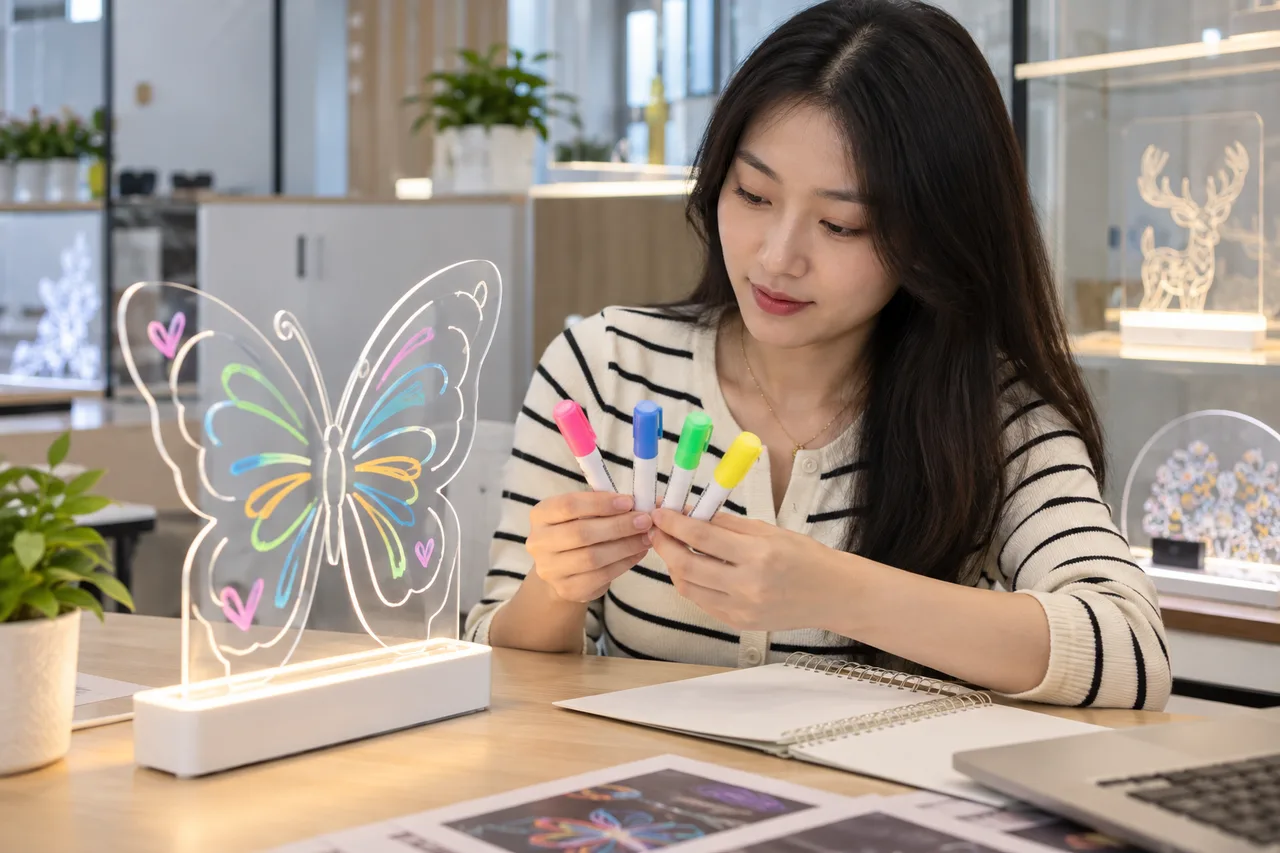
- Illustrative AI-generated photograph: markers are reviewed beside an ordinary visible-light drawing board.
- ALT text
- Asian buyer reviewing fluorescent markers beside a clear butterfly LED drawing board
View AI image direction
Use case: photorealistic-natural. Asset type: editorial photograph for a LumDigi B2B LED acrylic drawing board buying guide. A Chinese adult buyer compares four capped fluorescent markers beside a clear butterfly-shaped acrylic drawing panel illuminated by a modest visible white LED base in a bright sample room. Simple coloured marker curves on acrylic. No UV lamp, violet beam or safety-test implication. Landscape 3:2, real acrylic material texture and believable human anatomy, candid authentic commercial photography rather than a glossy AI render. Any employees are Chinese/Asian adults. No invented logos, watermarks, readable certificates, text overlays or numerical test results. This is an illustrative planning scene, not proof of an actual LumDigi test or customer project.
Review ink and lighting as separate components
- Placement
- after-second-section
- Caption
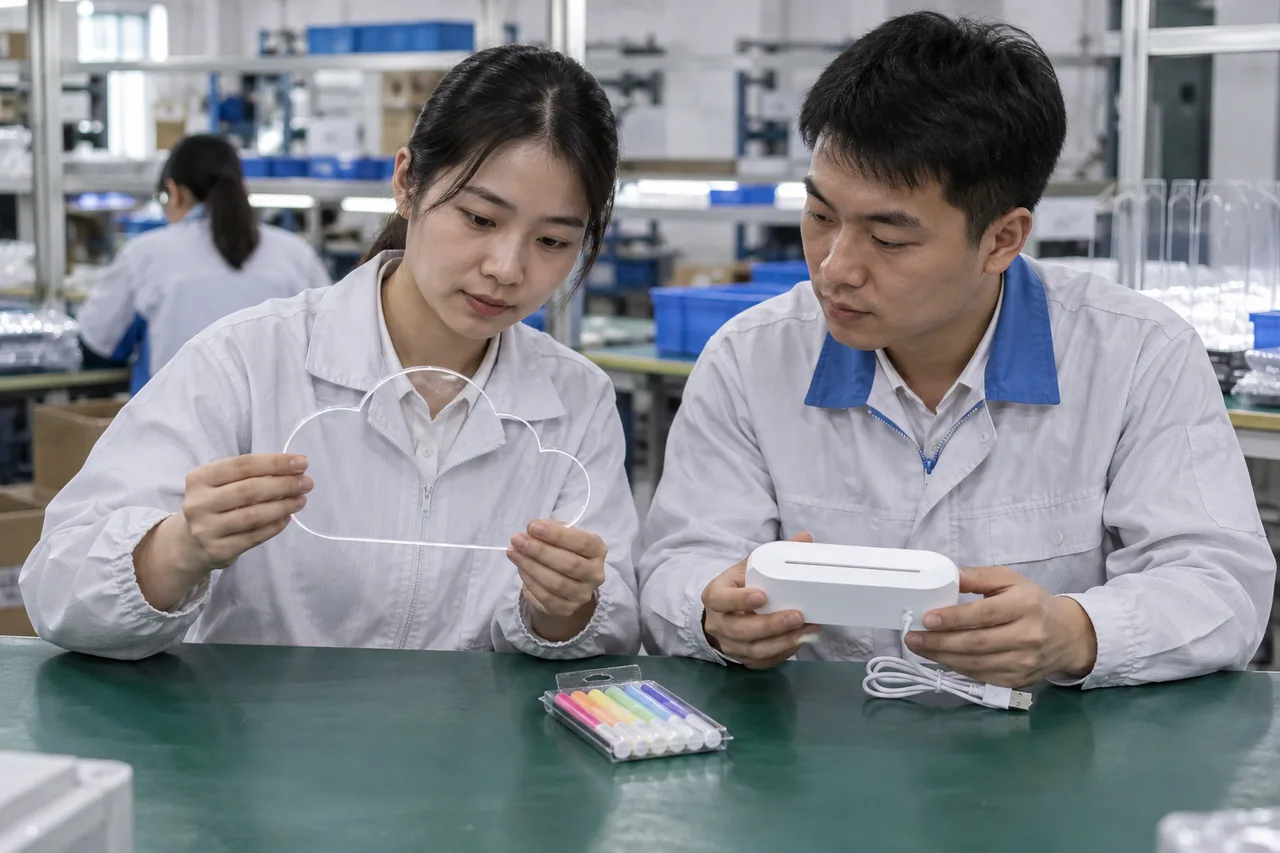
- Illustrative AI-generated photograph: sample staff examine a panel, LED base and marker set.
- ALT text
- Chinese factory sample staff inspecting an acrylic panel, LED base and capped markers
View AI image direction
Use case: photorealistic-natural. Asset type: editorial photograph for a LumDigi B2B LED acrylic drawing board buying guide. Two Chinese adult sample staff at a real factory workbench examine an unpowered plain USB LED base, a separate clear cloud-shaped drawing panel and a sealed plain fluorescent marker set. Documentary medium shot, unbranded white and blue workwear. No ultraviolet equipment, certificates or purported safety test. Landscape 3:2, real acrylic material texture and believable human anatomy, candid authentic commercial photography rather than a glossy AI render. Any employees are Chinese/Asian adults. No invented logos, watermarks, readable certificates, text overlays or numerical test results. This is an illustrative planning scene, not proof of an actual LumDigi test or customer project.
Turn the article into a practical sourcing brief
Use the checkpoints above to document the product, evidence, packaging, and approval decisions relevant to your market. A clear brief helps suppliers respond to the same commercial question and gives your team a traceable basis for the next step.
Useful external references
- American Chemical Society: DayGlo fluorescent pigments
Educational context on fluorescent pigments absorbing light and re-emitting visible colour; not evidence about a particular marker formulation.
- ACRYLITE: light-guiding edge-lit sheet
Material maker's account of a particular light-guiding sheet and edge-light arrangement, not a specification for LumDigi panels.
- CIE: position statement on the blue light hazard
Authoritative context for keeping photobiological terminology and exposure assessment separate from casual colour descriptions.
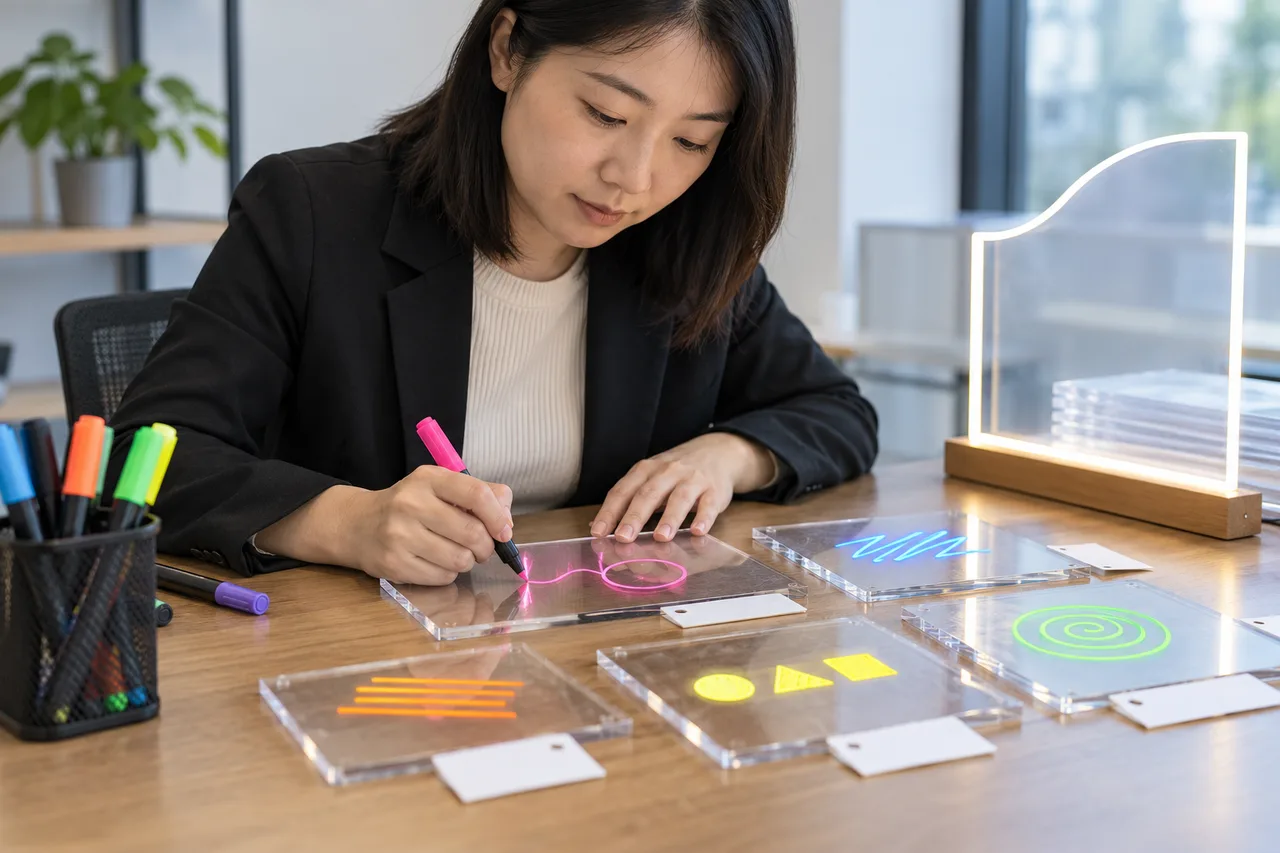
Fluorescent Marker and Acrylic Panel Compatibility: A B2B Sample Review Protocol
A sample-testing plan for buyers qualifying a specific marker formulation with a specific acrylic surface and care method.
Read article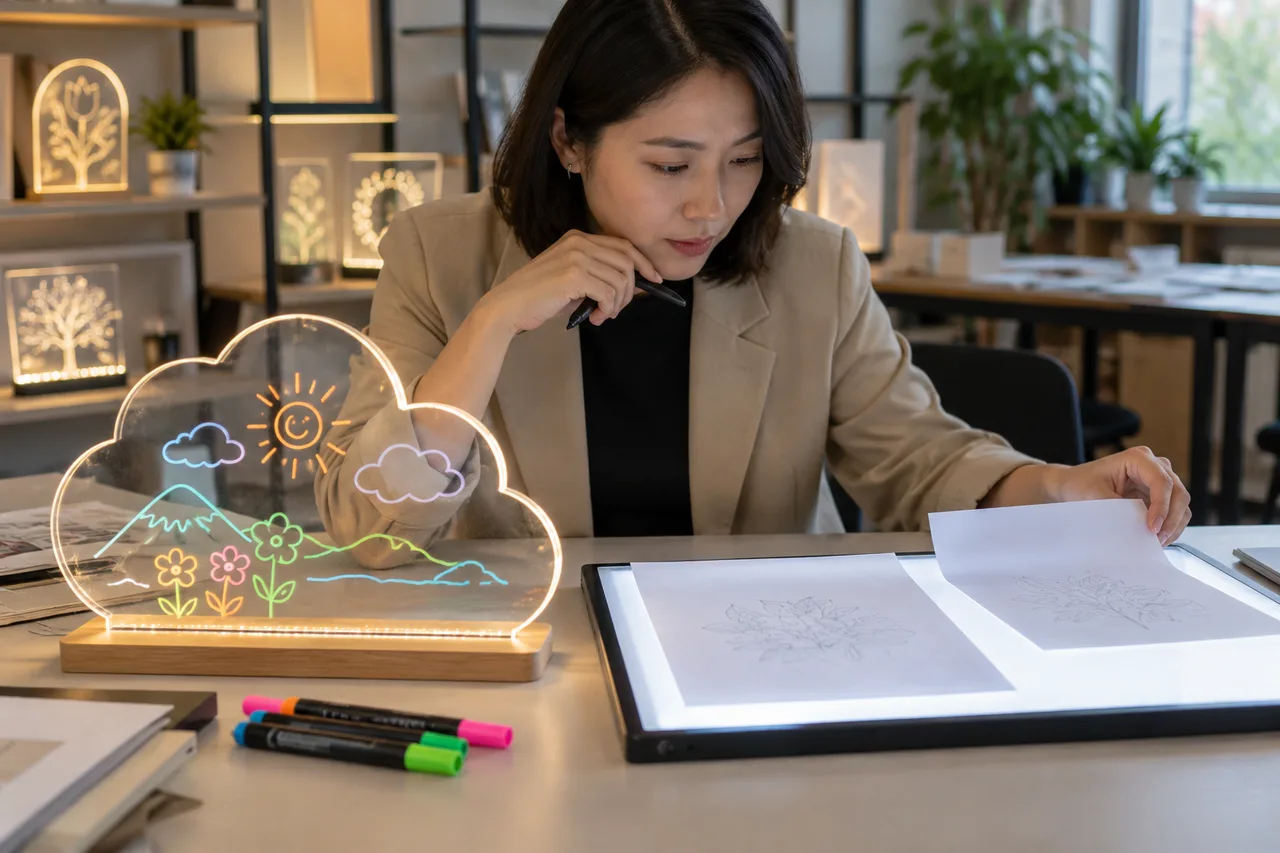
Edge-Lit Acrylic Drawing Board vs Tracing Lightbox: Which Product Should a Buyer Source?
A category-selection guide for importers choosing between a glowing drawing surface and a backlit aid for tracing on paper.
Read article
How to Substantiate LED Drawing Board Claims Before Publishing a Listing
A B2B buying guide for ecommerce sellers, brand managers, importers, and retailer content teams who need to classify each express or implied claim, identify the evidence and scope that support it, and remove or qualify unsupported wording before publishing.
Read article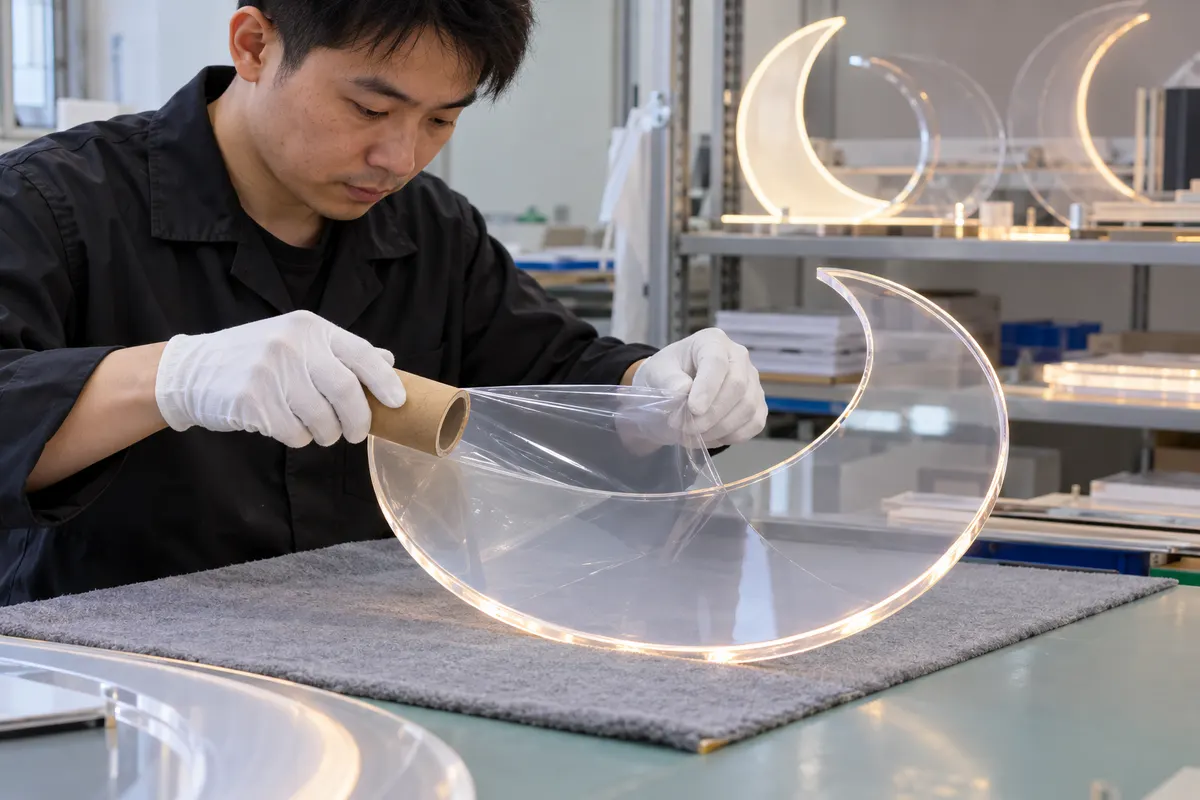
Protective Film on Acrylic LED Panels: Removal Timing and Residue Control
A practical specification and inspection guide for keeping acrylic panels protected without leaving difficult masking or hidden damage.
Read article